30 Days of Screenplays — Day 4: “Fargo”
Read 30 movie scripts in 30 days.
Read 30 movie scripts in 30 days.
Why?
Because whether you are a novice just starting to learn the craft of screenwriting or someone who has been writing for many years, you should be reading scripts.
There is a certain type of knowledge and understanding about screenwriting you can only get from reading scripts, giving you an innate sense of pace, feel, tone, style, how to approach writing scenes, how create flow, and so forth.
So each day this month, I will provide background on and access to a notable movie script.
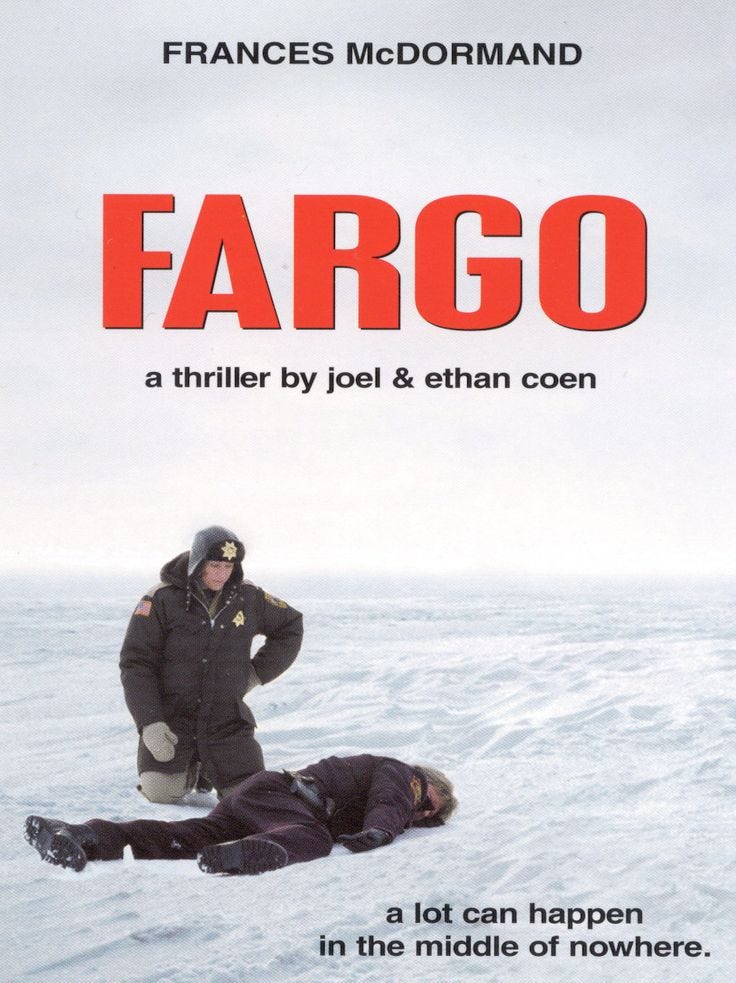
Today is Day 4 and the featured screenplay is for the movie Fargo.
You may read the script here.
Background: The script was written by Ethan and Joel Coen. The movie is currently #170 in the IMDB Top 250.
Plot summary: Jerry Lundegaard’s inept crime falls apart due to his and his henchmen’s bungling and the persistent police work of the quite pregnant Marge Gunderson.
Tagline: An ordinary place, an extraordinary thriller.
Awards: The Coen brothers won an Academy Award and the WGA Award for Best Original Screenplay.
Trivia: Joel Coen had Frances McDormand and John Carroll Lynch conceive a back-story for their characters to get the feel of them. They decided that Norm and Marge met while working on the police force, and when they were married, they had to choose which one had to quit. Since Marge was a better officer, Norm quit and took up painting.
Since I lived at Minot Air Force Base (N.D.) for four years as a youth, I have a special interest in this Coen brothers movie. And while I didn’t knowingly encounter any murderers or pregnant policewomen in my time there, Fargo certainly passes the verisimilitude test for me insofar as nailing local accents and sensibilities.
It’s interesting to compare Fargo to Witness, both cop movies, but different than the more typical procedural or action films we’re used to seeing. For example, we noted how John Book wasn’t introduced until P. 11 in Witness. In Fargo, Marge Gunderson (in a Best Actress award-winning performance by Frances McDormand) doesn’t appear in the script until P. 31! The first note of any script consultant reading the script blind would almost undoubtedly be, “Introduce the cop sooner!”
Fargo is a great example of a movie that turns around the typical take on two character archetypes: Protagonist and Nemesis. Normally in cop movies, the Protagonist is the police officer or detective, and we root for them as they try to solve and/or stop a crime. Not so in Fargo. This is Jerry’s story. The movie starts with him. The spine of the plot is provided by his cockeyed kidnapping scheme. His character is at the center of the story from beginning to end. And if anyone changes in this movie, it’s Jerry, descending into his own private — and eventual public — hell, step by darkly comic step. All of those point to him being the story’s Protagonist.
Which means that Marge Gunderson functions as the story’s Nemesis. Think on that for a minute. Genuinely nice, sweet-spoken, kind-hearted, and very pregnant Marge is what we typically associate with being a ‘bad guy.’
Takeaway: The same set of character archetypes exists in all stories. But they can be shaded in an endless variety of ways. An interesting exercise is to take a story you’re working on and switch Protagonists. Imagine the story through their narrative point of view. Even if they remain a Nemesis character or some other type, you will deepen your understanding of them. And who knows? Your story make take on a whole new life by changing who your Protagonist is.
Annika Wood made a wonderful observation about the script which I’m lifting in its entirety:
I love the use of snow in the movie. I’ve watched the movie numerous times and read the script at least once a while back, but one thing I’ve never caught until now was the use of “snow” to describe the static that Carl and Grimsrud are plagued with one their TV. “Snow” is a term I used to hear for static all the time when I was a little kid, but used in this script is has extra meaning — Carl and Grimsrud are lost in a world of snow — cold, confusion, lack of clarity. It takes life and light and warmth (everything that Margie and her husband have) to melt a warm little circle in that snow and keep it at bay. In fact, the few times we do see Margie and Norm in a place that should be cold, the Coen’s are careful to bring some warmth there — the coffee that Margie holds when she’s surveying the triple homicide scene, the heater when Norm fishes. Jerry is in a borderland between the two worlds — having to chip snow away from his car windshield, wearing snowboots that thunk to the floor. He has some warmth (his home is a warm home) but he lets the snow in, both literally and figuratively, since the killers, after coming for his wife, leave a window open that lets snow into Jerry’s house, now much colder without Jean’s presence.
There’s a lot of talk about a movie’s theme and typically that refers to the moral of the story. But one mark of a great script is that there are recurring symbols and images — let’s call them motifs — that are tied to and expand upon the story’s theme. As Annika pointed out, the Coens use snow in that way in Fargo.
Takeaway: As you write a screenplay, pay attention to images that reoccur in the pages you write. Sometimes that can be our subconscious / creative ‘self’ revealing some heretofore hidden aspect of the story. Once visible, you can then look for ways to weave them into the tapestry of the overall narrative.
How about you? What did you see when you read Fargo?
This series and use of screenplays is for educational purposes only!
UPDATE: Here is something I just posted on the Coen Brothers and the Craft of Storytelling course site in response to a discussion about Fargo:
How can one not love Fargo? It’s a simple story of a grand scheme gone awry and is pitch perfect in combining humor, humanity and violence, something the Coens seem to pull off with innate ease.
As alluded to in Lecture 2, one of the most fascinating aspects of what the Coens accomplish in the script for Fargo is work the Protagonist dynamic. Clearly Jerry is the story’s P. And yet he is a ‘bad’ guy. Yes, we can sympathize with him. Who hasn’t had financial struggles? We can even empathize with him as he concocts his grand scheme after a lifetime of trying to find a way to play with the Big Boys [represented by his father-in-law]. We can even squirm along with him as the noose gets drawn tighter and tighter around his neck as Marge draws ever closer.
But then that nifty bit of business where his Nemesis — Marge — becomes in a way our Protagonist. It’s a deft trick they pull off, akin to a role reversal. It defies conventional wisdom, but works beautifully in fully immersing us in this tiny corner of the universe amidst a morality play: Marge a common-sense moral individual; Jerry a not so bright guy trying to fit his schemes through some pretty wide cracks in his own moral code.
Great stuff!
Head to comments and let us know what you think of Fargo.
To see all of the posts in the 30 Days of Screenplays series, go here.
This series and use of screenplays is for educational purposes only!