30 Days of Screenplays, Day 30: “The Great Gatsby”
Why read 30 screenplays in 30 days?
Why read 30 screenplays in 30 days?
Because whether you are a novice just starting to learn the craft of screenwriting or someone who has been writing for many years, you should be reading scripts.
There is a certain type of knowledge and understanding about screenwriting you can only get from reading scripts, giving you an innate sense of pace, feel, tone, style, how to approach writing scenes, how create flow, and so forth.
We did 30 Days of Screenplays in 2013 and you can access each of those posts and discussions here. This time, we’re trying something different: I invited thirty Go Into The Story followers to read one script each and provide a guest post about it.
Today’s guest columnist: Nora Berry.
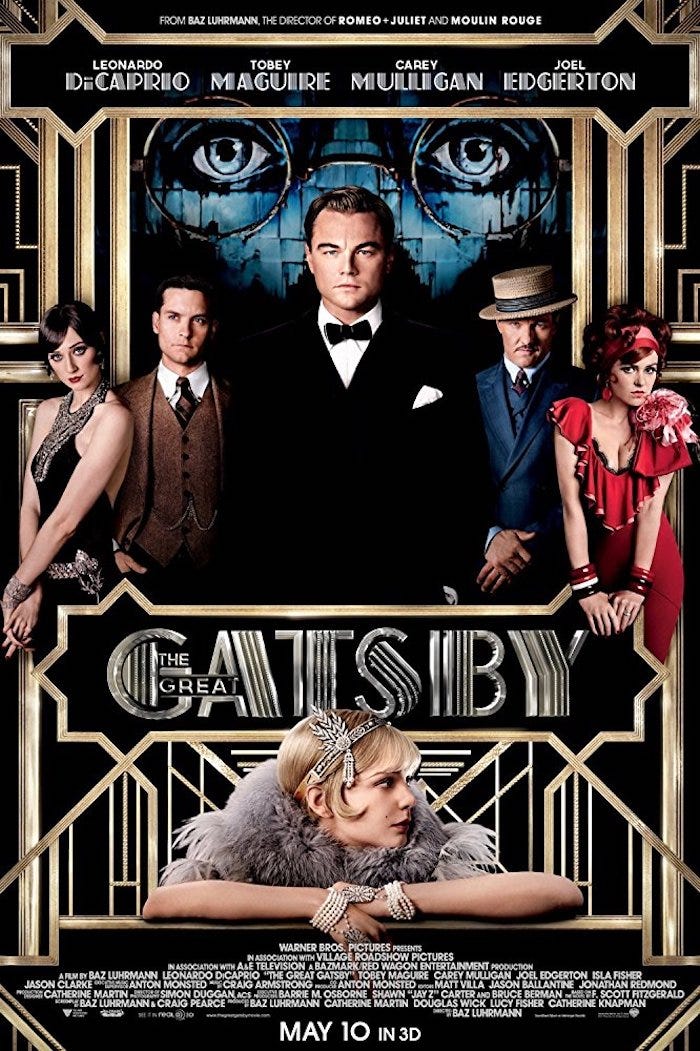
Title: The Great Gatsby. You may read the screenplay here.
Year: 2013
Writing credits: Baz Luhrman, Craig Pearce (based on a novel by F. Scott Fitzgerald)
IMDB rating: 7.3
IMDB Plot summary: A Midwestern war veteran finds himself drawn to the past and lifestyle of his millionaire neighbor.
Analysis: Fitzgerald famously wrote that the rich are different than the rest of us and he mines that motif in this story of a poor young many who falls in love with a wealthy, unattainable Southern Belle. He sets out to make a fortune big enough to win the other half of her love. Even after she marries another, he pursues her, never understanding that he’s pursuing a dream that dissipated long ago. So, while he embraces and personifies “everything modern” in his professional life, his personal life anchors him to the past. He is tethered to a dream and he pays the price for it.
It’s also the story of the man through whose eyes the story unfolds. A naive, educated mid-westerner who comes East to seek his own fortune in the Manhattan of the roaring, drunken, over-the-top 20’s and becomes a victim of it instead: “Back then all of us drank too much…The more in tune with the times we were, the more we drank. And none of us contributed anything new.”
Luhrman employs his candied, hyper-real visual style to portray the excesses of the Jazz Age. But he routinely passes his characters through a bleak, gray “Valley of Ashes”, grounding them to the dismal reality of their very real, personal stories.
Memorable Moment: When Jordan is relaying the story of Daisy’s wedding to the very wealthy Tom, she says he gave her pearls worth $350,000. We see Tom putting the strands around Daisy’s neck — and then he pulls them tight, like a chokehold, for just a minute. She of course did not marry Gatsby because he was penniless — and in marrying Tom because of his money, she became a prisoner of it. A short moment but brilliant.
Memorable dialogue: Nick gives Gatsby a compliment and it’s the only time in the movie anybody gives him anything — they all usually take from him:
Nick: They’re a rotten crowd! You’re worth the whole damn bunch put together!
What I learned about scriptwriting from this screenplay: How to adapt an iconic novel.
I was wary of seeing this movie because I’d never liked the Redford version and I’m a major Fitzgerald fan. But the screenplay really opened the story up and let the characters spill out. I liked the framing device of Nick writing the story after the fact — an homage to Fitzgerald I think. The screenplay also takes the infamous green light and repeats it throughout the story, so that it’s not a tag line, but a leitmotif, an analogy for the hope that Gatsby has. The light is constantly just visible, so that it begins to resemble a mirage. It’s a terrific visual allegory — and Baz Luhrman being who he is, he uses a lot of wonderful visuals to underscore the major themes of the story. When we first see a glimpse of Gatsby, he is half-hidden in a window in a tower of his mansion — almost like a princess locked in a tower in a fairy tale. When we first meet Daisy, she is in a room full of billowing white gauze curtains and we see her through that gauze — an ephemeral character. Daisy sees Gatsby as an image as well — the infamous shirts billowing down in the bedroom scene is underscored by the billboard of the man in the Arrow shirt.
These visual devices underline the sad truth, which is that Daisy and Gatsby are really in love with images of each other.
As to Nick, who is sick at heart at the end, Luhrman and Pearce do a nice job of driving that home by putting him in a sanitarium — but then, he writes his way out of it. It’s a story, after all.
Thanks, Nora! To show our gratitude for your guest post, here’s a dash of creative juju for you. Whoosh!
To see all of this year’s 30 Days of Screenplays: Vol. 2, go here.