30 Days of Screenplays, Day 30: “Saving Mr. Banks”
Why read 30 screenplays in 30 days?
Why read 30 screenplays in 30 days?
Because whether you are a novice just starting to learn the craft of screenwriting or someone who has been writing for many years, you should be reading scripts.
There is a certain type of knowledge and understanding about screenwriting you can only get from reading scripts, giving you an innate sense of pace, feel, tone, style, how to approach writing scenes, how create flow, and so forth.
We did 30 Days of Screenplays in 2013 and you can access each of those posts and discussions here. This time, we’re trying something different: I invited thirty Go Into The Story followers to read one script each and provide a guest post about it.
Today’s guest columnist: John Hörnschemeyer
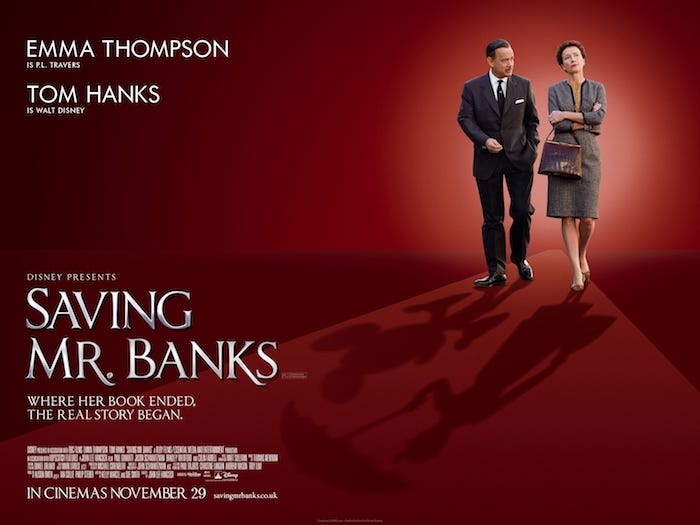
Title: Saving Mr. Banks. You may read the screenplay here.
Year: 2013
Writing Credits: Kelly Marcel, Sue Smith
IMDB rating: 7.6
IMDB plot summary: Author P.L. Travers reflects on her childhood after reluctantly meeting with Walt Disney, who seeks to adapt her Mary Poppins books for the big screen.
Tagline: Where her book ended, her story began.
Awards: The movie obtained fifty nominations and won ten major international awards.
Concerning the screenplay, nominations include:
BAFTA Awards 2014 — Outstanding Debut by a British Writer.
Australian Film Institute 2014 — Best Screenplay
Satellite Awards 2013 — Best Screenplay, Original
Trivia: No one in Hollywood seemed interested in telling Travers’ story on the big screen until producer Alison Owen at Ruby Films in England suggested honing in on the Disney subplot. When the project came across the desk of screenwriter Kelly Marcel, she was instructed to focus solely on Travers’ connection to the production of Mary Poppins (1964). She included many lines from the Disney film, as well as its songs and a scene set at Disneyland with Walt Disney and Travers riding the carousel together. It was only later that Marcel realized the risk involved in doing that. “I was so naïve when I started writing it,” she says, admittedly oblivious that Disney owned the intellectual rights to the material. “Once I finished it, I was like, ‘Oh s**t. There is only one studio who can make this film, and they’ll probably give us a cease-and-desist order.’” ‘Alan Horn’, Chairman of the Walt Disney Studios, didn’t believe any other studio could have made Saving Mr. Banks. “Why would Paramount make a movie about Walt Disney?” he asked. “I think that would be a difficult pitch.” It was also a difficult pitch to Disney, which had never made a movie that featured its founder. If it veered too far in one direction, the film could have seemed like a self-promotional infomercial; too far in another, and it could be an embarrassing blow to the brand.
In 2011, Kelly Marcel’s screenplay was listed in film executive Frank Leonard’s Black List, voted by film producers as one of the best unsold, un-produced screenplays circulating in Hollywood. In early 2012, Walt Disney Pictures acquired the screen rights to Marcel’s script; Alan Horn, newly-appointed Chairman of The Walt Disney Studios, referred to the film as “brand deposit.”
The audiotapes of the working sessions between Travers and the Disney creative team amounted to 39 hours, all of which screenwriter Kelly Marcel and later Tom Hanks and Emma Thompson had access to. Emma Thompson has said she listened to all of them in preparation for her role, and that the experience was “like being poked in the ear with hot forks!”.
Although the film focusses on Pamela Travers’ internal struggle, it is told from a Disney perspective, sugared, without the incidents that would otherwise have proven uncomfortable to the image of the company. The picture ends, for example, with Travers moved beyond words at the Mary Poppins premiere in 1964, omitting the ensuing testy showdown at the reception, with the author demanding that Disney remove every last trace of animation from the film before its release. (“Pamela, that ship has sailed,” he told her, before walking off; Travers’s response was to withhold the rights to the rest of her books.)
Analysis: Above all, this is a tale of resistance, both internal and external, against a backdrop of Cultural divergence. Given the title, one would assume that it is about saving a certain image of Pamela’s father, as represented by the character George Banks in Mary Poppins, but at the end of the day, it is about the crushing weight of our darkest emotional scars, and the influence that they have on our lives and decisions.
Kelly Marcel’s screenplay centres on the events that took place in 1961, when after twenty years of unsuccessful negotiation, Pamela Travers accepts, reluctantly, to come to the Disney studios in Burbank. Disney wants desperately to obtain the the rights to Mary Poppins, supposedly because of a promise that he made his daughter, twenty years earlier, while Travers clings to the notion that Disney and his collaborators are unworthy of what is an extremely personal story, representing her shadow, her failed attempt to save her father.
The depth of this emotional scar, and our understanding of why she is how she is, becomes apparent through the intertwining of theme-similar flashbacks with the ongoing process of Disney’s flawed attempt at seduction and manipulation. Through the flashbacks, we discover that Travers had an unhappy upbringing in a remote Australian township, where her alcoholic father toiled unhappily in a bank until his early death, implying that she wrote Mary Poppins as a form of rehabilitation.
Yes, I know… the use of flashbacks is often signaled out as a motive for taking the reader out of the story, a Spec script no-no, yet, in this particular case, the quality of Marcel’s writing enables her to integrate flashbacks that actually enhance the movie.
Most Memorable Dialogue: From a screenwriting point of view, how could I not mention Pamela’s first encounter with script formatting:
PAMELA (CONT’D): Let us begin.
Pamela takes a seat, she perches her glasses on her nose and raises an eyebrow at the cover of her script — “Walt Disney’s Mary Poppins”.
PAMELA (CONT’D): Hm.
A rustling of papers and one or two uneasy glances as the men, too, open their scripts.
DON DI GRADI (reading) Scene one. Exteri —
PAMELA (reading) Scene one. Ext. Ext? What’s Ext?
Dick and Bob cover their faces with the embarrassment of it all.
DON: Exterior. It means the scene is taking place outside.
PAMELA: Ah, I see, an abbreviation. (beat) Scene One. Exterior — (beat) Oh, I’m sorry Mr Di Gradi, did you feel you should — ?
DON: No, no, Mrs Travers, please go ahead.
PAMELA: Yes, I do think it’s best. I’ve the most practise. Readings of my books you know? Anyway — (beat) Scene one. Exterior. 17 Cherry Tree Lane, London. Day.
She nods.
PAMELA (CONT’D): Yes. That’s good, that can stay.
DICK: That’s just the scene heading!
PAMELA: — Though I do think we should say number 17, instead of just 17, yes? It’s proper.
DICK: No one’s going to see it.
PAMELA: I will see it.
She makes a note in her script and looks to the others who are dumbstruck.
PAMELA (CONT’D): Write it down, write it down, chop chop.
They dutifully make the note.
PAMELA (CONT’D): Good — onwards.
Most Memorable Moments: There are many memorable moments, both dramatic and comic, yet few are stronger than Walt’s Act 3 monologue, as he lowers his public façade, allowing Pamela to glimpse the shadow that drives the man, underlining the need to let go of the past, of her own self-imposed suffering.
WALT: Do you know Missouri at all Mrs Travers?
PAMELA: Can’t say I do and as I have no plans to ever set foot on American soil again I’m afraid I never will.
WALT: It’s cold there in the winters. Bitter. (beat) My father, Elias, he owned the newspaper delivery route in our town. Thousand papers. Twice daily. Morning and evening edition.
Walt’s normal enthusiasm has completely disappeared. He’s suddenly as ragged and as weary as Pamela.
WALT (CONT’D): Elias, he was a shrewd businessman. A save-a-penny anywhere you can type of fella so he didn’t employ any delivery boys, he just used me and my brother Roy. I was eight then — eight. Like I said, those winters were harsh and old Elias didn’t believe in new shoes until the old ones were worn right through so — (beat) Honestly, Mrs Travers, the snow would be up to here —
He gestures to his knees.
WALT (CONT’D): You’d push through it like wading through treacle. And the cold and the wet would be seeping through the shoes and the skin would be raw and peeling from our faces — and sometimes I’d find myself sunken in the snow, waking up, cuz I must’ve passed out for a moment — I dunno. And by the time we got home it’d be just getting dark, and every part of you would sting like crazy as it slowly came back to life in the warmth. My mother would feed us dinner and then it’d be time to go out again for the evening round. (beat) Best be quick Walt, best be quick or poppa’s gonna show you the buckle end again boy. He was a mean old drunk.
Walt smiles at Pamela, sips his tea.
WALT (CONT’D): I don’t tell you this to make you sad Mrs Travers, I don’t. I love my life — it’s a miracle. But, there isn’t a day goes by where I don’t think of that little boy in the snow and old Elias with his bottle and strap and I’m just so tired — I’m tired of remembering it that way. Aren’t you tired Mrs Travers? We all have our tales but don’t you want to find a way to finish the story? Let it all go and have a life that isn’t dictated by a past? (beat) It’s not the children she comes to save. It’s their father. (beat) Your father — ?
What Did I Learn About Screenwriting From Reading This Script: Beyond Marcel’s creative use of flashbacks as a means to inform the reader about Travers’ backstory, I suggest that the reader pay particular attention to the seamless scene transitions, which, in themselves, represent a very good reason to read this script.
An example:
Disney Flowers, Disney champagne, Disney exotic fruit baskets, Disney chocolates, Disney posters, cuddly Daffy, Donald, Pluto and Minnie toys and — taking up the entire bed — the BIGGEST stuffed Mickey Mouse imaginable. Imagine it. Nope. BIGGER! Pamela cannot contain her horror. She stares at it in disgust for a moment, her eyes falling upon three pears in the fruit basket. She rushes over and picks them out, turning them over in her hands before an enormous wave of panic washes over her.
PAMELA (muttering to the pears): This won’t do.
She throws open the balcony doors for fresh air and is greeted with dry arid heat, dust, dazzling sunlight —
EXT. GOFF HOUSE — ALLORA — DAY
— Arid heat, dazzling sunlight. Travers, Margaret and the children climb down from a buggy, stopped at the top of a pathway. From Ginty’s perspective all there is to see is a cloud of swirling red dust; it obscures and then gradually reveals her new home. The surrounding land yellow and burnt — unlike the lush greens of Maryborough. The house is ramshackle and meagre.
Thanks, John! To show our gratitude for your guest post, here’s a dash of creative juju for you. Whoosh!
To see all of this year’s 30 Days of Screenplays: Vol. 2, go here.