30 Days of Screenplays, Day 30: “Michael Clayton”
Why 30 screenplays in 30 days?
Why 30 screenplays in 30 days?
Because whether you are a novice just starting to learn the craft of screenwriting or someone who has been writing for many years, you should be reading scripts.
There is a certain type of knowledge and understanding about screenwriting you can only get from reading scripts, giving you an innate sense of pace, feel, tone, style, how to approach writing scenes, how create flow, and so forth.
So each day this month, I will provide background on and access to a notable movie script.
Today is Day 30 and the featured screenplay is for the 2007 movie Michael Clayton. You may read the screenplay here.
Background: Written by Tony Gilroy.
Plot summary: A law firm brings in its “fixer” to remedy the situation after a lawyer has a breakdown while representing a chemical company that he knows is guilty in a multi-billion dollar class action suit.
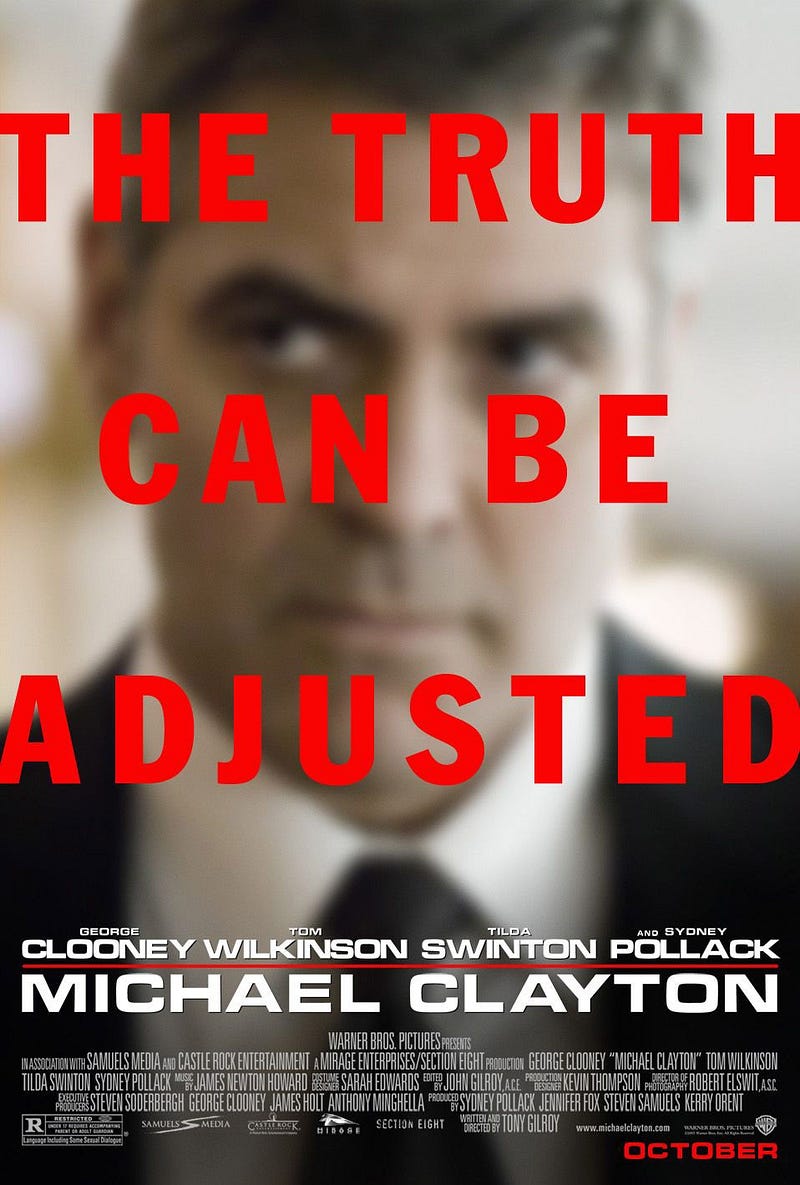
Tagline: The Truth Can Be Adjusted.
Awards: Nominated for 7 Academy Awards including Best Original Screenplay as well as the WGA Award.
Trivia: Committed to a fully developed back story, director Tony Gilroy spent a good deal of time establishing the details of “Realm and Conquest” with production designer Kevin Thompson. The director explains that right from the beginning, when he first read the script, he could tell that “Realm and Conquest” was going to be a key prop. In the movie it’s a metaphor for truth and justice. In creating the details of the fictional novel, Thompson generated original visuals inspired by German Expressionistic images cut from wood blocks, and Gilroy wrote the first two pages for three chapters of the book. They even went as far as designing a “Realm and Conquest” card game for a scene between Henry and Michael. Thompson offers, “This detail was important to Tony because, in his own life, novels and games similar to ‘Realm and Conquest’ allow him to connect with his son in a meaningful way.”
While I am a huge Joseph Campbell acolyte, I get frustrated with the way The Hero’s Journey gets used sometimes in screenwriting quarters, as if there is something sacrosanct about its supposed ‘stages’ [17 in Campbell’s book “The Hero With a Thousand Faces,” 12 as articulated by Vogler].
So oftentimes I find myself stepping out of that minutiae and focusing on the Big Three movements Campbell always talks about:
Separation
Initiation
Return
In Michael Clayton, the major Plotline points that serve as transitions from one movement to the other are provided by Arthur:
The Separation from the Ordinary World into the Extraordinary World is when Arthur loses his shit and starts taking off his close at the deposition. This forces Michael to — literally — go on a journey to try to placate the company’s legal clients.
The transition from Initiation to Return happens when Arthur is assassinated, causing Michael to rethink his existence, eventually leading to his decision re Karen.
Those Big Three movements, what we may call Three Act Structure, is fundamental stuff and critical to almost every single movie that comes down the pike.
Here is my take on the story’s character archetypes paradigm:
Protagonist: Michael Clayton
Nemesis: Karen Crowder
Attractor: Horses
Mentor: Henry Clayton
Trickster: Arthur Edens
Protagonist: While I think it’s fair to look at the story through Karen’s eyes as a Protagonist as a literary exercise, and she does go through a significant transformation, it is hard for me to consider any other character in the movie as the actual Protagonist than Michael. He is front and center at the heart of the Plotline and Themeline, his is the most compelling story, and… oh, let’s not forget the movie is called “Michael Clayton.”
This is a character in a deep state of Disunity at the beginning:
- He is a fixer who can’t fix himself.
- He is a lawyer who isn’t practicing law [at least as a litigator as he imagines himself].
- He is divorced and only sees his son occasionally.
- He makes a lot of money, but owes more than he has.
- But most importantly, he has lost virtually any connection he once had to humanity. The only people tethering him to reality are Arthur and Henry. Otherwise he is completely adrift, a lost soul, and heading toward destruction.
I like to ask this question of Protagonist figures: Why does this story have to happen to this character at this time? In the story universe of “Michael Clayton,” Arthur Edens goes off his nut because that’s where he is at in his life journey. But from a more macro view of Michael’s journey, Arthur loses his shit because that is how Michael is going to save his soul.
Nemesis: Karen is a most interesting Nemesis figure as she is so ill-equipped to be a villain. Indeed that is one of the reasons she is so compelling: most often Nemesis characters don’t go through any sort of metamorphosis, they are who they are, they know what they want, and they provide a consistent and powerful oppositional dynamic in relation to the Protagonist.
From the first time they meet, Karen doesn’t cotton to Michael, nor he to her. Initially that could be the stuff of a rom-com meet cute: boy meets girl, boy hates girl, girl hates boy, they fall in love. But their dynamic is considerably different. She has a problem [Arthur] that needs fixing. Michael is supposed to fix it. Michael is exhausted by fixing other people’s problems when his own personal life is a wreck. Plus he has an attachment to Arthur. Not satisfactory for Karen.
As events evolve, Karen has to grow into the role of corporate eviscerator. That scene with Verne where she works her way and his thinking into the idea of whacking Arthur is sheer brilliance. It’s not really in her to be a murderer. But as we see her shifting her pitch in the beginning of the story, we learn that she is a malleable creature driven by greed and power. So she tries to become her own Shiva. And almost succeeds.
In a sense, she tries to become her own fixer. And in that respect, represents Michael’s shadow. Whereas Michael still has some shreds of emotion and humanity, witness his illogical support for Arthur and parental connection to Henry, Karen has nothing more than her connection to the company. She represents the worst of what Michael feels about himself.
Indeed as I interpret Jung, Nemesis characters are often projections of a Protagonist ‘shadow,’ their darkest impulses.
Which is why the ending is so perfect: He starts off a fixer who doesn’t want to fix shit any more. That forces her to become a proactive fixer on her part. And she almost pulls it off. But then Michael raises his game, playing his best hand of poker [sans cards], and traps her, fixing his own situation but good.
Attractor: Michael has an odd connection to nature, one that is all focused and crystallized by that seemingly random bit of business with the horses. The movie is urban, urban, urban, urban, then suddenly… stop. Rural. Field. Fog. Horses. This bizarre moment with Michael standing in front of three horses. It is a truly apocryphal moment [so I wish there had four horses per the book of Revelations, but maybe Gilroy never got that religious download].
Nature. We have horses. Bread. And Anna from rural Wisconsin, described in the script as a “dairy madonna.” Those are the minimal narrative elements in the story that provide a sort of connection for Michael to nature. But as minimal and fractured as they are, they all come together for Michael and feed his metamorphosis: from fixing other people’s problems to fixing his own.
The horses, what do they represent? Nature, yes. But also wild. Free. Beauty. Powerful.
He has an existential moment with them, underscored by the fact his car [symbolic of his connection to his Old World] gets blown up.
BTW there is horse language at least three times including saddle up, if you think you have the horses. That can’t be coincidental.
Mentor: Henry provides wisdom to Arthur in a really overt way, creating a bridge for Arthur to the book series Henry loves: “Realm and Conquest.” But he also provides a wisdom function in relation to Michael, a projection into which Michael can pour his hope for redemption, a young unblemished version of Michael.
There is that great scene on P. 86 where Michael stops the car to proclaim to Henry that “You’re not gonna be one of those people who goes through life wondering why things keep falling out of the sky around them.” In other words, Henry is the anti-Michael.
So when Michael has a ‘multiple choice’: Take the money and run, or face up to the moral corruption at the heart of United Northfield, he makes the right choice.
I don’t think it’s a random choice that Henry has given himself over so fully to the book series and the RPG game as it shows him immersing himself in a universe bigger than himself. At the end of the day, Michael needs to break away from the narrow confines of who he perceives himself to be.
Henry provides inspiration in that way.
Trickster: It can’t be anybody else but Arthur. Friend. Enemy. Can’t trust him for a second. Provides on test after another. And in the end, forces Michael to confront his crap.
Finally a few words about names.
Michael Clayton: Clay as in malleable.
Karen Crowder: Crowder as in shaped by the impulses of the crowd.
Arthur Edens: Eden as in some sort of elegiac state, one that Arthur believes himself to have found, his wandering through the city in beatific amazement.
I invited you to stop by comments and post your thoughts about Michael Clayton.
To see all of the posts in the 30 Days of Screenplays series, go here.
This series and use of screenplays is for educational purposes only!