30 Days of Screenplays, Day 3: “Jane Eyre”
Why 30 screenplays in 30 days?
Why 30 screenplays in 30 days?
Because whether you are a novice just starting to learn the craft of screenwriting or someone who has been writing for many years, you should be reading scripts.
There is a certain type of knowledge and understanding about screenwriting you can only get from reading scripts, giving you an innate sense of pace, feel, tone, style, how to approach writing scenes, how create flow, and so forth.
We did 30 Days of Screenplays in 2013 and you can access each of those posts and discussions here. This time, we’re trying something different: I invited thirty Go Into The Story followers to read one script each and provide a guest post about it.
Today’s guest columnist: Femme Malheureuse.
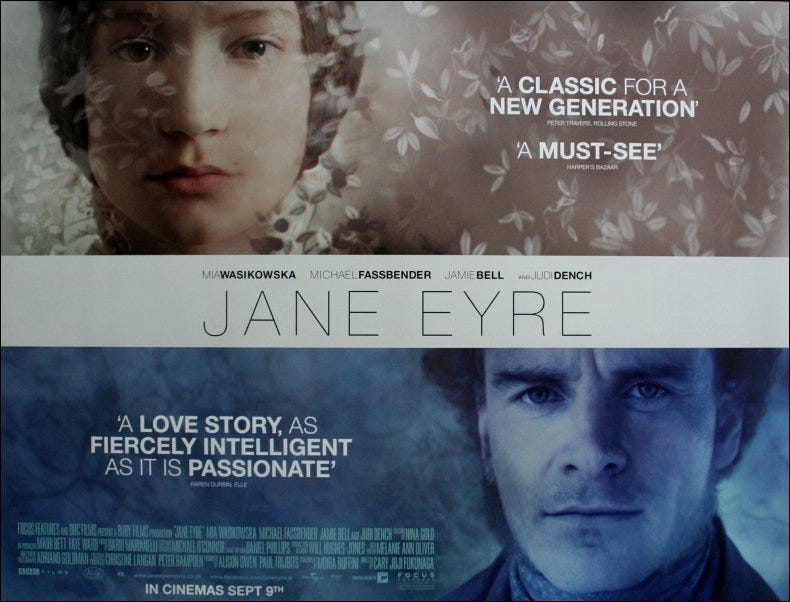
Title: Jane Eyre. You may read the screenplay here.
Year: 2011
Writing Credits: Charlotte Brontë (novel), Moira Buffini (screenplay)
IMDB rating: 7.4.
IMDb plot summary: Jane Eyre (Wasikowska) flees Thornfield House, where she works as a governess for wealthy Edward Rochester (Fassbender). The isolated and imposing residence — and Mr. Rochester’s coldness — have sorely tested the young woman’s resilience, forged years earlier when she was orphaned. As Jane reflects upon her past and recovers her natural curiosity, she will return to Mr. Rochester — and the terrible secret that he is hiding… (Focus Features)
Tagline: A mousy governess who softens the heart of her employer soon discovers that he’s hiding a terrible secret.
Awards: 0 wins and 11 nominations
Nominated — Oscar, Best Achievement in Costume Design, Michael O’Connor
Nominated — BAFTA Film Award, Best Costume Design, Michael O’Connor
Nominated — AACTA International Award, Best Actress Mia Wasikowska
Nominated — British Independent Film Award, Best Actress Mia Wasikowska
Nominated — Critics Choice Award, Best Costume Design, Michael O’Connor
Nominated — CDG Award, Excellence in Period Film, Michael O’Connor
Nominated — Evening Standard British Film Award, Best Technical Achievement, Michael O’Connor-Production Design
Nominated — Goya, Best European Film (Mejor Película Europea), Cary Fukunaga
Nominated — PFCS Award, Best Costume Design, Michael O’Connor
Nominated — Satellite Award, Best Costume Design, Michael O’Connor
Nominated — USC Scripter Award, Moira Buffini (screenwriter), Charlotte Brontë (author)
[Actor Michael Fassbender also nominated for (4) additional best actor awards for multiple movies in the same year, although Jane Eyre not cited among them.]
Analysis: Charlotte Brontë’s Jane Eyre has been immensely popular as a source for adaptation; (8) silent and (12) feature films as well as (13) television programs and series were made before this 2011 version was released. Adaptations for radio and stage have been equally prolific. The popularity of the material put screenwriter Moira Buffini under singular pressure: what could Buffini do that would be unique and memorable, in contrast to other adaptations? At the same time, any writer adapting this novel must remain faithful to the original, or risk losing an audience expecting the book and characters they know, and not some watered-down representation.
This particular variant approached the protagonist in a way that made Jane more sympathetic, yet not maudlin. She is a just-the-facts person, more so than other adaptations where Jane tended to be more passionate to the point of impudence by Victorian standards. Jane’s unstinting acceptance of her impoverished condition once her aunt has cast her off appears in this version to be a coping mechanism — a suck-it-up attitude contemporary audiences might relate to readily considering the economic conditions of 2010s.
Buffini also concentrates on the interaction of Jane and Mr. Rochester in a way that heightens the unresolved emotional and sexual tension between them. Gothicism has been tamped down so as not to detract from the interplay of characters. Other moral questions have also been restrained in a way that allows the story to concentrate on the main characters and not be derailed by side or backstories. The question of secondary character Adele Varen’s parentage, for example, is implied; the writer displays Rochester’s frustration with Adele’s mother in a single line. In contrast, the 1996 film version offered an entire scene in which Rochester vents heatedly about Adele and her mother, in order to get to a simple key message: Rochester addresses his responsibilities. Buffini shows this instead by way of Rochester’s acquisition of Jane’s services for Adele — the writer does not dumb down for the audience by telling rather than showing.
The counterpoint relationship between Jane and St. John Rivers is also intensified, dialog stripped down in a way that not only heightens the contrasting unrequited passion between Jane and Rochester, but speaks to modern sensibilities. St. John’s desire for Jane’s utility and not her mind or heart is crystallized by removal of all language that does not directly convey St. John’s focus on his mission. Elements from the novel such as St. John’s love for another woman are streamlined to a passing mention to ensure focus on the increasingly contentious relationship between Jane and St. John. It’s not entirely clear, but a deleted scene may also have removed any traces of familial relations between the Rivers siblings and Jane, who were revealed to be cousins in the novel.
Jane Eyre is a bildungsroman, specifically a women’s coming-of-age story, in which a girl/maiden must attain both knowledge and wisdom, then exercise them in a conflict to successfully realize progression to woman/wife-mother. The plot tests Jane’s character, asking her whether she would prefer to live her days in flawed, risky, passionate love, or safe, convenient, dispassionate utility, and whether one’s self-respect can ever be sacrificed for either. Buffini masterfully honed the story down to this crux.
Most Memorable Dialogue:
Jane Eyre: I have lived a full life here. I have not been trampled on. I have not been petrified. I have not been excluded from every glimpse that is bright. I have known you, Mr. Rochester and it strikes me with anguish to be torn from you.
Rochester: Then why must you leave?
Jane Eyre: Because of your wife.
Rochester: I have no wife.
Jane Eyre: But you are to be married.
Rochester: Yes — Jane, you must stay.
Jane Eyre: And become nothing to you? Am I a machine without feelings? Do you think that because I am poor, plain, obscure, and little that I am soulless and heartless? I have as much soul as you and full as much heart. And if God had possessed me with beauty and wealth, I could make it as hard for you to leave me as I to leave you… I’m not speaking to you through mortal flesh. It is my spirit that addresses your spirit, as it passes through the grave and stood at God’s feet equal. As we are.
Rochester: As we are.
Jane Eyre: I am a free human being with an independent will, which I now exert to leave you.
Rochester: Then let you will decide your destiny. I offer you my hand, my heart. Jane, I ask you to pass through life at my side. You are my equal, my likeness. Will you marry me?
Jane Eyre: Are you mocking me?
Rochester: Do you doubt me?
Jane Eyre: Entirely.
Most Memorable Moments:
1) The scene after the aborted bigamous wedding between Rochester and Eyre —
Rochester: Who would you offend by living with me? Who would care?
Jane Eyre: I would.
Rochester: You would rather drive me to madness than break some mere human law.
Jane Eyre: I must respect myself.
Rochester: I could bend you with my finger and my thumb. A mere reed you feel in my hands. But whatever I do with this cage, I cannot get at you, and it is your soul that I want. Why can’t you come of your own free will?
Jane Eyre: God help me.
2) Flight from Thornfield Hall — both at the beginning of the film, and after the aborted bigamous wedding — the script suggests, but the director delivers the loneliest, heart-rending landscape, intensified by Dario Marianelli’s emotional-rife score.
What Did I Learn About Screenwriting From Reading This Script:
— An inciting event is created by this screenplay at the beginning of the movie, departing from the original narrative’s sequential order by inserting part of the emotion-fraught transition from Mr. Rochester/Thornfield Hall to St. John Rivers/Moor House. The event not only hooks the audience, but allows for better engagement of a streamlined backstory. The audience isn’t initially certain if it’s a flashback or flash forward, but it matters not once they are hooked. The reordering helps make this particular adaptation fresh in comparison to the plethora of inflexible predecessors.
— The number of deleted scenes in this revised script is incredible to a novice’s eye. The screenplay is 92 pages long after these deletions, however the resulting film is 120 minutes in length and doesn’t feel as if it were cheated.
— The screenplay does not include the epilogue-like ending from the original novel, in which Rochester has regained a small amount of his site and Eyre has born him a son. Again, the movie does not feel shorted for this omission. This portion of the novel could be safely excised as it did not add any value to the key question of the novel: flawed, risky, loving passion, versus perfect, safe, passionless utility. Clearly adaptations of period novels can be trimmed with a chainsaw provided the screenwriter understands the work’s core message and edits to preserve it.
— The spareness of the screenplay allowed the director plenty of room to realize his own vision. Fukunaga’s Nordic-Japanese heritage showed in the similarly pared down scenes by way of a moody darkness typical of Nordic films, and a pared-down visually-intense style common in Japanese art films. Both screenplay and final product could have been far more over-produced and floridly Gothic, but the screenwriter used restraint and the director made excellent use of it. The dialog in which Rochester asks Eyre to marry him is a solid example of this brevity, in which feeling is highly distilled. Screenwriter Buffini uses approximately 250 words to effect Bronte’s version which clocks in at +950 words.
Thanks, Femme Malheureuse! To show our gratitude for your guest post, here’s a dash of creative juju for you. Whoosh!
Twitter: @Femme_Mal.
To see all of this year’s 30 Days of Screenplays: Vol. 2, go here.