30 Days of Screenplays, Day 29: “Lincoln”
Why read 30 screenplays in 30 days?
Why read 30 screenplays in 30 days?
Because whether you are a novice just starting to learn the craft of screenwriting or someone who has been writing for many years, you should be reading scripts.
There is a certain type of knowledge and understanding about screenwriting you can only get from reading scripts, giving you an innate sense of pace, feel, tone, style, how to approach writing scenes, how create flow, and so forth.
We did 30 Days of Screenplays in 2013 and you can access each of those posts and discussions here. This time, we’re trying something different: I invited thirty Go Into The Story followers to read one script each and provide a guest post about it.
Today’s guest columnist: Paul Graunke.
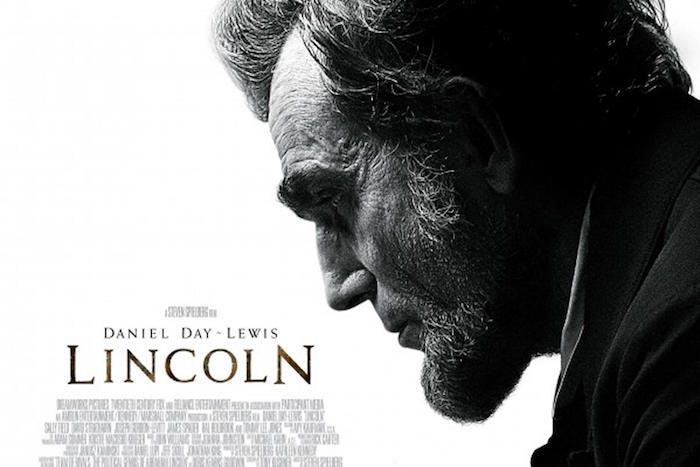
Title: Lincoln. You may read the screenplay here.
Year: 2012
Writing Credits: Tony Kushner (screenplay), Doris Kearns Goodwin (book)
IMDB rating: 7.5
Plot summary: With military victory in the Civil War in sight, President Lincoln fights to win the political battle in Washington to abolish slavery.
Awards: Oscar nominated for Best Writing, Adapted Screenplay, Golden Globe nominated for Best Screenplay, Motion Picture. WGA nominated for Best Adapted Screenplay.
Analysis: Four aspects of the script stand out in my mind: 1] focusing the story, 2] exposition; 3] historical accuracy; and 4] the child’s point of view.
Focusing the Story: “Why, if the old Greeks had had this man, what trilogies of plays — what epics — would have been made out of him,” wrote the poet Walt Whitman about Abraham Lincoln. This was the challenge facing Steven Spielberg when he bought the film rights to “Team of Rivals”, historian Doris Kearns Goodwin’s best-selling history of Abraham Lincoln in 2001. How to make a film that does dramatic justice to one of American’s greatest presidents, to “… the uniquely American story of Abraham Lincoln,” as Goodwin wrote in her introduction, “[that] has unequalled power to captivate the imagination and to inspire emotion”?
A sprawling biopic would have been inadequate to the subject, impossible to do within within contemporary time constraints for feature films. Gone is the era of 3 hour plus films on the grand scale of “Lawrence of Arabia”. Perhaps, narrow the focus to just his political career? Or narrow it further to just his Presidency during the Civil War?
Seven years, several writers, and many rewrites later, Tony Kushner produced a 500 page draft that focused on only the last four months of Lincoln’s life. After more rewriting, Kushner narrowed the focus still further to a 126 page script about just two months of Lincoln’s life, his struggle to win passage of the 13th Amendment abolishing slavery. That is the plot of “Lincoln”.
Exposition: The film opens with a powerful visual, a horrific battle scene, hand-to-hand combat between Union Negro soldiers and white Confederate soldiers. The scene dramatizes what is at stake, that Blacks have literal “skin in the game” of the Civil War. They have the most to gain from Union victory, the most to lose from Confederate victory.
After that, the script is tasked with carrying some heavy water of exposition. It must expend a lot of dialogue to introduce characters, explain issues, and describe context, the military and political situation facing Lincoln in early 1865.
Lincoln has won re-election (though not yet inaugurated). After four years of carnage, the Confederacy is being inexorably ground down. Grant is besieging Lee around the capital of the Confederacy, Richmond, Virginia, while Sherman marches north into South Carolina. Meanwhile newly liberated slaves are sacking plantations and seizing land. It is only a matter of months before the war ends.
But Union victory does not assure freedom for the slaves, the moral casus belli. Lincoln fears that the Emancipation Proclamation is not enough to abolish the abominable institution of slavery once and for all time; a Constitutional amendment is needed to guarantee the freedom of Blacks. And so, by page 28, Lincoln has established the objective goal of the film, winning passage of the 13th Amendment to abolish slavery. And he starts the ticking clock: “…get the Thirteenth Amendment through the House…wrap the whole slavery thing up, forever and aye…Now. End of this month… come February the first, I intend to sign the Thirteenth Amendment.”
Historical Accuracy: Even with its narrow focus on the final push to abolish slavery, the script juggles a complicated story line, complicated issues — and attempts to portray facets of the most complicated man ever to reside in the White House. In its initial release, the movie got generally passing grades from scholars for showing Lincoln as the shrewd politician he was, a man of principle to be sure — and a man willing to twist arms and use the power of patronage to further those principles. As Kushner has the radical Republic Thaddeus Stevens say, the 13th Amendment was “passed by corruption, aided and abetted by the purest man in America.” And Kushner did a fairly adept tap dance around the land mines of Lincoln’s own complicated opinions of the future of Blacks in the United States after the Civil War.
But he did step on one political land mine. He was severely criticized for not just getting history wrong, but for blatantly rewriting it. In the film, two of Connecticut’s four congressmen vote against the abolition of slavery. In reality, all four voted for the 13th Amendment. Kushner defended his rewrite, pointing out that the names were changed to protect the innocent and history was rewritten to serve the larger story, to highlight how close the vote was.
The Child’s POV: A signature feature of a Spielberg film is telling the story in part or whole from a child’s point of view. In this script, that point of view is shown through the character of Lincoln’s 10 year old son, Tad. By every account, Lincoln was a loving and indulgent father and the script leverages this human side of him, showing his relationship with Tad to full effect. Scenes of father and son are woven throughout the story. At the climax of the political fight, while the historic vote to ratify the 13th Amendment is taking place in the House of Representatives, the scripts cuts away to Tad sitting on his father’s lap reading a book.
At the end of the film, the character of Tad is paid off in how Kushner and Spielberg chose to show Lincoln’s assassination. Or rather the choice to not to go with the obvious choice: recreate the assassination, the reaction of the crowd at Ford’s Theater, et cetera.
Instead, the script has the assassination take place off screen. What is to be shown on screen is Tad’s reaction upon finding out while attending another theater. Thus we see the assassination from the his point of view, a boy who has just lost his father. In this way, Tad serves as the dramatic proxy for a race of people crying for the man who was instrumental in their liberation, for a nation crying over the loss of one of its greatest leaders.
Most Memorable Dialogue: The attempt to ambush Thaddeus Stevens in the House debate, make him confess to his conviction that all men are, indeed, created equal:
THADDEUS STEVENS: The true purpose of the amendment — I don’t hold with equality in all things only with equality before the law and nothing more.
FERNANDO WOOD: (surprised) That’s not so! You believe that Negroes are entirely equal to white men. You’ve said it a thousand times -
GEORGE PENDLETON: (leaping to his feet) For shame! For shame! Stop prevaricating and answer Representative Wood!
THADDEUS STEVENS: I don’t hold with equality in all things, only with equality before the law and nothing more.
GEORGE PENDLETON: (stands) After the decades of —
THADDEUS STEVENS: I don’t hold with equality in all things, only with equality before the law and nothing more.
JAMES ASHLEY: (leaping up) He’s answered your questions! This amendment has naught to do with race equality!
GEORGE PENDLETON: (stands) After the decades of fervent advocacy on behalf of the colored race — You have long insisted, have you not, that the dusk colored race is no different from the white one.
THADDEUS STEVENS: I don’t hold with equality in all things only with equality before the law and nothing more.
GEORGE PENDLETON: Your frantic attempt to delude us now is unworthy of a representative. It is, in fact, unworthy of a white man!
THADDEUS STEVENS: (giving in to his anger) How can I hold that all men are created equal, when here before me — (pointing to Pendleton) — stands stinking the moral carcass of the gentleman from Ohio, proof that some men are inferior, endowed by their Maker with dim wits impermeable to reason with cold pallid slime in their veins instead of hot red blood! You are more reptile than man, George, so low and flat that the foot of man is incapable of crushing you!
GEORGE PENDLETON: HOW DARE YOU!
THADDEUS STEVENS: Yet even you, Pendleton, who should have been gibbetted for treason long before today, even worthless unworthy you ought to be treated equally before the law! And so again, sir, and again and again and again I say: I DO NOT HOLD WITH EQUALITY IN ALL THINGS. ONLY WITH EQUALITY BEFORE THE LAW.
Most Memorable Moments:
#1: The Scene in the House of Representatives when Rep. Thaddeus Stevens is ambushed on the issue of whether he believes all men are really created equal.
#2: The “now, now, now” moment in the White House. The ticking clock is running down; passage of the 13th Amendment seems at a hopeless impasse; Lincoln’s advisors and allies prevail upon him to abandon the political fight the 13th Amendment and negotiate with the Confederate peace commissioners waiting outside the city. But Lincoln is determined to abolish slavery.
#3: The “pillow talk” between Thaddeus Steven and his Black mistress after ratification: he climbs into bed and bids her “Read it again to me, my love.” And she reads the official text of the amendment.
What I Learned About Screenwriting From Reading This Script:
** Ongoing conflicts originating in the backstory need a specific related problem arising in the present.
Lincoln’s troubled marriage with his wife was longstanding and the subject of vicious Washington gossip. After the death of her second son Willie in 1862, she plunged her into deep, hysterical mourning. So much so serious thought was given to committing her to a mental asylum. There were whispers about where her true sympathies lay in the Civil War because she was born to slaveholders in a border state (Kentucky) and several of her half-brothers served in the Confederate Army. She had a hard time fitting into the social life of Washington. And a Congressional committee actually did investigate whether she was misspending government money for her living expenses.
And all of that is backstory in the script. All of it occurs before the FADE IN:.
Rather than just recycle the backstory to stoke the fires of the “B” story conflict, Kushner adds an additional conflict: Their oldest son wants to enlist in the war. Mary Lincoln adamantly opposes it and Abraham Lincoln is caught in the crossfire because although Robert is an adult now, his father, as Commander-in-Chief, can block his enlistment. And Mary insists he must as she is already enduring the sorrow of two lost children.
** How to build a transformation arc from Disunity to Unity in a way that also unites the “A” and “B” stories.
So, in the “B” story, the family are disunited over Robert’s enlistment. Finally Mary relents in a way that makes the struggle in the “A” story very personal for her:
MARY: I believe you when you insist that amending the constitution and abolishing slavery will end this war. And since you are sending my son into war, woe unto you if you fail to pass the amendment. Because if you fail to secure the necessary votes, woe unto you, sir. You will answer to me.
** The power of story
Whatever criticisms historians had about the film, it was instrumental in rectifying an embarrassing legal oversight. The movie brought to light the fact that one state, Mississippi, had failed to ratify the 13th Amendment. The state finally got around to ratifying the amendment in 1995 — but the paperwork had not been formally filed with the Archivist of the United States to make it official.
Doh!
What historians had overlooked or failed to provoke the state to do, the film accomplished. The official paperwork was forthwith dispatched to the Archivist and on February 7, 2013, 148 years after the 13th Amendment was passed, all 50 states had (finally) signed on.
That, folks, is the power of a well-told story.
Thanks, Paul! To show our gratitude for your guest post, here’s a dash of creative juju for you. Whoosh!
To see all of this year’s 30 Days of Screenplays: Vol. 2, go here.