30 Days of Screenplays, Day 28: “The Spectacular Now”
Why read 30 screenplays in 30 days?
Why read 30 screenplays in 30 days?
Because whether you are a novice just starting to learn the craft of screenwriting or someone who has been writing for many years, you should be reading scripts.
There is a certain type of knowledge and understanding about screenwriting you can only get from reading scripts, giving you an innate sense of pace, feel, tone, style, how to approach writing scenes, how create flow, and so forth.
We did 30 Days of Screenplays in 2013 and you can access each of those posts and discussions here. This time, we’re trying something different: I invited thirty Go Into The Story followers to read one script each and provide a guest post about it.
Today’s guest columnist: Joni Brainerd.
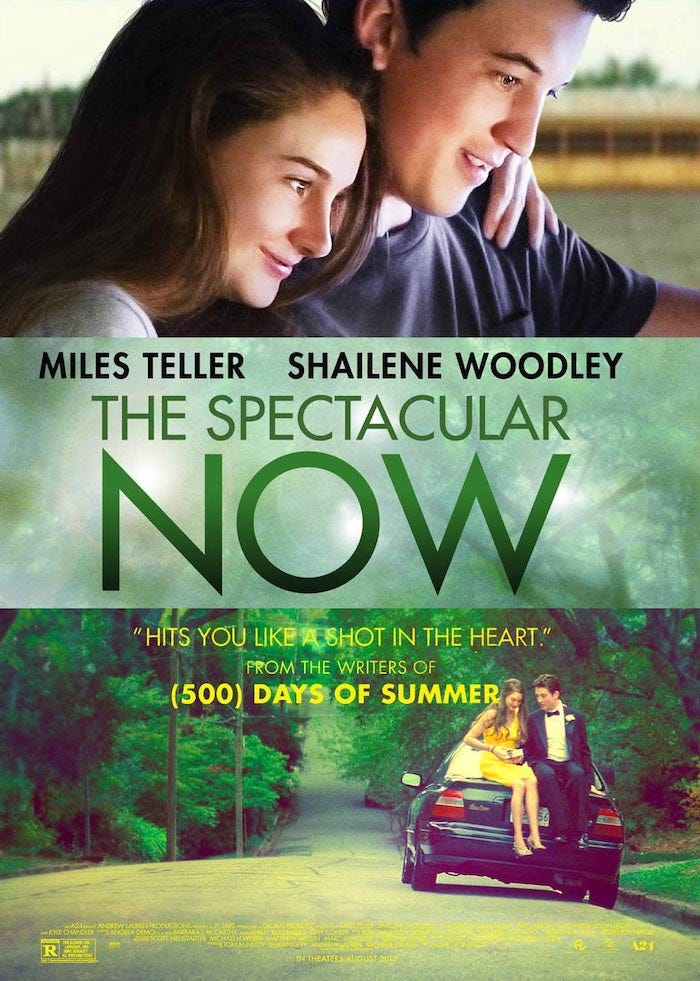
Title: The Spectacular Now. You may read the screenplay here.
Year: 2013
Writing Credits: by Scott Neustadter & Michael H. Weber Based on the novel by Tim Tharp
IMDB Rating: 7.3
IMDB Plot Summary: A hard- partying high school senior’s philosophy on life changes when he meets the not-so-typical “nice girl”.
Analysis: I’ve not seen this film, but I’ve attempted to read the Tim Tharp novel three times, as I love YA fiction. I get about 100 pages in each time only to find myself bored and frustrated and not relating to the characters. So .. I was curious to see how an adaptation of this material would fare. Sadly, for me, not much better. At a scant 99 pages, this should’ve been a breeze to read. It was not.
The story is a coming-of-age teen dramedy following the relationships and drunken exploits of one Sutter Keely. The unlooked-after product of a one-parent home, Sutter has the freedom to do and be whatever and whoever he wants to be. With a chip on his shoulder the size of the state of Oklahoma (where the novel is set, the adaptation leaves this detail up for grabs) over the father who disappeared from the picture too many moons ago, Sutter has chosen a life of virtually no extracurricular activities aside from a part-time job at a men’s clothing store, lusting after his too-good-to-be-true-for-him girlfriend, Cassidy, and drinking. Drinking gets top-billing. As a “cautionary tale”, it’s adequate, although the stakes don’t ever seem high enough. Or maybe they’re “too typical” — loss of girlfriend, teacher riding his butt at school, date throwing up at prom, his mom wavering between riding his butt and being clueless about where his butt is, a best bud who eventually turns on him when others form a sort of intervention — interestingly enough, not about Sutter’s drinking, but about rescuing an innocent, previously unnoticed girl from his detrimental clutches. Oh, and a car accident of sorts near the end, but even that didn’t amp things up for me. Like …. he still “got away with” his loose cannon life, complete with an ER doctor opting to call Sutter’s mom instead of the police, which was difficult to swallow from a believability standpoint. There were just too few consequences, maybe. And so … Sutter’s spiral waged on.
What is interesting about Sutter is this — — for as much as he could be “down” and for as “selfish” as perhaps his drinking is, he’s a big-hearted goofy, semi-lovable guy. The girlfriend who dumps him, Cassidy, does so chiding him for not taking others’ feelings into consideration. But we see, time and time again, he actually does this a lot — — we get him relating to a young kid on the verge of running away from home to go to Florida in search of his father. We get Sutter doing his best bud, Ricky, a solid in the way of a set-up so Ricky can find a girlfriend. And we see Sutter assisting the dutiful, plain jane, damsel in some semblance of distress, Aimee, with her paper route — — her mother’s paper route, actually — — the morning she finds Sutter waking up in some random yard after passing out drunk there the night before. Hence, we see these shades of “a great guy” in amongst the rubble of Sutter’s life. So … we kinda want to root for this guy, despite his relentless, habitual state of drunkenness. He just makes it tough. And maybe that stems from him not really knowing who he is or who he should be, because a) he’s too caught up in “the now” and the wonderful oblivion that state provides and/or b) he’s got this “I don’t know my dad” anchor weighing him down which he’s not doing anything about. So, I was thrilled for the nice tit-for-tat arrangement between Sutter and Aimee which prompts Sutter to finally see his dad again, and Aimee finally stands up to her mother. Sutter takes Aimee along to see his dad, and the scenes are a dose of reality for poor Sutter — — both in that he sees his dad prefers drink and women to just about anything else in life, and in learning his dad chose to leave all those years ago.
In the script, Sutter winds up making better decisions — — applying to college, getting sober, going to Philly to find Aimee in the end after not joining her initially. The book is different. It maintains more of a morose, downbeat, unsure what in the world’s gonna come of this kid ending. And that ending, even in its uncertainty and wide openness, is more honest. The script goes “tidy” and to “fluff”, wiping its hands in an instant and wrapping it all up with a little bow. I’m all for someone cleaning up their life, moving on and making the most of things, but …. it just seemed too easy. Too abrupt. I personally didn’t buy it.
The language of the script is fine — nothing glaringly off-putting or anyting like that. But, at the same time, it didn’t rise off the page for me. Nothing in this made me sit up and say “Whoa” or make me thirst for what comes next. I wanted that desperately, but came away much like I did with the novel.
Most Memorable Dialogue: There’s a nice exchange when Cassidy, in a weak moment, finds herself kinda-sorta hooking back up with Sutter after they’ve broken up:
CASSIDY : But you can’t go around having fun all the time. Sometimes you have to be serious.
SUTTER: I am serious. I’m 100 percent serious.
CASSIDY: About what?
SUTTER: About… not being serious.
CASSIDY: Did you even apply to college yet?
He doesn’t answer. Cassidy looks at him “thought so.”
SUTTER: Hey, my Dad never went to college and now he’s, like, the number two real estate developer in Cook County. Who needs it? I have everything I need right here. A job. A car. A beautiful woman. You think beauty’s in some classroom? A text book? It’s here. It’s all around us.
CASSIDY: You’re drunk.
SUTTER: Yeah but I’m not wrong. You got to live in the moment, Cass.
CASSIDY: I want more than just… “moments.” I want —
SUTTER: What?
CASSIDY: A future.
Most Memorable Moments:
— When Aimee and Sutter meet…. she gets his worst and his best all in the same morning, and it’s just enough to start to fall for the guy. i.e. sees his potential. There IS potential in this kid, even if he himself doesn’t see it, or twists it up differently than everyone else.
— When Sutter takes Aimee to a party and she has a conversation with someone else about the sci-fi books she adores. Like right there, in that moment, seeing how different they were, I wanted Sutter to walk away. Like he’d done her some good and yay and now he can mosey on to a next good deed. But……
— Sutter’s brutal honesty with Dan at the clothing store about not being able to (er, choosing not to) agree with his boss’s stipulation about not coming to work after drinking anymore, and thereby choosing to quit the job rather than clean up his act.
— Sutter and Aimee across the booth tabel from his dad. A glimpse at his potential future self. The gut-check of that. Raw and awesome.
What Did I Learn About Screenwriting From Reading This Script: I really really wanted to love this script. These screenwriters are the same guys who wrote “500 Days of Summer”, an original script, which is a spectacular story! So not really enjoying this script, I wagged a finger at the source material — — assuming my lack of taste for the book naturally led me to lack of taste for this. Which could be. Then last week I went to see the movie “The Fault in Our Stars”, an adaptation of a John Green novel by this same screenwriting duo. I loved the John Green book! Easily the best book I read last year. But the movie? Sadly, not so much. Sooooo lacking. Very one-note. And maybe that’s what this is for me — one note. Which leads me to the lessons for me………… 1) a script — like any great story — and its subsequent film need to provide some sort of emotional roller coaster for its readers/viewers. It needs high stakes. A crescendo of obstacles. Tough choices. Punch-in-the-stomach consequences. Characters should truly grapple — and in their grappling, in their ups and downs, their fits and starts, their wins and losses, we should care about them. Whether or not we relate to them or root for them, we should care. Whatever waves they’re riding, we too should ride. If we don’t WRITE a good roller coaster of a story, no one gets the thrill of RIDING it. And who wants to go to the amusement park that doesn’t offer a roller coaster??
Thanks, Joni! To show our gratitude for your guest post, here’s a dash of creative juju for you. Whoosh!
Fact: We can learn from reading scripts we don’t like as well as the ones we do.
To see all of this year’s 30 Days of Screenplays: Vol. 2, go here.