30 Days of Screenplays, Day 28: “The King’s Speech”
Why 30 screenplays in 30 days?

Why 30 screenplays in 30 days?
Because whether you are a novice just starting to learn the craft of screenwriting or someone who has been writing for many years, you should be reading scripts.
There is a certain type of knowledge and understanding about screenwriting you can only get from reading scripts, giving you an innate sense of pace, feel, tone, style, how to approach writing scenes, how create flow, and so forth.
So each day this month, I will provide background on and access to a notable movie script.
Today is Day 28 and the featured screenplay is for the 2010 movie The King’s Speech. You may read the screenplay here.
Background: Written by David Seidler.
Plot summary: The story of King George VI of the United Kingdom of Great Britain and Northern Ireland, his impromptu ascension to the throne and the speech therapist who helped the unsure monarch become worthy of it..
Tagline: Find Your Voice.
Awards: Nominated for 12 Academy Awards, winning 4 including Best Original Screenplay.
Trivia: David Seidler stammered as a child, and heard George VI’s wartime speech as a child. As an adult, he wrote the Queen Mother and asked for permission to use the King’s story to create a film. The Queen Mother asked him not to during her lifetime, saying the memories were too painful. Seidler respected her request.
I want to focus on one point: Creating a sympathetic Protagonist.
To be sure, you do not need to write a screenplay with a sympathetic Protagonist — witness Mark Zuckerberg’s character in The Social Network. However any writer who has worked in Hollywood has doubtless heard this note from development execs countless time in script meetings: Can’t you do something to make the Protagonist more sympathetic?
Why is this such a big deal?
To fully understand this mindset, we have to step back and consider the movie-watching experience. To create a successful movie, one goal the filmmakers should have is to lure the viewer into the movie — make them stop thinking about their job, their popcorn, the people around them, and instead get their heads and hearts immersed in what’s going on inside the story universe. If a movie can transport us from this world into that world, it increases the movie’s chances of being experienced in a positive way. After all, isn’t that the point of movies as escapist fare — to take us away from our ordinary world and entertain us for a few hours in the story’s extraordinary world?
The most direct and perhaps best way to accomplish that is via the Protagonist character. From a psychological standpoint, there is a way in which it’s not the Protagonist alone going through what they experience in the movie universe, it’s the Protagonist and us sharing it. Indeed at some heightened points in a movie, it’s possible the Protagonist disappears entirely from our consciousness and it is just us experiencing what’s going on in the story.
We can call this phenomenon audience identification and it is one key to the success of most Protagonist characters, how we identify with that pivotal character in some fundamental and powerful way which in turn transports us into the story universe.
Hollywood is not stupid. They know the simplest, easiest way to accomplish audience identification is by telling stories with sympathetic Protagonists. The fact is we are much more likely to identify with a Protagonist if we sympathize with them. So as far as the studios are concerned, screenwriters should accept that as a given and go write them a hit script.
In The King’s Speech, written by David Seidler, the story’s Protagonist is “Bertie” (Colin Firth), Prince George, a member of British royalty, second in line to the throne of England. Unless you or I are part of a monarchical family, on the face of it we would have little in common with Bertie, thus making our identification with him a challenge for the screenwriter. What did Seidler do to create a sympathetic Protagonist? Several things. Here are just a few:
The process begins in the opening sequence where George is to give a speech:
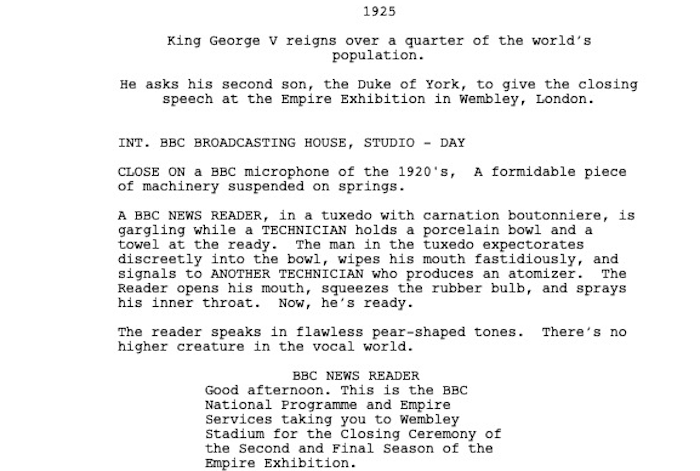
There’s no higher creature in the vocal world. Talk about setting the bar high! Then we shift to George as he begins his speech:
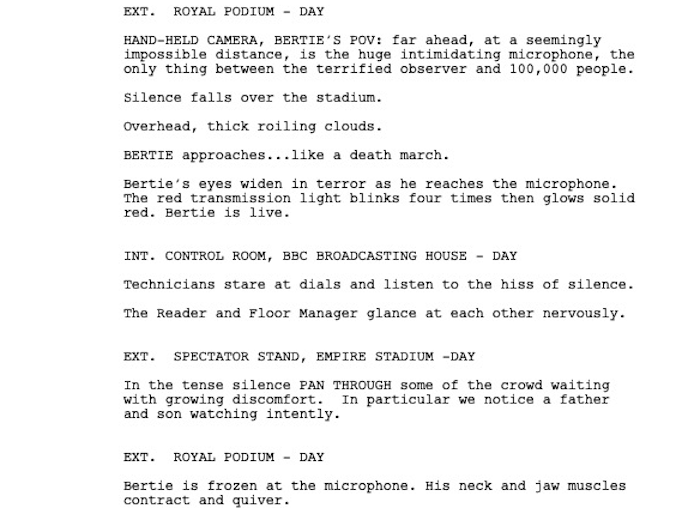

Within a few moments of the movie’s beginning, we learn that Bertie is a stutterer, the contrast heightened by the comparison to the BBC announcer. And immediately we feel sorry for him, this emotion driven deeper and deeper by how long we endure Bertie’s suffering at the public event. In an earlier draft, Bertie is described like this:
Bertie stands frozen, his mouth agape, jaw muscles locked. He
knows he’s considered by all, especially himself, unfit for
public life.
Our sympathy for Bertie increases as we realize, he is not only a stutterer, but a man whose very birthright forces him to be a public figure, thus putting his vocal condition on stage over and over again.
Later, Seidler includes a scene where Bertie’s two children, Lilibet and Margaret Rose, ask their father to tell them a story:
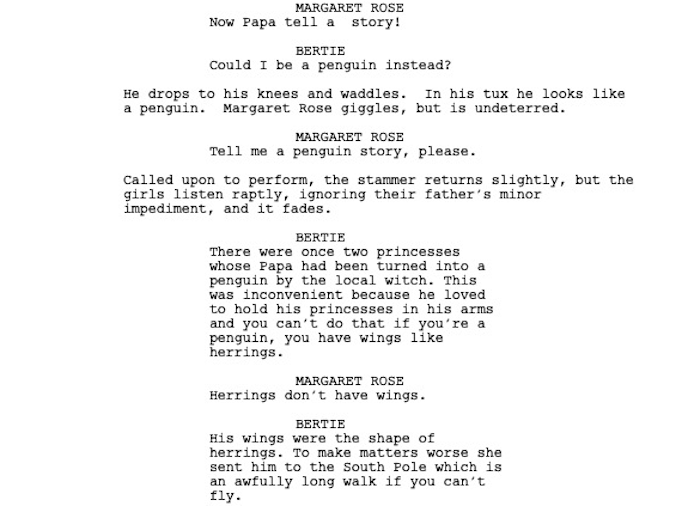
The scene accomplishes at least two things: (1) It establishes that Bertie is a loving father and devoted family man. (2) It demonstrates that Bertie’s stuttering ebbs and flows depending upon circumstances, suggesting it is not strictly a physical condition, but a psychological one. Both dynamics engender more sympathy.
Shortly thereafter, Bertie has a humiliating experience at the hands of his father, the King:

We begin to sense the roots of Bertie’s stuttering are tied to his upbringing and in part the unforgiving demeanor of his father. This shrinks the emotional distance between us and this member of the royal family since it’s only natural for each of us to have at least some misgivings about our own childhood experiences.
When Bertie meets Lionel (Geoffrey Rush) for the first time, it is an extremely awkward moment for the Prince:
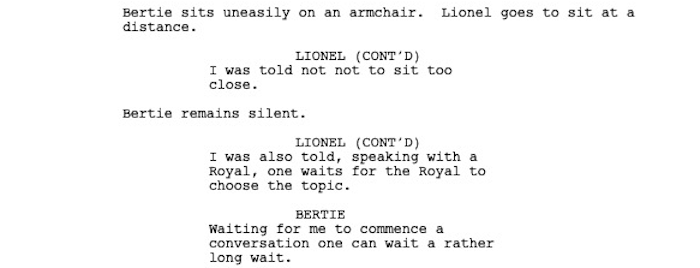
Here Bertie is man enough to be able to make fun of himself and his condition — a small thing, but again increases our sympathy for the Protagonist.
These are just a few examples taken from the story’s set-up, but it demonstrates the lengths to which Seidler went to establish a sympathetic Protagonist in The King’s Speech.
How about you? That story you’re currently writing? How is your Protagonist sympathetic? Have you dug deep enough into the character to discover all the ways in which you can create a sense of audience (reader) identification with the character?
And for those of you who have seen The King’s Speech, what other ways did Seidler treat Bertie’s character to create a sympathetic Protagonist? Stop by comments and post your thoughts.
To see all of the posts in the 30 Days of Screenplays series, go here.
This series and use of screenplays is for educational purposes only!