30 Days of Screenplays, Day 27: “Wreck-It Ralph”
Why read 30 screenplays in 30 days?
Why read 30 screenplays in 30 days?
Because whether you are a novice just starting to learn the craft of screenwriting or someone who has been writing for many years, you should be reading scripts.
There is a certain type of knowledge and understanding about screenwriting you can only get from reading scripts, giving you an innate sense of pace, feel, tone, style, how to approach writing scenes, how create flow, and so forth.
We did 30 Days of Screenplays in 2013 and you can access each of those posts and discussions here. This time, we’re trying something different: I invited thirty Go Into The Story followers to read one script each and provide a guest post about it.
Today’s guest columnist: Cory Terry.
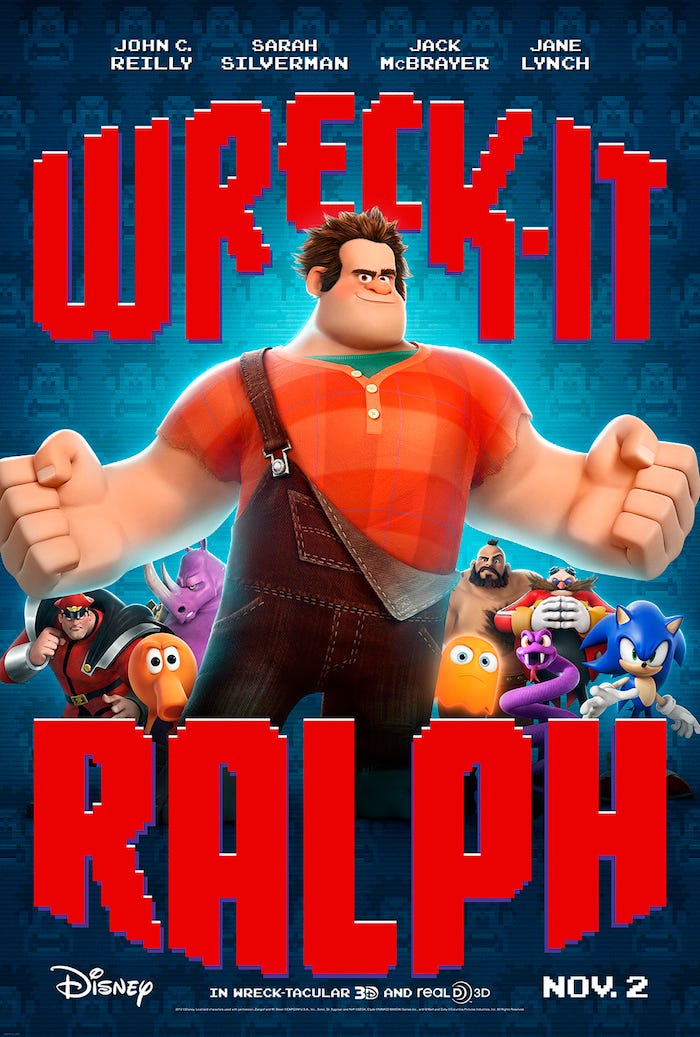
Title: Wreck-It Ralph. You may read the screenplay here.
Year: 2012
Writing Credits: Story by: Rich Moore and Phil Johnston and Jim Reardon. Screenplay by: Phil Johnston and Jennifer Lee. Additional Story Material by: John C. Reilly and Sam Levine & Jared Stern.
IMDB rating: 7.8
IMDB plot summary: A video game villain wants to be a hero and sets out to fulfill his dream, but his quest brings havoc to the whole arcade where he lives.
Tagline: The story of a regular guy just looking for a little wreck-ognition.
Awards: Oscar Nominee for Best Animated Feature, Golden Globe Nominee for Best Animated Film (the film lost both the Oscar and Golden Globe awards to “Brave”)
Analysis: I want to first admit that I have not seen “Wreck-It Ralph.” Which, interestingly enough, corresponds with my first impression reading the script: That the (many) writers did not describe much, making it difficult to visualize what was going on. I suspect this is a symptom of working in animation. They know exactly what Ralph looks like, to them every brick of the Niceland Apartments has been rendered, they can see this “stump” where Ralph lives. But as a reader I found myself wondering exactly what I’d be seeing on screen, had I the time to watch the film…which I hadn’t. I suspect that if this script were written as a spec (and not as the culmination of a development process that began at Disney in the 80’s), simply writing “Ralph wrecks a building” would be insufficient as a description. Okay. That’s all about that.
The script quickly sets up our protagonist, Ralph, a video game villain who wrecks buildings so the game’s hero, Fix-it Felix, can rebuild them, earning Felix the admiration of the townies. The inherent conflicts between Ralph and Felix could not be simpler: Ralph wrecks and Felix rebuilds, Ralph is the hated villain and Felix is the revered hero. It works. In the setup we learn how Ralph longs for acceptance and on page 5 he says, “Man, it must be nice being the good guy,” which I view as the statement of Ralph’s “emotional goal” in the script: Ralph wants to be a beloved hero. Ralph pines for recognition in the form of hero medals, which I’ll call his “story purpose.” Is Ralph really “bad”? He does steal some cherries in the setup, but he gives one to homeless Q-Bert, so how bad can he be?
“Then one day,” Ralph’s game celebrates its 30th anniversary and Ralph crashes Felix’s party. It is there that his story purpose is forged by a random nemisis “Gene” (who, for all I know could be anything from a Mario turtle-duck to the Stay Puft Marshmallow Man….see, I couldn’t leave it alone). Gene agrees to admit Ralph into the Niceland penthouse if he wins a hero’s medal. Story purpose!
There’s some debate about how Ralph will get his medal. But, eventually, he makes the decision to masquerade as a soldier and go into another video game (Hero’s Duty) to retrieve one. This occurs on page 21, which I’ll call the END OF ACT 1. The protagonist has made a decision to pursue his story goal of obtaining a medal and, had he made a different decision, the movie would be over.
In the new world of ACT 2, Ralph is in over his head as “Hero’s Duty” is a first person shooter game where the player battles giant “Cy-bugs.” We’ve also been told that if you die outside of your own game you do not regenerate. Stakes!
It’s here we meet Tamora Calhoun, the no-bullshit sergeant of the Hero’s Duty soldiers. Can I say bullshit in a Disney review? Scott can change it to “bullcrap” if he so chooses. Calhoun will factor into the B story soon.
Ralph is a terrible soldier, but he sneaks away and steals a medal from the game! Movie over!
Except that he trips and falls into an escape pod with a stowaway Cy-bug and is launched into a new video game. Back in Ralph’s home game “Fix-It Felix,” stuff is bad without Ralph wrecking things. This earns the game an “out of order” sign and the store owner promises to get rid of Fix-It Felix for good if it can’t be repaired. Stakes! So Felix goes out searching for Ralph, and arrives at Hero’s Duty just in time to see Ralph’s escape pod leave the game. Now, in the B Story: Felix teams up with Calhoun (who is worried that the stowaway Cy-bug with eat through every game in the arcade if it’s not stopped) and the duo follow Ralph into the new game.
Ralph crash-lands in “Sugar Rush,” a candy-themed racing game, and promptly loses his medal to Vanellope, a 9 year old girl who uses the medal as payment to enter the “big race.” Now the medal can only be retrieved by the winner of the big race. Ralph is forlorn, but, after Vanellope has her race car destroyed by bullies sent by King Candy (’cause she’s a “glitch” that could ruin their game), Ralph defends her and the pair make a deal: If Ralph helps her wins the big race, she’ll give Ralph back his medal.
Meanwhile, in the B Story, Felix and Calhoun are searching for Ralph and the Cy-bug, respectively. Felix tells her a story about Turbo, a jealous game hero that went crazy after his game was unplugged and, after Felix sorta saves them from some Nesquik sand, we see the pair are starting to fall in love. But Calhoun is determined to find the Cy-bug before it lays eggs and ruins the entire arcade. Stakes with a quasi-time clock!
Back in the A story, Ralph uses his wrecking strength to break into a race-car making game and, at the MIDPOINT: Ralph successfully wins the game and BUILDS a race car. They now have a race car AND Ralph gets a taste of creating something, instead of wrecking. Things are looking up!
But it’s a “false victory” as the Candy King, fearful of the “glitch,” vows to destroy their new car and, more importantly, we learn that Vanellope doesn’t know how to drive! Vah?! But, she’s the one who’s supposed to drive! How can this be?!
Back at Vanellope’s dump of a home (a hovel in Diet Cola Mountain with falling Mentos that launch molten soda all over the place), Ralph and Vanellope realize they are kindred spirits in that they are both outsiders in their games seeking redemption. So Ralph BUILDS her a training track and starts to teach her how to drive. In montage she learns how to drive, but then she “glitches” (which I guess is like a seizure) and nearly dies. These seizures are going to be a problem.
To make matters worse, King Candy underhandedly hacks into the intricate web of the game’s code and steals Ralph’s medal. Dick move. We’ll ignore that this is a somewhat curious decision as (reading ahead) this doesn’t disqualify Vanellope from the race or anything. Weird. But here we also see the code for Vanellope. It’s not connected to the rest of the web at all. Also weird.
Meanwhile, Felix professes his love for Calhoun (calling her a “dynamite gal”), but it triggers a memory in her tragically programed back story (her husband-to-be was murdered by a Cy-bug just after using the same term of endearment) and she abandons Felix. This leads Felix to seek help at the King Candy castle and get locked up by a henchman (Sour Bill).
Now, the day of the race, King Candy propositions Ralph. Not like that you sicko. He offers Ralph his medal back if he talks Vanellope out of racing. He even explains how this is what’s best for her, because if she wins and the gamers see her glitch, Sugar Rush will be placed “out of order,” and, because Vanellope is a glitch, she can’t leave the game and will die when it’s unplugged…which leads me to wonder how this game has never been unplugged before…but, eh, “logic.”
Ralph takes the medal (story goal achieved!) and destroys Vanellope’s car (he’s back to wrecking things). Now the race can, seemingly, never be won and Vanellope’s pissed, saying Ralph “really is a bad guy.” So much for his emotional goal of being a hero…at least in the eyes of his one friend. When Ralph returns to his own game, it’s been abandoned. Turns out everyone panicked when Felix disappeared, no one cares about his shiny new medal and the arcade owner is pulling the plug on Fix-It Felix in the morning. Time clock! And now all is really lost. Even though Ralph has the meaningless medal, he’s lost his only friend and can’t be a hero now. How can he recover from this? Well, he notices that Vanellope’s picture is featured on the side of the Sugar Rush game and he gets an idea. END OF ACT 2.
ACT 3 — Ralph sneaks back into the Sugar Rush game and confronts King Candy’s henchman (Sour Bill…who also locked up Felix). Ralph licks him until he spills the jelly beans: King Candy actually went into the game code and MADE Vanellope a glitch. Also, he wiped everyone’s memory, but if Vanellope can just crosses the finish line in a race, the game will reset and Vanellope will no longer be a glitch! Deus ex machin-yeah! But she’s locked in the “fungeon” (a fun dungeon) with Felix. So Ralph breaks in and, after a moment of understanding between him and Felix wherein Felix realizes Ralph’s pain, Felix agrees to reassemble Vanellope’s wrecked race car. They rescue her and she forgives Ralph (a little quickly if you ask me).
So now Vanellope is in the race. But, if I think about it, it would have been helpful to SEE her weigh the risk of potential death if she fails to finish the race against the reward of becoming unglitched if she succeeds. I’m also a little confused about the free will of these racers, don’t they have kids in the arcade controlling them?
Anyway, as Vanellope starts to succeed in the race, the Cy-bugs take over, forcing Calhoun to start evacuating the game. King Candy tries to run Vanellope off the road and as their racecars bump, he inexplicably starts glitching, revealing that he is in fact…Turbo, the jealous game hero from Felix’s story. Turns out, he learned to code and reprogrammed this game to make himself king!
But, like the other characters in the story, Vanellope uses her weakness as a strength and “glitches” out of harm’s way, causing King Candy/Turbo to be eaten by a Cy-bug. Phew! But the Cy-bugs also destroy the finish line and cause Vanellope to crash.
CLIMAX: So, Ralph, the protagonist with an emotional goal of becoming a hero, scoops Vanellope up and tries to evacuate her to safety. But she can’t leave and the bugs are advancing. Calhoun exclaims that the bugs can only be stopped by a beacon (a bug zapper type light that they had in Hero’s Duty). Vanellope tells Ralph to leave her, but our hero is going to use his wrecking skills to save the day. In a big action scene, Ralph tries to wreck Diet Cola Mountain to create a Mentos-powered beacon to lure the bugs away, but King Candy/Turbo has regenerated into a Cy-bug and snatches Ralph away. He’s going to kill Ralph by dropping him from the sky, but Ralph sacrifices himself and drops onto Diet Cola Mountain, destroying it and unleashing a massive explosion. Just as he’s about to fall into the molten diet cola, Vanellope uses her glitching to rescue him. The diet cola beacon is raised and all the bugs are lured into it and destroyed….even King Candy/Turbo/Cy-bug who can’t resist it and dies as well. They did it!
With the bugs dead Felix and Calhoun make out, it’s sweet (couldn’t help myself). Felix fixes the finish line and Vanellope crosses it. She’s transformed into a princess and all the memories of the Sugar Rushers are restored, reminding them that Vanellope was actually their leader. There’s certainly Cadbury Egg on their faces (last one, I swear). Ralph goes back to his game and is embraced by Felix and the other characters and things are going to be A-okay! THE END.
Most Memorable Dialogue:
Zangief: I relate to you, Ralph. When I hit bottom, I was crushing man’s skull like sparrow egg between my thighs. (smacking his thigh) And I am wondering, why do you have to be so bad, Zangief? Why can’t more like good guy? Then I have moment of clarity: If Zangief is good guy, who will crush man’s skull like sparrow egg between thighs? And I say, “Zangief, you are bad guy. But this does not mean you are bad guy.”
Most Memorable Moments: I liked when the script leveraged characters we were already familiar with (e.g., Zangief, Ryu and Ken going out for a drink and whenever we saw homeless Q-Bert. I also enjoyed when Ralph licked Sour Bill into submission and the flashback depicting the death of Calhoun’s fiancé.
What Did I Learn About Screenwriting From Reading This Script: When I think of a protagonist’s “story goal,” I usually think of it as a goal driving him or her until some point in Act 3 when the character succeeds, fails or abandons that goal. Sometimes the story goal also seems to change at the midpoint when the character learns something important. But in “Wreck-In Ralph,” Ralph achieved is story goal when he got his medal (for good) way past the midpoint in Act 2, causing his story goal to shift in act 3 to “helping Vanellope cross the finish line of the race.” I wasn’t a huge fan of the false stakes with the medal to begin with and think it would have been a stronger story if Ralph had abandoned the medal goal at the midpoint (upon learning a great truth about what is important to him). But, overall I think the story worked well and it taught me that a character’s story goal can shift and, if it ties in well with their emotional goal, you can do so while keeping the audience connected to the story.
Also, the script would make Plato proud as there is no shortage of reversals within scenes and at the ends of acts. The climax of the script is a strong example of several large reversals that make it engaging and, ultimately, lead to a cathartic resolution.
Finally, I think this script is a great example of giving every character their own story arc. Everyone from Ralph, to Felix, to Calhoun, and even the Moffet girl playing the arcade games, goes through a change. It’s satisfying and a great lesson to implement in my own writing.
Thanks, Cory! To show our gratitude for your guest post, here’s a dash of creative juju for you. Whoosh!
To see all of this year’s 30 Days of Screenplays: Vol. 2, go here.