30 Days of Screenplays, Day 23: “Pan’s Labyrinth”
Why 30 screenplays in 30 days?
Why 30 screenplays in 30 days?
Because whether you are a novice just starting to learn the craft of screenwriting or someone who has been writing for many years, you should be reading scripts.
There is a certain type of knowledge and understanding about screenwriting you can only get from reading scripts, giving you an innate sense of pace, feel, tone, style, how to approach writing scenes, how create flow, and so forth.
So each day this month, I will provide background on and access to a notable movie script.
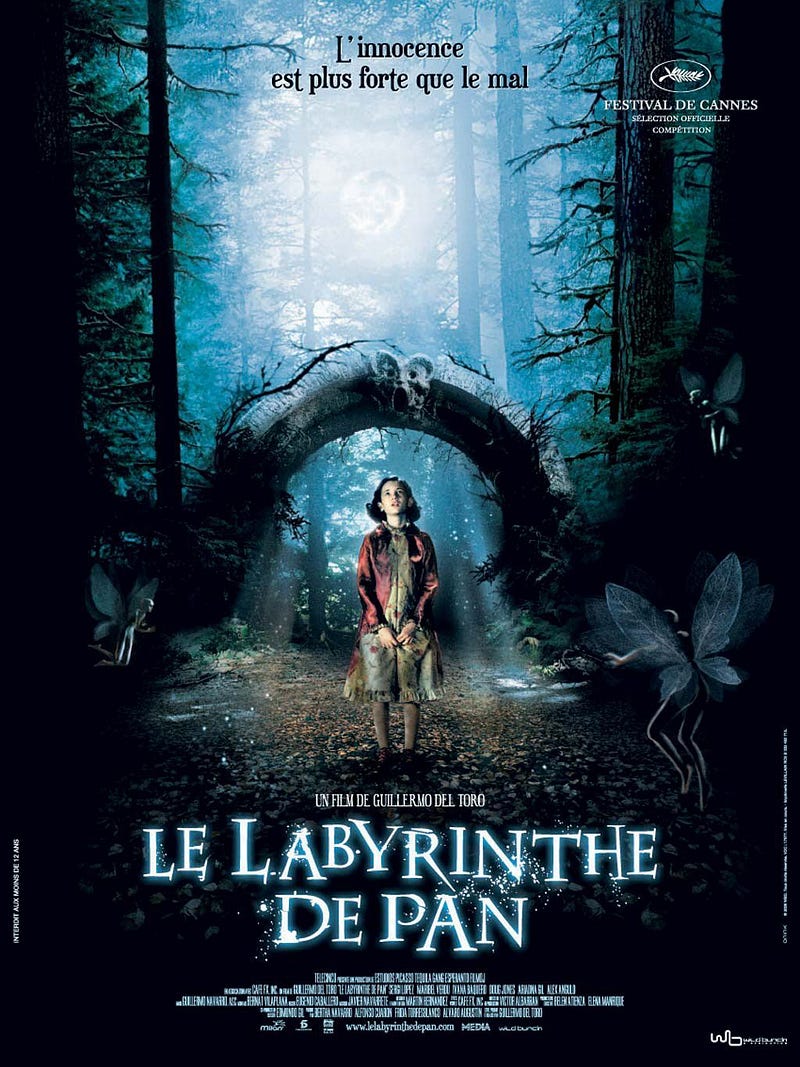
Today is Day 23 and the featured screenplay is for the 2006 movie Pan’s Labyrinth. You may read the screenplay here.
Background: Written by Guillermo del Toro
Plot summary: In the fascist Spain of 1944, the bookish young stepdaughter of a sadistic army officer escapes into an eerie but captivating fantasy world.
Tagline: What happens when make-believe believes it’s real?
Awards: Nominated for 6 Academy Awards including Best Writing, Original Screenplay
Trivia: Guillermo del Toro is famous for compiling books full of notes and drawings about his ideas before turning them into films, something he regards as essential to the process. He left years worth of notes for this film in the back of a cab, and when he discovered them missing, he thought it was the end of the project. However, the cab driver found them and, realizing their importance, tracked him down and returned them at great personal difficulty and expense. Del Toro was convinced that this was a blessing and it made him ever more determined to complete the film.
As background, here are some thoughts from an interview with del Toro about what inspired him to write a modern day fairy tale:
“In the time of spiritual formation, for me, both fairy tales and the Bible had the exact same weight. I was as enthralled by a parable in the Bible about the grain of mustard, as I could be about three brothers on their quest to marry a princess. I found equal spiritual illumination in both. Even when I was a kid, funny enough, I used to be able to find those fairy tales that felt preachy and pro-establishment, and I hated them. I hated the ones that were about, ‘Don’t go out at night.’ There are fairy tales that are created to instill fear in children, and there are fairy tales that are created to instill hope and magic in children. I like those. I like the anarchic ones. I like the crazy ones. And, I think that all of them have a huge quotient of darkness because the one thing that alchemy understands, and fairy tale lore understands, is that you need the vile matter for magic to flourish. You need lead to turn it into gold. You need the two things for the process. So when people sanitize fairy tales and homogenize them, they become completely uninteresting for me.
“I have collected them since I was a kid, so it’s hard for me to tell you. There’s a whole streak of them. The movie and the notebook both say that we are doing homages to Lewis Carroll, to The Wizard of Oz, to Hans Christian Andersen with the little magical girl, to Oscar Wilde, and very specifically to David Copperfield and Charles Dickens. These are things that I voluntarily do. But, the one book that I would say was a huge influence on making the movie is a book called The Sands of Fairy Tales which is a recent catalog of all the primordial streaks of storytelling in fairy tale lore.”
Interesting choice of words: primordial. The script has that feel, doesn’t it. Even though it’s set in a specific time and place because of its location in a forest and an old abandoned mill, it has a timeless feel to it.
One of the most powerful and universal ideas of The Hero’s Journey is how the Protagonist ventures forth from their Old / Ordinary World into a New / Extraordinary World. Generally speaking, we see this at the middle of Act One or the end of Act One depending upon the specific nature of each story.
In “Pan’s Labyrinth,” we can see that transition when Ofelia follows the Stick Insect, ventures into the labyrinth for the first time, and meets the Faun [P. 20–24]. Even though Ofelia begins the story traveling to this new place, it is still her Old World in that she is with her mother, but more important in relation to this story — in essence a fairy tale — that world is substantially different than the New World she experiences, one of Fauns, the Three Challenges, nightmarish creatures, and dark danger.
Here is a direct quote from Joseph Campbell’s book “The Hero With a Thousand Faces”:
“A hero ventures forth from the world of common day into a region of supernatural wonder: fabulous forces are there encountered and a decisive victory is won: the hero comes back from this mysterious adventure with the power to bestow boons on his fellow man.”
Isn’t that the basic structure of “Pan’s Labyrinth”‘s narrative?
I was also struck by the choice of names:
– Vidal from the same root as “vital” or “life.” As in he is the arbiter of life… or death. He has so much invested in the life of his son.
– Ofelia is from “ophellus” which means “help.” Of course, the name hearkens Shakespeare’s “Hamlet” in which it belongs to Hamlet’s lover who eventually goes insane and drowns herself. Her name a portent of her death?
– Mercedes means “mercies.” Provides understanding and tenderness to Ofelia.
There is a line to Ofelia to avoid the labyrinth because “you could get lost.” And indeed she does in the way of her psyche. But then if you get lost, you can also be found, which is the ultimate resolution to her character reunited with her father and mother in death.
And then this: I was struck by how much of the story was comprised of Vidal twin subplots: His relationship to the birth of his son and his relationship to the rebel soldiers. I barely remembered that from the one time I saw the movie, almost all of my memories about Ofelia and her descent into the ‘other’ world.
Finally per Narrative Throughline:
ACT ONE
The Opening: Ofelia’s journey to her new home [1–5]
The Hook: Ofelia finds the labyrinth [8–10]
The Lock: Ofeila ventures into the labyrinth and meets the Faun [20–24]
ACT TWO
Deconstruction Test: The Toad challenge [34–36]
Transition: The Pale Man challenge [53–55]
Reconstruction Test: The Faun tells her she has failed [69–70]
All Is Lost: Carmen dies while the baby is born [77–78]
ACT THREE
On The Offensive: Faun gives her another chance and she kidnaps her brother [86–87]
Final Struggle: Ofelia refuses to give up her brother, then is shot and killed by Vidal [92–94]
Denouement: Ofelia reunited with her parents [95–96]
Ofelia’s story is — in my view — a classic tale of metamorphosis, and each of these Plotline points form the spine of that narrative.
What’s your take on Pan’s Labyrinth? Stop by comments and post your thoughts.
To see all of the posts in the 30 Days of Screenplays series, go here.
This series and use of screenplays is for educational purposes only!