30 Days of Screenplays, Day 23: “Flight”
Why read 30 screenplays in 30 days?
Why read 30 screenplays in 30 days?
Because whether you are a novice just starting to learn the craft of screenwriting or someone who has been writing for many years, you should be reading scripts.
There is a certain type of knowledge and understanding about screenwriting you can only get from reading scripts, giving you an innate sense of pace, feel, tone, style, how to approach writing scenes, how create flow, and so forth.
We did 30 Days of Screenplays in 2013 and you can access each of those posts and discussions here. This time, we’re trying something different: I invited thirty Go Into The Story followers to read one script each and provide a guest post about it.
Today’s guest columnist: Colleen Costello.
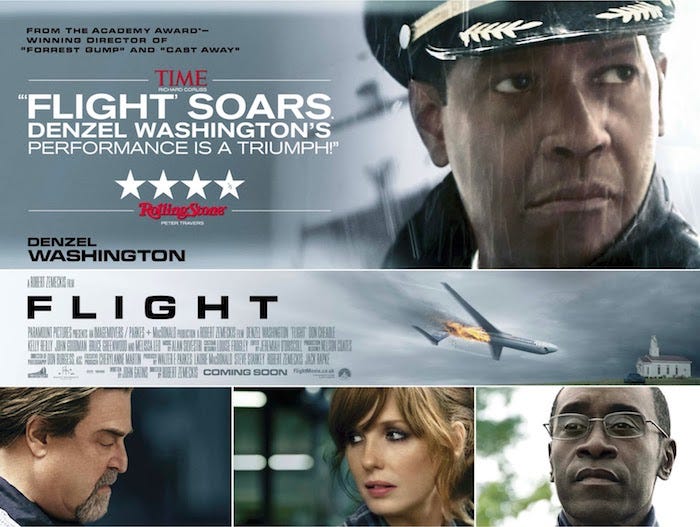
Title: Flight. You may read the screenplay here.
Year: 2011
Writer: John Gatins
IMDB Rating: 7.3
IMDB Plot Summary: An airline pilot saves almost all his passengers on his malfunctioning airliner which eventually crashed, but an investigation into the accident reveals something troubling.
Awards: Two Academy Award Nominations; Best Actor, Denzel Washington; Best Original Screenplay, John Gatins. Other; 11 wins/35 Noms
Analysis: I was eager to see this film as soon as I saw the trailer, despite having doubts about a commercial jet flying inverted. As it turns out, it has happened! I only learned that fact now as I started to prepare this review; Mr. Gatins did an amazing amount of work starting back in 1999 on this impressive script. After I saw the film, I searched the credits for the aviation advisor. I did not immediately notice the addiction advisor credit. Since addiction is a central theme, nothing less than “keeping it real” would have been convincing. This is not a film about a bad plane ride or an arrogant pilot. The audience is quickly hooked and clued into the deeper issues. The tense action starts immediately and the story moves swiftly. Where to? Not unlike an airplane: up, down….leveling off and then taking some turns. I’m going to try to avoid spoilers, I hope you’ll see this…you must read it!
The script comes in at 149 pages, well beyond the standard length of most screenplays and in most cases a writer wouldn’t get far with that many pages. Mr. Gatins had been acting, writing & directing for quite awhile and luckily, Mssrs. Zemeckis & Washington came across “Flight” in 2009. Eager to get it made, they both reportedly took huge pay cuts. Mr. Gatins wrote a tight script based on two complex themes; aviation and addiction. I wasn’t expecting it, but I was able to grasp both plots intimately because I know commercial pilots and former addicts. One was both, but not a commercial pilot! The accuracy of the range of emotions that addicts in denial experience were written and portrayed authentically. The social relevance of addiction within this story is significant. Anyone can become addicted. We see exactly why in Whitaker and Nicole, who are both good people with very different lives. They are similar in that they have succumbed to substance abuse in struggling with their pain. What this story shows us is that for those who want it, there is a another life thorough recovery. Mr. Gatins handled the subplot of recovery realistically in the choices he made with Nicole and Whitaker.
No pilot (no person!) ever wants to crash. Pilots practice for emergencies that will hopefully never happen. The job comes with immense responsibility and while pilots love flying, it’s a difficult life, they are human and thus very interesting characters. In the aftermath of the crash, Mr. Washington’s Captain Whitaker receives heroic praise he is very uncomfortable with because he is fighting demons. Whitaker is a conflicted man and Mr. Gatins took on two elements of a pilot’s life that just cannot mix: substances and flying. In a poignant subplot, Whitaker connects romantically with Nicole who has experienced loss in her life, became addicted and also almost nearly died; they meet smoking (joined by “gaunt young man” who is dying of cancer, so yeah, also smoking; this character and scene resonate deeply) in a hospital stairwell….but she still has her treasure, a camera. Whitaker’s kindness helped start to get her on her way to recovery while he is still falling apart. It doesn’t seem like he has any “treasure” at all in his life. He does have allies, Charlie, then Hugh, after the accident and one very “god-like doctor of non-pharmaceutical products” who loves Whitaker. That’s Harling Mays, portrayed by John Goodman. He is otherwise alone.
Goodman as Mays makes only two appearances in the film, a scene early in the film and one near the end; he steals both scenes but I doubt anyone minded as his character — a colorful creation by Mr. Gatins — occur at pivotal moments in the film. This character adds authenticity, incredulity and freakish humor. This dude is FLYING on another plane, he likes it and dubious as he may seem, he’s loyal to Whitaker.
Although it seems possible Whitaker will remain a pilot, while in refuge at an old family farm he sinks deeper into despair and contemplates running away. He makes an apparently inappropriate visit to his ex-wife and son’s home where we get a glimpse of what his “treasure” might be. A brief but very important scene. Mr. Gatins’ writing and portrayal of a “rock bottom” addict is faithful, brutally honest, thorough and fair. The message of recovery is thoughtfully presented…how to get it, that it’s hard work, and can change and save one’s life. Sadly, it seems this pilot isn’t interested. He didn’t last five minutes at an A.A. meeting. He’s prepared to continue lying, keep flying and let the drink fix his misery, numb the pain. Whitaker flips off everyone on the morning of his NTSB testimony. His allies Charlie and Hugh have worked hard to virtually ensure the Captain remains a hero. Whitaker gets into his chair to testify. What a scene! Just like his Captain’s seat, he’s following procedure but then, a beat. He can keep “existing” or start living. Mr. Gatins keeps us glued and guessing to the last pages to learn which path Whitaker chooses to “fly.” Reading this script was a fantastic voyage. That’s how you DO that John Gatins! Thank you.
Most Memorable Dialogue:
(between Captain & injured First Officer)
WHIP: I don’t know what you remember, but the plane started to fall apart
EVANS: I remember everything until we crashed. I know what went on
WHIP: What are we talking about?
EVANS: I don’t know Captain Whitaker, what are we talking about?
WHIP: I just wanted to get a sense from you what you thought caused the crash
EVANS: Was it the fact that you got on the plane drunk from the night before?
Whip goes white and drops his head
EVANS (Cont’d): The NTSB is coming back tomorrow to finish taking a deposition from me about the events on the flight
WHIP: You think you’d be alive without me on that plane?
EVANS: No we’d all be dead. But are you gonna argue that your physical state was tip-top?
WHIP: I’m not gonna argue anything with you
Most Memorable Moments: In a film where every moment is tightly connected to plot or subplot, not an easy choice! At the start, certainly the action in the cockpit, dialogue between Whitaker and Evans as the crisis escalates; intense! Goodman as Harling….surreal, essential to the addict life. Later, Whitaker’s “rock star” drunk bender that results in a trashed hotel room; great symbolism. Has Whitaker hit bottom? Lastly, it may seem odd but at the start and end of the script there are two long, expertly crafted expositions that perfectly “wrap” the script. An audience doesn’t “see” that but I read the final shooting script (8–9 revisions in two months) and this extended expo is vital and certainly visual in the story telling.
What Did I Learn About Screenwriting From This Script: I think that every one of the 149 pages were essential but that it’s probably best not to try and sell a lengthy script unless it’s nearly perfect and one is already pretty well established as a writer. Not to worry that John Gatins started it in 1999 and sold it in 2009. He was already working in the business and had found success. He needed the time to work on the script and it IS nearly perfect. His success may have helped, another benefit of time although I think this script might have been produced eventually, somehow! Ultimately it all happened in its time, an important credo to a screenwriter, to anyone chasing a dream. It paid off with a grand “Flight!”
Thanks, Colleen! To show our gratitude for your guest post, here’s a dash of creative juju for you. Whoosh!
To see all of this year’s 30 Days of Screenplays: Vol. 2, go here.