30 Days of Screenplays, Day 22: “Mud”
Why read 30 screenplays in 30 days?
Why read 30 screenplays in 30 days?
Because whether you are a novice just starting to learn the craft of screenwriting or someone who has been writing for many years, you should be reading scripts.
There is a certain type of knowledge and understanding about screenwriting you can only get from reading scripts, giving you an innate sense of pace, feel, tone, style, how to approach writing scenes, how create flow, and so forth.
We did 30 Days of Screenplays in 2013 and you can access each of those posts and discussions here. This time, we’re trying something different: I invited thirty Go Into The Story followers to read one script each and provide a guest post about it.
Today’s guest columnist: Rob Grundel.
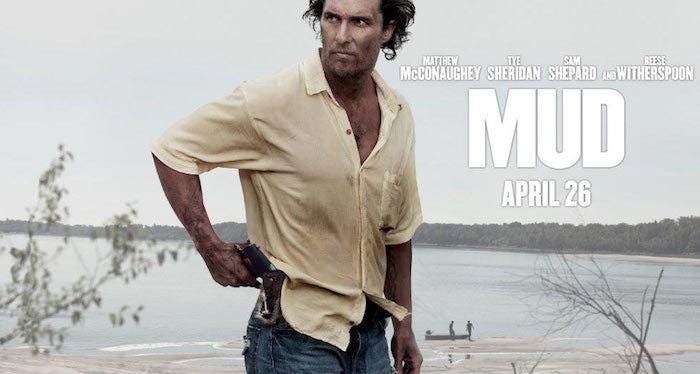
Title: Mud. You may read the screenplay here.
Year: 2013
Writing Credits: Jeff Nichols
IMDB Rating: 7.5
IMDB Plot Summary: Two young boys encounter a fugitive and form a pact to help him evade the vigilantes that are on his trail and to reunite him with his true love.
Analysis: “Good stories are inevitable…not predictable” That’s what Andrew Stanton from Pixar said in his 2012 TED talk. Jeff Nichols has written a script in Mud that sets up all the characters, their relationships and their clashes of values in the first 50 pages of the script and then lets them fall in the remaining 82 with a pleasing inevitability which leaves the reader wanting to read until the last page.
This is a coming of age screenplay, which is introduced, straight away on page 1 describing the 14-year-old protagonist Ellis as having “a few blonde hairs on his upper lip struggling desperately to be a mustache”.
On page 2 Ellis observes an altercation between the father and the mother where the father isn’t prepared to deal with something in their relationship (we don’t know what yet) — this subplot bookends and drives the whole story. The first conversation between Ellis and close friend Neckbone (page 2–3) further sets up the question about love and how to deal with it — a theme that is then explored through the rest of the screenplay.
Ellis and Neckbone head out to an island in an act of escapism, This is Ellis’s last boyish adventure, and Nichols uses this island (where they meet the titular Mud) as the world for where Ellis’s naïve ideals about love hold, even though they are crumbling apart at home. But eventually, even on the island, Mud’s “fairytale” romance falls apart and Ellis begins to understand something about what it is to be an adult.
Another device to explore the theme of love are pairs of father or father-like figures and their sons, which are introduced throughout the script. The first is Ellis and his father Senior (pg. 1); Neckbone and 36-year-old sleep around uncle Galen (pg. 17); bounty hunters Carver and his father King (pg. 63); Mud and the mysterious ‘assassin’ Tom Blankenship (pg. 64). The fathers each have their own issues with love and relationships whose examples heavily influence their sons.
Another strong theme is that of good vs. evil as set up by Mud’s superstitions, the constant references and eventual crisis driven by the snakes. Mud sets himself up as a good guy and King, the father of the man Mud killed, as ‘triple six real deal’. But even as the villain for Ellis and Mud, King is the hero in his own story, trying to avenge the death of his son. King is not drawn unsympathetically by Nichols. In fact, King gets a scene receiving a phone call that his other son Carver has been killed in the final battle (pg. 122). As in all good storytelling, two points of view can be set up and held simultaneously. As the reader we get no schadenfreude that this man has lost another son.
The coming of age story is a familiar one with readers and so can be introduced quickly with little exposition and then Nichols can test its limits. For example, Ellis and Mud do not get their respective girls despite physically fighting (and, in Mud’s case, killing) for her. But because of this, a deeper truth about love can be explored rather than giving the reader a feel-good happy ending.
Most Memorable Dialogue:
Pg. 1 –
NECKBONE: She’s got nice titties. You talk to her?
ELLIS: Nah.
NECKBONE: You’re gonna have to talk to her.
ELLIS: I know.
Pg. 25 –
MUD: There are fierce powers at work in the world, boys. Good, evil, poor luck, best luck. Men have to take advantage where they can.
Pg. 32 –
ELLIS: But ya’ll are married. Ya’ll are s’posed to love each other.
SENIOR: I don’t know about that anymore.
Pg. 79A –
GALEN: (pointing up) You see that ceiling fan?
ELLIS: Yeah.
GALEN: I found it in the river. Works great. Best ceiling fan I’ve ever owned. This river brings a lotta trash down it. Some a that trash is worth a lotta money, some of it’s not. You gotta know what’s worth keepin’ and what’s worth lettin’ go. You know the difference?
Pg. 93
MARY LEE: You’re a man who’s never had the strength to support his own life. I never asked you for a thing, and I’ve never took a thing from you that I couldn’t provide for on my own. If they do tear my home apart the only joy I’ll have in my heart is knowin’ that they’ll be tearing you out of my life for good.
Pg. 116
MUD: I just made mistakes. We both did. This is a hard life to keep up with. You can’t blame her for gettin’ tired of tryin’.
ELLIS: My dad says you can’t count on women lovin’ you. He says you can’t trust it.
MUD: That’s not true. Don’t judge your life on all of our mistakes. You’ll make plenty mistakes of your own, no need takin’ on everybody else’s. You’re a good man Ellis. If you find a girl half as good, you’ll be all right.
Most Memorable Moments:
The first time Neckbone and Ellis encounter Mud on the island.
Ellis protecting May Pearl’s honour.
Mud meeting Tom Blankenship on the island.
Ellis stepping in to stop Juniper’s attacker.
The meeting of Carver with King with the other men.
The action sequence where Ellis is bitten by a snake and Mud rushes him from the island to the hospital.
The shooting scene on the house boat.
What Did I Learn About Screenwriting From Reading This Script: Nichols introduces physical details early and naturally so that when they finally have a function in the story they don’t seem unnatural or forced. Galen’s bright lights for underwater fishing are introduced on page 27, reintroduced on page 79 and then get their use right near the end on page 123 which poetically reveals Mud’s apparent death. Nichols only ever use the characters to reveal the story. The script never shows the reader a secret. This only lets the reader consider everything that happens from the characters’ points of view — which may be contradictory.
Nichols uses the location of the Mississippi and Arkansas rivers as kind of a character. The locations themselves experience their own death and rebirth. Toward the end of the screenplay Ellis, now becoming an adult, sees his houseboat destroyed and has to move into a more suburban lifestyle, away from his “playground”. Conversely, right at the end we see Mud “reborn” physically and the Mississippi providing him and Tom a conduit for the rebirth of their relationship.
The pacing is really well thought out. The reader is first drawn into the story through the action and the mystery of the island, the boat and Mud’s identity, but then is compelled to deal with constant opposing points of view about what it is to be a man, a father and a lover. Right up to the end, the action scenes all serve the story around these themes — they are a physical manifestation of the tensions and opposing values at play; they are never an end in themselves.
The unfolding of the story is so pleasurable. Jeff Nichols uses similar language in his dialogue and in the description of action so that there is a unity of feel in the screenplay — the world is self contained and whole. The writing is terse and focuses almost solely on what is physical and tangible, not the inner thoughts of characters. This allows a lot of space to let the reader imagine what the characters are going through.
Thanks, Rob! To show our gratitude for your guest post, here’s a dash of creative juju for you. Whoosh!
To see all of this year’s 30 Days of Screenplays: Vol. 2, go here.