30 Days of Screenplays, Day 22: “Double Indemnity”
Why 30 screenplays in 30 days?
Why 30 screenplays in 30 days?
Because whether you are a novice just starting to learn the craft of screenwriting or someone who has been writing for many years, you should be reading scripts.
There is a certain type of knowledge and understanding about screenwriting you can only get from reading scripts, giving you an innate sense of pace, feel, tone, style, how to approach writing scenes, how create flow, and so forth.
So each day this month, I will provide background on and access to a notable movie script.
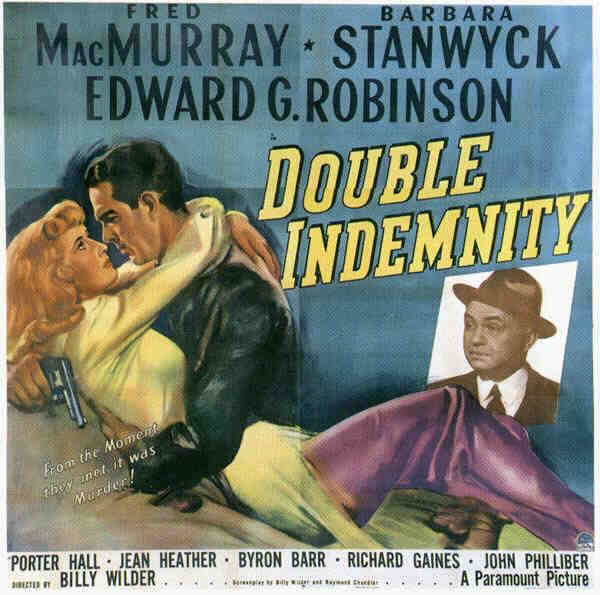
Today is Day 22 and the featured screenplay is for the 1944 movie Double Indemnity. You may read the screenplay here.
Background: Screenplay by Billy Wilder and Raymond Chandler, novel by James M. Cain
Plot summary: An insurance rep lets himself be talked into a murder/insurance fraud scheme that arouses an insurance investigator’s suspicions.
Tagline: It’s Love And Murder At First Sight!
Awards: Nominated for 7 Academy Awards including Best Writing, Screenplay
Trivia: Raymond Chandler hated the experience of writing the script with Billy Wilder so much that he actually walked out and would not return unless a list of demands was met. The studio acceded to his demands and he returned to finish the script with Wilder, even though the two detested each other.
This is the second oldest script in our current 30 Days challenge (Casablanca older by 3 years). As we all know, screenplay style has changed dramatically over time. For example, whereas current style guides dictate that we keep paragraphs of scene description to no more than 3–4 lines, there are plenty of paragraphs in Double Indemnity that are much longer, including one on P. 124 that is 24 lines.
However, I suggest you get your eye-rolling and heavy sighs of disdain over with now because DI is a sweet script with especially crackling dialogue. But the main narrative element — the descent of Walter Neff (as played by Fred MacMurray) into lust, then murder — is a great psychological study, and especially relevant for any of you who are writing stories of a Protagonist who goes through a negative transformation.
Check out this scene. When Neff first enters the Dietrichson house, he has a ‘chance’ meeting with Phyllis, he at the bottom of the stairs, she at the top of the stairs — wrapped in nothing but a towel. He proceeds into the living room, waiting for Phyllis to “put something on.” When she enters the room, Neff goes on for a bit about insurance, but then the conversation takes a turn down double entendre boulevard, one sexy juiced-up line after another. Here are the script pages for the entire scene.
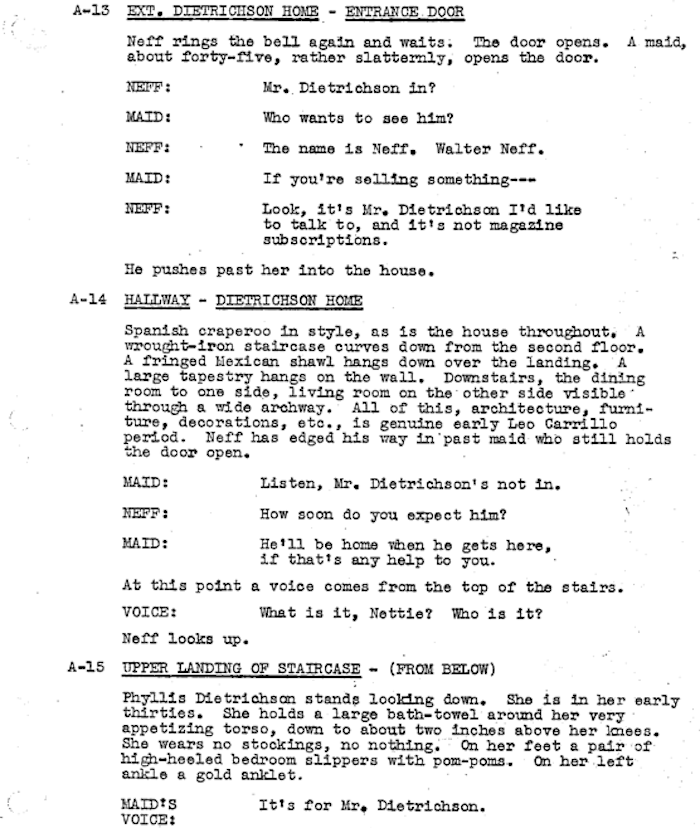
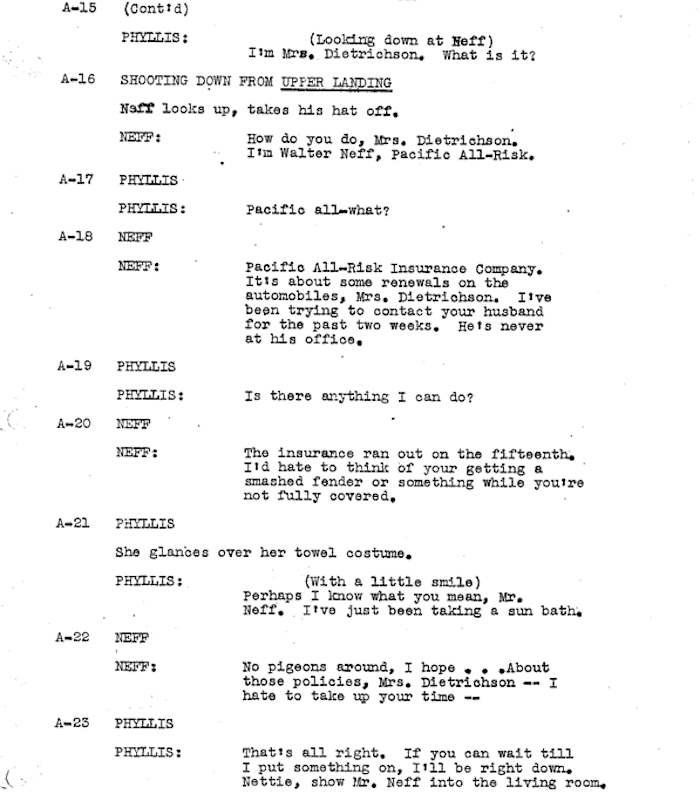
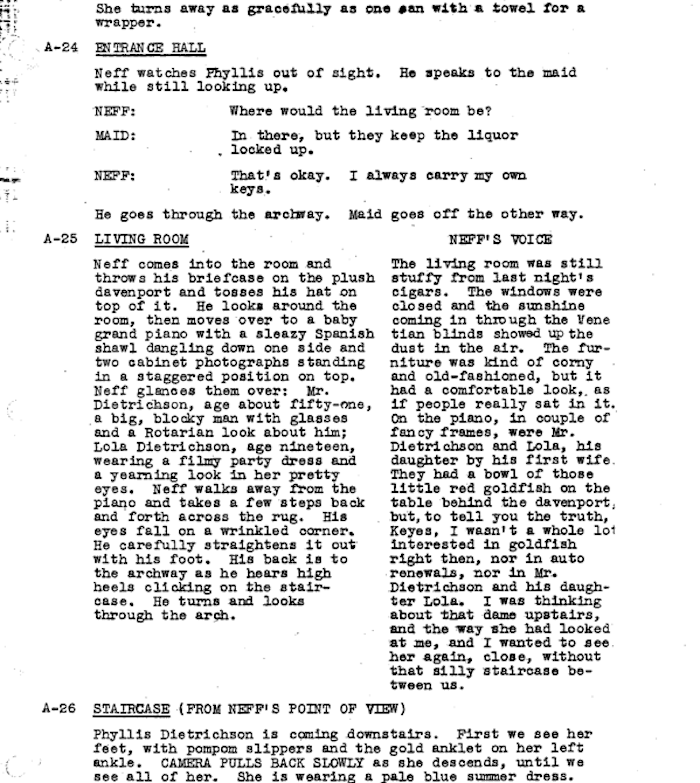
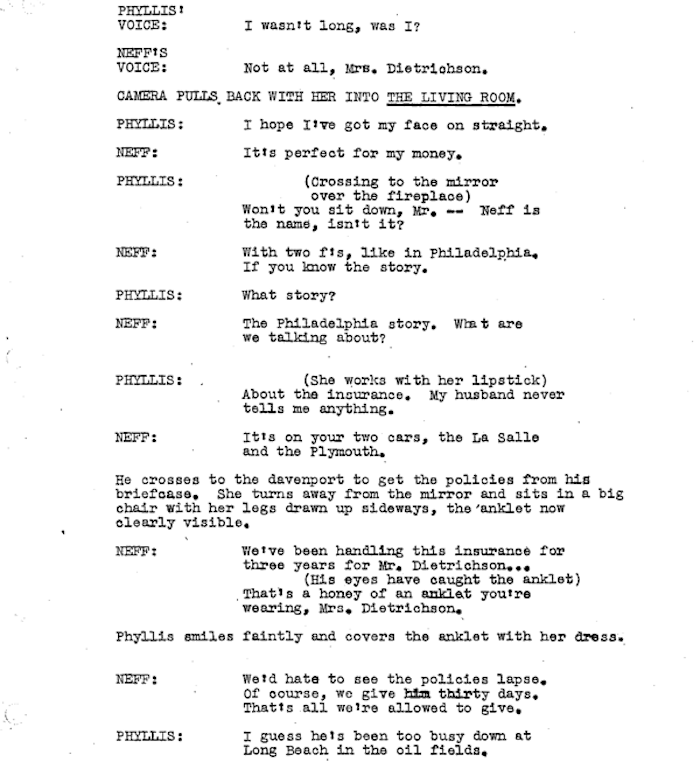
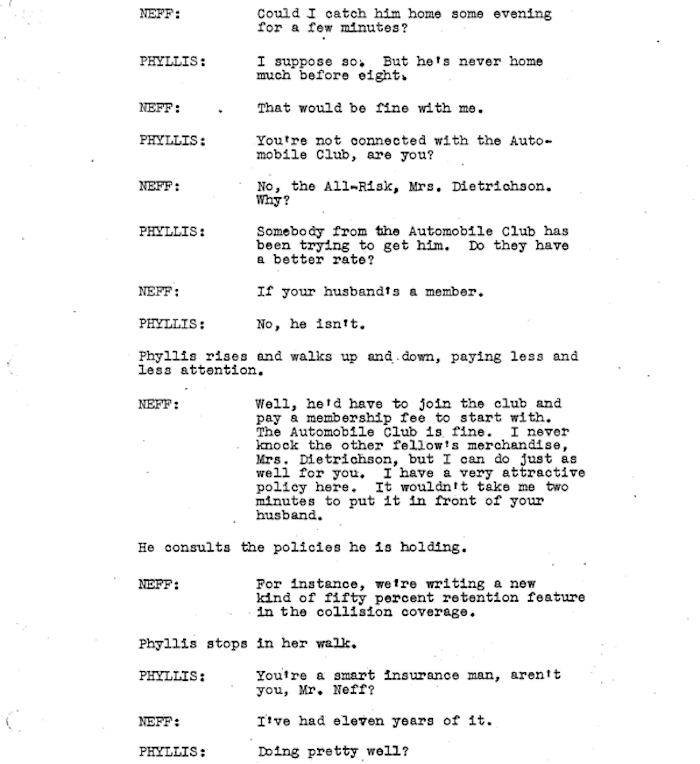
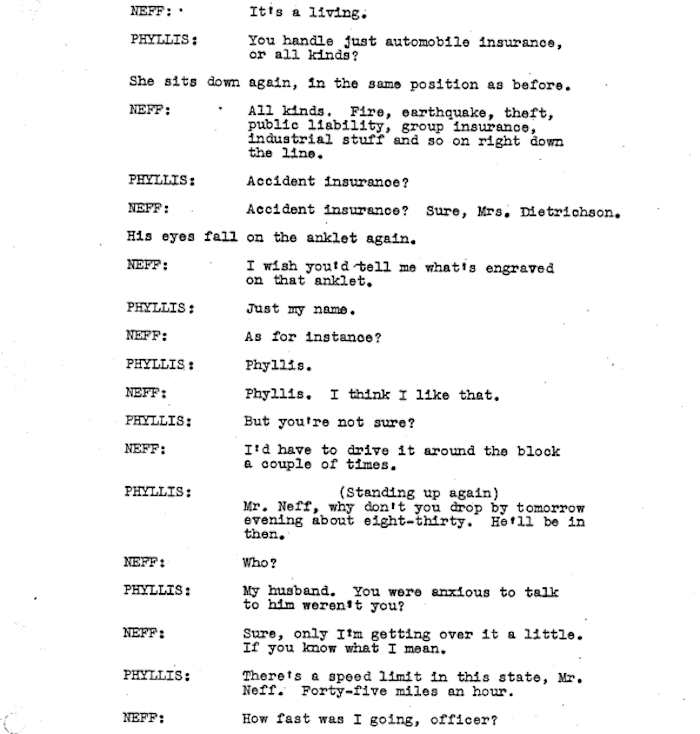
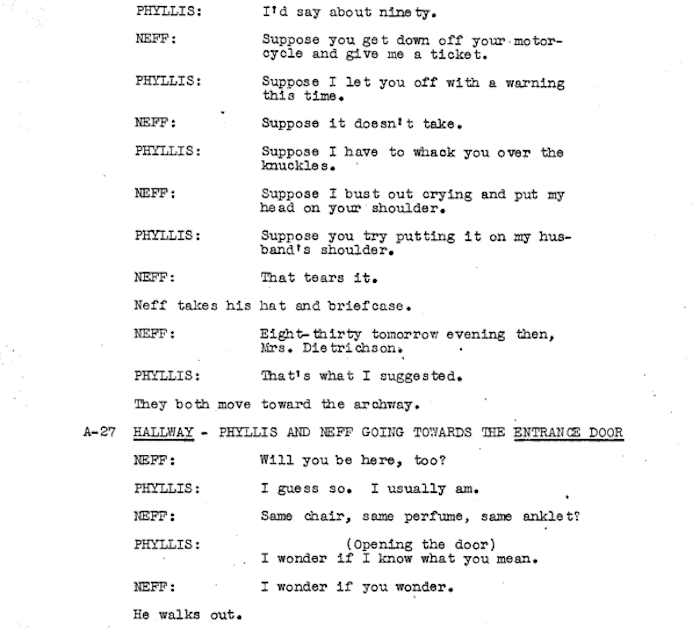
Great stuff, each character trying to top the other in their little dance of seduction. Of course, Phyllis has to play hard to get — if she immediately fell into Neff’s arms, he’d be suspicious of her motives. But this is clearly the first step in her efforts to ensnare Neff in her plan to have him kill her husband.
One interesting side note: The emergence of subtext in dialogue was hastened by the adoption of the Motion Picture Production Code in 1934. Here is a partial list of some prohibited items:
Resolved, That those things which are included in the following list shall not appear in pictures produced by the members of this Association, irrespective of the manner in which they are treated:
Pointed profanity — by either title or lip — this includes the words “God,” “Lord,” “Jesus,” “Christ” (unless they be used reverently in connection with proper religious ceremonies), “hell,” “damn,” “Gawd,” and every other profane and vulgar expression however it may be spelled;
Any licentious or suggestive nudity-in fact or in silhouette; and any lecherous or licentious notice thereof by other characters in the picture;
The illegal traffic in drugs;
Any inference of sex perversion;
White slavery;
Miscegenation (sex relationships between the white and black races);
Sex hygiene and venereal diseases;
Scenes of actual childbirth — in fact or in silhouette;
Children’s sex organs;
Ridicule of the clergy;
Willful offense to any nation, race or creed;
And be it further resolved, That special care be exercised in the manner in which the following subjects are treated, to the end that vulgarity and suggestiveness may be eliminated and that good taste may be emphasized:
The use of the flag;
International relations (avoiding picturizing in an unfavorable light another country’s religion, history, institutions, prominent people, and citizenry);
Arson;
The use of firearms;
Theft, robbery, safe-cracking, and dynamiting of trains, mines, buildings, etc. (having in mind the effect which a too-detailed description of these may have upon the moron);
Brutality and possible gruesomeness;
Technique of committing murder by whatever method;
Methods of smuggling;
Third-degree methods;
Actual hangings or electrocutions as legal punishment for crime;
Sympathy for criminals;
Attitude toward public characters and institutions;
Sedition;
Apparent cruelty to children and animals;
Branding of people or animals;
The sale of women, or of a woman selling her virtue;
Rape or attempted rape;
First-night scenes;
Man and woman in bed together;
Deliberate seduction of girls;
The institution of marriage;
Surgical operations;
The use of drugs;
Titles or scenes having to do with law enforcement or law-enforcing officers;
Excessive or lustful kissing, particularly when one character or the other is a “heavy.”
The prohibition regarding all things sexual meant that writers were forced to use innuendo and metaphors to suggest sexual themes, something we see in spades in the example here in Double Indemnity.
Here is the scene in the movie:
I don’t care what era you’re from, that’s great writing.
What’s your take on Double Indemnity? Stop by comments and post your thoughts.
To see all of the posts in the 30 Days of Screenplays series, go here.
This series and use of screenplays is for educational purposes only!
UPDATE: In a conversation with John Geraci in comments, I was reminded of the alternate ending Wilder shot for the movie. Here is Wilder explaining what it was and why he cut it:
You can read more background on the ending here. And here is the only known production still of the gas chamber set:
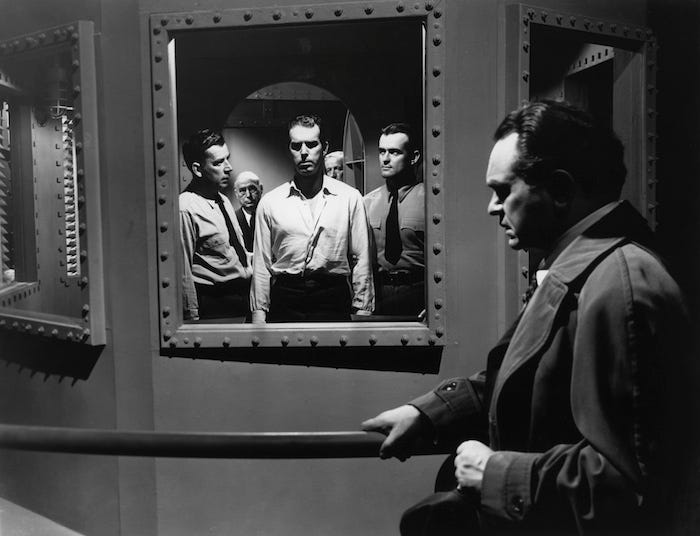
Little known fact about a noir classic.
UPDATE #2: I dug into my archives and found this interview with Wilder about the conflict he had with Raymond Chandler in writing the script. Here’s an excerpt:
WILDER: Yes. Chandler had never been inside a studio. He was writing for one of the hard-boiled serial magazines, The Black Mask — the original pulp fiction — and he’d been stringing tennis rackets to make ends meet. Just before then, James M. Cain had written The Postman Always Rings Twice, and then a similar story, Double Indemnity, which was serialized in three or four installments in the late Liberty magazine.
Paramount bought Double Indemnity, and I was eager to work with Cain, but he was tied up working on a picture at Fox called Western Union. A producer-friend brought me some Chandler stories from The Black Mask. You could see the man had a wonderful eye. I remember two lines from those stories especially: “Nothing is emptier than an empty swimming pool.” The other is when Marlowe goes to Pasadena in the middle of the summer and drops in on a very old man who is sitting in a greenhouse covered in three blankets. He says, “Out of his ears grew hair long enough to catch a moth.” A great eye… but then you don’t know if that will work in pictures because the details in writing have to be photographable.
I said to Joe Sistrom, Let’s give him a try. Chandler came into the studio, and we gave him the Cain story Double Indemnity to read. He came back the next day: I read that story. It’s absolute shit! He hated Cain because of Cain’s big success with The Postman Always Rings Twice.
He said, Well, I’ll do it anyway. Give me a screenplay so I can familiarize myself with the format. This is Friday. Do you want it a week from Monday?
Holy shit, we said. We usually took five to six months on a script.
Don’t worry, he said. He had no idea that I was not only the director but was supposed to write it with him.
He came back in ten days with eighty pages of absolute bullshit. He had some good phrases of dialogue, but they must have given him a script written by someone who wanted to be a director. He’d put in directions for fade-ins, dissolves, all kinds of camera moves to show he’d grasped the technique.
I sat him down and explained we’d have to work together. We always met at nine o’clock, and would quit at about four-thirty. I had to explain a lot to him as we went along, but he was very helpful to me. What we were doing together had real electricity. He was a very, very good writer — but not of scripts.
One morning, I’m sitting there in the office, ten o’clock and no Chandler. Eleven o’clock. At eleven-thirty, I called Joe Sistrom, the producer of Double Indemnity, and asked, What happened to Chandler?
I was going to call you. I just got a letter from him in which he resigns.
Apparently he had resigned because, while we were sitting in the office with the sun shining through, I had asked him to close the curtains and I had not said please. He accused me of having as many as three martinis at lunch. Furthermore, he wrote that he found it very disconcerting that Mr. Wilder gets two, three, sometimes even four calls from obviously young girls.
Naturally. I would take a phone call, three or four minutes, to say, Let’s meet at that restaurant there, or, Let’s go for a drink here. He was about twenty years older than I was, and his wife was older than him, elderly. And I was on the phone with girls! Sex was rampant then, but I was just looking out for myself. Later, in a biography he said all sorts of nasty things about me — that I was a Nazi, that I was uncooperative and rude, and God knows what. Maybe the antagonism even helped. He was a peculiar guy, but I was very glad to have worked with him.
And here is a 1945 interview with Chandler. An excerpt about Hollywood:
I have worked there a little over two years, which is far from enough to make me an authority, but more than enough to make me feel pretty thoroughly bored. That should not be so. An industry with such vast resources and such magic techniques should not become dull so soon. An art which is capable of making all but the very best plays look trivial and contrived, all but the very best novels verbose and imitative, should not so quickly become wearisome to those who attempt to practice it with something else in mind than the cash drawer. The making of a picture ought surely to be a rather fascinating adventure. It is not; it is an endless contention of tawdry egos, some of them powerful, almost all of them vociferous, and almost none of them capable of anything much more creative than credit-stealing and self-promotion.
Hollywood is a showman’s paradise. But showmen make nothing; they exploit what someone else has made. The publisher and the play producer are showmen too; but they exploit what is already made. The showmen of Hollywood control the making — and thereby degrade it. For the basic art of motion pictures is the screenplay; it is fundamental, without it there is nothing. Everything derives from the screenplay, and most of that which derives is an applied skill which, however adept, is artistically not in the same class with the creation of a screenplay. But in Hollywood the screenplay in written by a salaried writer under the supervision of a producer — that is to say, by an employee without power or decision over the uses of his own craft, without ownership of it, and, however extravagantly paid, almost without honor for it.
Must have been fun times in that office with Wilder and Chandler!
To see all of the posts in the 30 Days of Screenplays series, go here.
This series and use of screenplays is for educational purposes only!