30 Days of Screenplays — Day 2: “Witness”
Read 30 movie scripts in 30 days.
Read 30 movie scripts in 30 days.
Why?
Because whether you are a novice just starting to learn the craft of screenwriting or someone who has been writing for many years, you should be reading scripts.
There is a certain type of knowledge and understanding about screenwriting you can only get from reading scripts, giving you an innate sense of pace, feel, tone, style, how to approach writing scenes, how create flow, and so forth.
So each day this month, I will provide background on and access to a notable movie script.
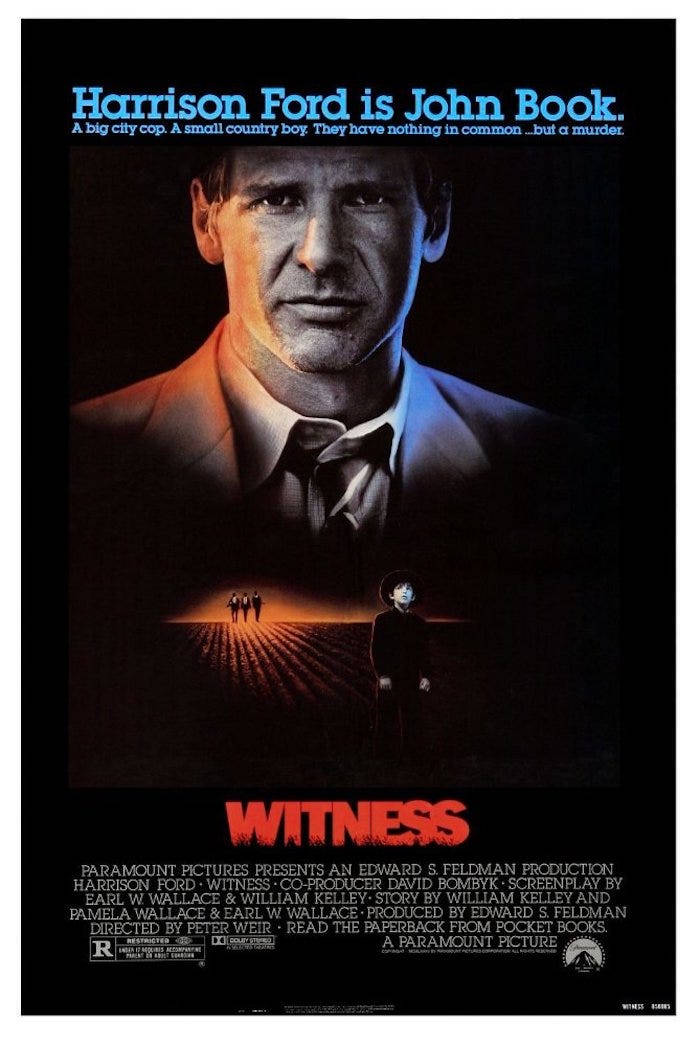
Today is Day 2 and the featured screenplay is for the movie Witness (1985). You may read the script here.
Background: Witness was written by Earl W. Wallace and William Kelley (screenplay), and William Kelley and Pamela Wallace & Earl W. Wallace (story). The movie currently has a 7.4 rating on IMDB.
Plot summary: A young Amish boy is sole witness to a murder; policeman John Book goes into hiding in Amish country to protect him until the trial.
Tagline: Harrison Ford is John Book — A big city cop who knows too much. His only evidence: a small boy who’s seen too much…
Awards: Winner of WGA Best Screenplay Written Directly for the Screen Award, nominated for 8 Academy Awards, winning two including Best Writing, Screenplay Written Directly for the Screen
Trivia: The original screenplay focused mainly on Rachel, but director Peter Weir asked screenwriters William Kelley and Earl W. Wallace to rewrite it to focus on the comparison of pacifism and violence as seen through the eyes of John Book.
The trivia note above is most interesting to bear in mind as you read the script, remembering that the original story featured Rachel (Kelly McGillis) as the story’s Protagonist, but that point-of-view shifted to John Book’s character, played by Harrison Ford.
It’s been said that Casablanca was a B-story with an A-script. It’s interesting to think of Witness in that way as the premise, while a strong one, does feel rather manufactured. However the script is written with a great deal of empathy and understanding of the Amish experience. Moreover it deftly handles the respective psychological journeys John and Rachel take in this compelling fish-out-of-water story, especially through their emerging romance.
OBSERVATIONS: Reading Witness drives home one of the most fundamental questions a reader asks as they work their way through the beginning of a script: Who is the Protagonist?
Often we’re tipped off because the P is the first (or one of the first) characters introduced in the story. But that’s not the case in Witness. John Book is not introduced until P. 11.
Sometimes we can identify the Protagonist because they are the key character in the plot. In this respect, Witness does a sleight of hand. In the first 4 pages, the focus is on Rachel Lapp and the proceedings of the Amish community involving the death of Rachel’s husband. Once the action moves to the train station in Philadelphia, the narrative point of attack switches to Samuel, culminating in him being a witness to a murder. But as detailed in the trivia note above, the movie’s director Peter Weir worked with screenwriters Kelly and Wallace to turn Book’s character into the story’s Protagonist, wanting to emphasize how a man from a violent world (being a cop) copes after being thrust into a pacifist environment (the Amish community).
That said another sign of a Protagonist character is to answer this question: Who goes through the most significant psychological, emotional, and/or spiritual metamorphosis? And this is one area where the script shines, deftly tracking both John and Rachel’s journeys, benefiting from their emerging romance which naturally ties the pair together.
Another aspect of Witness that is interesting is to ask, “What is the Act 1 end?” It’s not when Samuel witnesses the murder. It’s not when Samuel identifies another McElroy and John realizes he’s dealing with a bad cop. It’s not when John is shot by McElroy. Rather it’s when John returns Rachel and Samuel to their home, lapses into unconsciousness and crashes his car, then ends up recuperating in the Amish community. That is the central conceit of the story and therefore has to be established before the beginning of the story is complete.
Which means that the end of the story’s set-up in Witness does not take place until P. 40! Too long by current standards? Perhaps.
One final observation: Witness is one of those movies where the five primary character archetypes — Protagonist, Nemesis, Attractor, Mentor, Trickster — are easily identifiable.
Protagonist — John Book
Nemesis — Schaeffer, McElroy (McFee in the movie), Carter
Attractor — Rachel
Mentor — Eli, Amish community
Trickster — Samuel
What does John Book want (P)? To bust the bad cops in order to keep the Lapp family safe.
Who stands in the way of his goal (N)? The bad cops led by Schaeffer.
Who is most tied to Book’s emotional development (A)? Rachel via their romance.
Who is most tied to Book’s intellectual development (M)? Eli with his Amish wisdom, the Community
Who tests Book, sometimes his ally, sometimes his enemy (T)? Samuel.
Let’s look more closely at Samuel’s role as Trickster.
Often Trickster characters seem to have an instinct to create problems or a magnetic pull toward complications and Samuel fits the bill. It is he who happens to see the murder in the train bathroom. He identifies McFee as the murderer. That eventually results in Book’s shooting and his resulting recovery time on the Lapp farm. Once there, Samuel is fascinated with Book’s gun and that gets Book into trouble with Rachel. Throughout Act II, Samuel represents both Amish innocence and the potential for corruption, and Book must fight sharing his rather paternal instincts, grounded in his urban experience, with Samuel so as to avoid leading the boy astray. It is with Samuel that Book is put to the test in terms of what he learns about Amish pacifism, a lesson once fully embraced becoming the key to disarming a potentially murderous standoff at the story’s end.
Enjoy reading Witness and come back here to post your observations.
To see all of the posts in the 30 Days of Screenplays series, go here.
This series and use of screenplays is for educational purposes only!