30 Days of Screenplays, Day 19: “Gravity”
Why read 30 screenplays in 30 days?
Why read 30 screenplays in 30 days?
Because whether you are a novice just starting to learn the craft of screenwriting or someone who has been writing for many years, you should be reading scripts.
There is a certain type of knowledge and understanding about screenwriting you can only get from reading scripts, giving you an innate sense of pace, feel, tone, style, how to approach writing scenes, how create flow, and so forth.
We did 30 Days of Screenplays in 2013 and you can access each of those posts and discussions here. This time, we’re trying something different: I invited thirty Go Into The Story followers to read one script each and provide a guest post about it.
Today’s guest columnist: Sarah Grimes.
Title: Gravity. You may read the screenplay here.
Year: 2013
Writing Credits: Alfonso Cuarón and Jonás Cuarón (George Clooney is also noted as an uncredited “Script Coordinator”)
IMDB rating: 8.1
IMDB plot summary: A medical engineer and an astronaut work together to survive after a catastrophe destroys their shuttle and leaves them adrift in orbit.
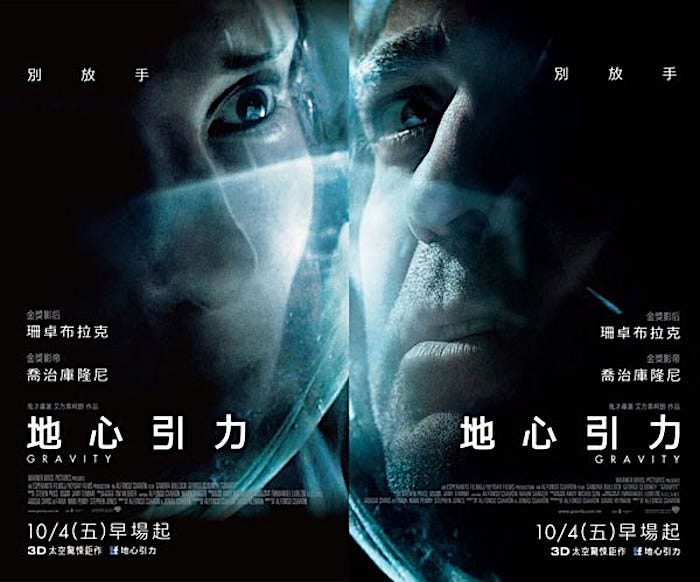
Tagline: Don’t Let Go.
Awards:
Nominated for a BAFTA Film Award for Best Original Screenplay;
Nominated for a Saturn Award for Best Writing;
Nominated for a Hugo Award for Best Dramatic Presentation (Long Form);
Nominated for an Image Award for Outstanding Writing in a Motion Picture;
Nominated for a PFCS Award for Best Original Screenplay;
Nominated for an SFFCC Award for Best Original Screenplay;
Nominated for a Bradbury Award by the Science Fiction and Fantasy Writers of America.
Analysis: Reading this script was a vastly different experience from seeing the movie. That seems obvious because reading in itself is a different experience from film or television viewing, but I say this for a few different reasons because there were certain things that stood out to me when I tried to analyze this script.
In particular was the fact that I found it difficult to decipher the beginning and end of certain scenes and sequences. It seems strange to me that I experienced those issues, but the overall lack of subplots, character interaction and location changes made it hard to distinguish when a certain scene was ending or a new one was beginning (as it all seemed to mesh together). Another thing that became more obvious to me while reading this script was the passage of time portrayed in the story because of the continuous nature of the action occurring. It didn’t feel as believable when I was reading the script that so much time had passed from when Ryan first detached from Explorer to when she arrived at the ISS with Kowalski. Granted, the concept of “Earth” time is something that doesn’t exist in space, but it seemed less feasible while reading the script that more than an hour had passed during their travels, as opposed to how I experienced it while watching the film.
Something else I noticed while reading the script was how the scene in the ISS when the fire broke out felt forced (pages 56–58). Then again, I actually felt that way when I saw the film, but it stood out even more to me when I read the script. Did the fire start because she opened the oxygen valves? It’s not made clear, but it seems like its only purpose was to force her to leave the ISS and not for any other reason. Granted, she needed to leave the ISS to try to make it home, but do I think the fire needed to happen in order for her to make a try for it? I can’t say for sure. I wonder to myself what choice she would have made if she wasn’t forced to leave. The scene just felt like an extra obstacle that really didn’t need to happen (as I’m sure no one would question the difficulty of traveling to Earth from outer space being in the position she was in).
Additionally, I experienced much less anxiety while reading the script than I did when watching the film. This could very likely be because I already knew the direction of the film and how Ryan’s journey would resolve, but when I saw this movie in theaters, I was literally clenching my fists practically throughout the entire film, which I didn’t experience at all during my readings.
Also, when I first saw the film, I was completely drawn to Ryan’s character and was extremely invested in her journey, however, I did not share those sentiments at all while reading the script. I was so distracted with trying to visualize the scene descriptions that her emotional journey was completely out of focus. I wonder if my feeling that way has anything to do with the fact that the film is intended to be more of a visual experience. That being said, most of the metaphors for Ryan’s characters “rebirth” are visualized in the film, not stated in dialogue (with the exception of Kowalski telling her she has to let go and move on after the loss of her daughter, and also, her stating that it’s going to be a hell of a ride and that she’s ready for it), and I didn’t find it as compelling to read the descriptions of her being “reborn” as I did when it was visualized on the screen.
For example, there are multiple references to her being in the “womb” when she first makes it to the ISS on pages 51–52. It’s referenced at least twice. There is also a description of her curling up in a fetal position, which was visualized in the film. In addition, Ryan’s descent through the atmosphere when she lands in the lake in the escape pod is another visual representation of her “rebirth.” The visual representation of these metaphors were much more compelling to see than read.
Most Memorable Dialogue:
Page(s) 93–94
Ryan: Houston, Houston in the blind, this is Mission Specialist Ryan Stone reporting from the Shenzhou. I’m about to undock from Tiangong… and I have a bad feeling about this mission. [laughs] Reminds me of a story… [screams] Never mind, Houston, never mind the story! Ah. It’s starting to get hot in here. The way I see it, there are only two possible outcomes. Either I make it down there in one piece and I have one hell of a story to tell! Or I burn up in the next ten minutes. Either way, whichever way… no harm, no foul! [growls] Because either way, it’s going to be one hell of a ride! I’m ready.
Page(s) 31–32
Ryan: Can they hear us on an alternate frequency?
Matt: We don’t know. That’s why we keep talking. If someone is listening they might just save your life. Set your watch for ninety minutes.
Most Memorable Moments: I’d have to say that the scene in Act II (pages 69–74) in which Ryan attempts to communicate with the man (Aningang) who couldn’t speak English was one of the most memorable moment for me. This particular moment is a pivotal point for Ryan because she has finally realized how alone she is, not just because of where she physically is at the moment, but in life. Losing her daughter seemingly caused her to her alienate herself from others, and as such, she is now facing her perceived reality that her death will be meaningless.
I also found it to be a heartfelt moment when she and the man were imitating his dogs barking because it provided a well-needed break in the tension of the previous scenes. It demonstrated a different side of her that had yet to be witnessed, which provided the reader with more insight into her character.
What Did I Learn About Screenwriting From Reading This Script: Reading this script helped reinforce the power of visual storytelling to convey meaning to the reader/audience, especially with respect to visually conveying thematic elements of the story.
In addition, I also feel that this script provided great examples of how to create strong feelings of tension and anxiety because of the way certain of the action scenes were relentless with respect to the emotional toll placed on Ryan’s character.
Thanks, Sarah! To show our gratitude for your guest post, here’s a dash of creative juju for you. Whoosh!
To see all of this year’s 30 Days of Screenplays: Vol. 2, go here.
30 Days of Screenplays: Vol. 1
For my deep dive analysis of Gravity (26 minute read), go here.