30 Days of Screenplays, Day 18: “North by Northwest”
Why 30 screenplays in 30 days?
Why 30 screenplays in 30 days?
Because whether you are a novice just starting to learn the craft of screenwriting or someone who has been writing for many years, you should be reading scripts.
There is a certain type of knowledge and understanding about screenwriting you can only get from reading scripts, giving you an innate sense of pace, feel, tone, style, how to approach writing scenes, how create flow, and so forth.
So each day this month, I will provide background on and access to a notable movie script.
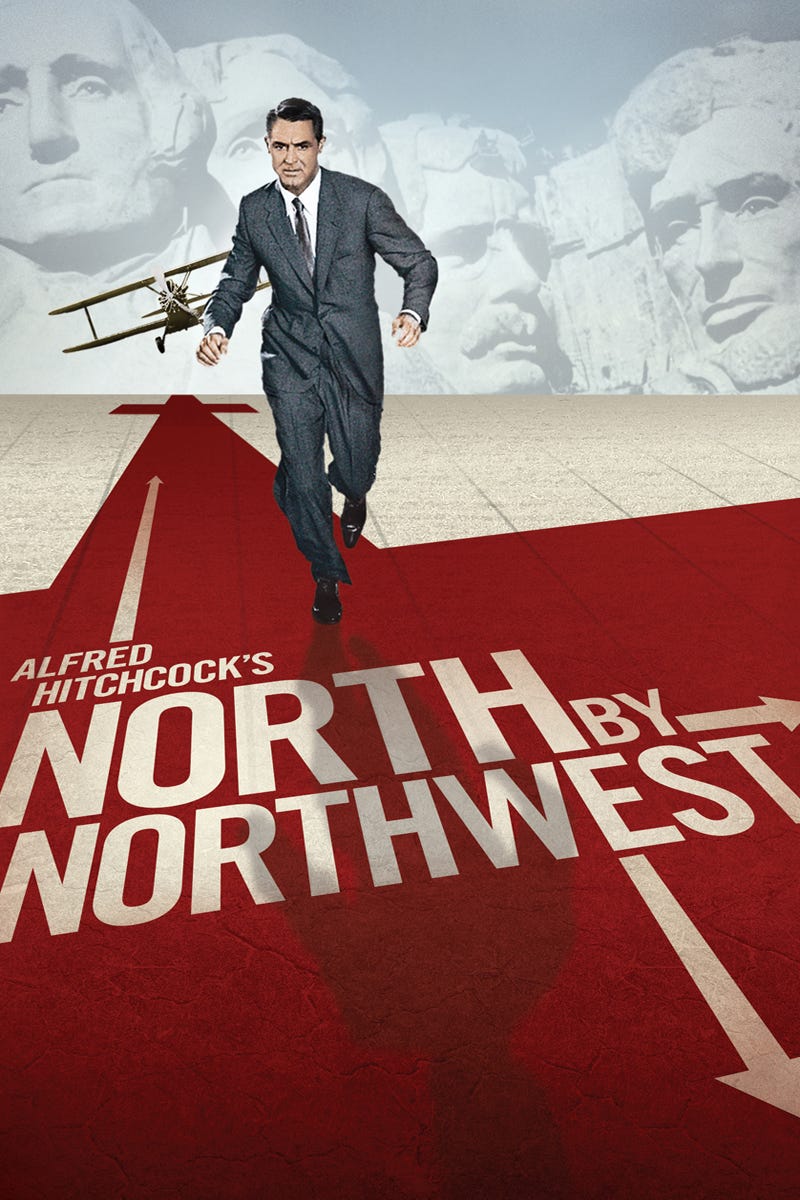
Today is Day 18 and the featured screenplay is for the movie North by Northwest. You may download a PDF the script here.
Background: Original screenplay written by Ernest Lehman.
Plot summary: A hapless New York advertising executive is mistaken for a government agent by a group of foreign spies, and is pursued across the country while he looks for a way to survive.
Tagline: The Master of Suspense presents a 2000-mile chase across America!
Awards: Screenplay nominated for an Academy Award and WGA Award.
Trivia: It was journalist Otis L. Guernsey Jr. who suggested to Alfred Hitchcock the premise of a man mistaken for a nonexistent secret agent. He was inspired, he said, by a real-life case during WW II, known as Operation Mincemeat, in which British intelligence hoped to lure Italian and German forces away from Sicily, a planned invasion site. A cadaver was selected and given an identity and phony papers referring to invasions of Sardinia and Greece. A British film, The Man Who Never Was (1956), recounted the operation.
I know, I know. You think you’ll hate me for having you read a 179-page script. Plus most of the overage is due to scene description which, we all know, is more laborious to read than dialogue (with its narrower margins).
But it’s worth wading through all that scene description because it represents a storyboard in screenplay form. Every camera shot right there in the script. In fact, here is screenwriter Lehman describing how he wrote the movie’s famous crop-dusting scene:
Hitch and I acted out the entire crop-dusting sequence in his living room. Then I incorporated every move into the script, and that was the way he shot it.
Storyboarding is really an illustrator’s work for the director. A motion picture illustrator puts pictures on paper and puts them on boards. In story-boarding a script for a Hitchcock film, the illustrator is told what pictures to put on the boards by the script, which has benefited from my conferences with the director. Of course, I participate in what is going to appear on that storyboard, because even without the storyboard the script describes exactly what is going to be on the screen. Hitch would have it no other way. The script even describes the size of the shot, whether it’s a medium or a tight close-up, whether the camera pulls back and pans to the right as the character walks toward the door, whether it tilts slightly down and shoots through the open doorway, getting the helicopter as the lights go on outside. That’s why Hitch says it’s a bore for him to get the picture on the screen, because it has all been done already in his office.
It’s interesting to note that Lehman wasn’t entirely satisfied with the script as he thought there were “holes” in the plot. See if you can find them during your read of North by Northwest.
From a previous discussion, Go Into The Story reader oys thinks he has spotted some:
One thing I find strange in the movie. Why should Vandamm send Thornhill to somewhere near the crop field to kill him, when he can send his people to enter Eve’s room and kill Thornhill? Or at the train station after Thornhill got through the police? I mean, they managed to kill someone in the UN building, so why not at the train station?
Well, of course, we all know the answer: Because one of Hitchcock’s inspirations for the movie was he wanted to shoot a scene where a guy gets chased by an airplane in a corn field. But that rationale is outside the story, not inside, as if Hitchcock believed that the love story and big set pieces in the movie would cover up any plot holes.
It starts right at the beginning, the entire set of circumstances that lead to First Man and Second Man mistaking Thornhill to be George Kaplan. In order to make this moment work:
- Thornhill has to be in an awful hurry so that he mistakenly tells his secretary to call his mother (he has to tell her this to provide the necessary exposition to the reader to establish Thornhill’s immediate need)
- Thornhill just happens to enter the exact location where First Man and Second Man are waiting to find George Kaplan, also just happens to be at the exact same time
- Kaplan’s mother can not be reached by phone because she ‘s playing bridge at a friend’s place
- Her friend’s place just happens to be freshly painted so there is [inexplicably] no telephone
- Just as Thornhill realizes he needs to get a message to his mother, the pageboy enters the room calling out for Kaplan
- Thornhill signals to the boy, appearing to First Man and Second Man that he [Thornhill] is Kaplan
Okay, that’s a lot of stuff to set up the first part of Thornhill’s mistaken identity. But then there’s more:
- Thornhill asks the bellboy to “get a wire” off to his mother, but the bellboy announces that he’s “not permitted to do that,” offering to lead Thornhill [presumably] to the place where Thornhill can send a wire to his mother
Why this beat? Because Hitchcock needs Thornhill to move from a more public place to a quieter location enabling First Man and Second Man to kidnap Thornhill
And so First Man and Second Man, using their guns to force the issue, order Thornhill outside and into a waiting car — and not once do they ask for some sort of identification from Thornhill to prove that he is, indeed, Kaplan.
I bought it the first time I saw the movie. I bought it the first time I read the script. But not this time. Extracting the names “Lehman” and “Hitchcock” from the equation, if this had been a set-up penned by one of my students, I would have told them it’s too complicated, too many moving parts, too much in the way of coincidence, especially in light of this one simple fact:
If a reader doesn’t buy the chain of events leading to Thornhill being mistaken to be Kaplan, you have no movie! In a way, it’s the single most critical plot point in the story so it’s absolutely imperative the writer nail it.
But then, there’s nailing it… and nailing it. And on one level, that is, someone watching the movie for the first time, the moment seemingly works (how else to explain Academy Award nominations for the script). But even Lehman had concerns about the opening. In his own words:
Once I decided Cary Grant had been mistaken for a nonexistent man called George Kaplan, my first problem was how to do this. It’s a very hairy thing in this film. I once showed the film to a class at Dartmouth College. After we ran it, I asked them how many understood how he had been mistaken for George Kaplan, and only half of the students said they understood. It wasn’t really done properly in the film, either by me or Hitch. It was a little too subtle.
In the end, it worked well enough. And the airplane scene… Mt. Rushmore… Cary Grant and James Mason… all of that was doubtless what moviegoers remembered and talked about, not the mistaken identity plot point. And as I suggested, I believe Hitchcock knew that would be the case as well. In other words, don’t sweat the opening, just get the story moving.
Nonetheless, we have a takeaway: We’re not Lehman and we don’t have the power and sway of Hitchcock behind us, so we must write set-ups that are locked down air tight.
What’s your take on North by Northwest? Stop by comments and post your thoughts.
To see all of the posts in the 30 Days of Screenplays series, go here.
This series and use of screenplays is for educational purposes only!