30 Days of Screenplays, Day 15: “Nebraska”
Why read 30 screenplays in 30 days?
Why read 30 screenplays in 30 days?
Because whether you are a novice just starting to learn the craft of screenwriting or someone who has been writing for many years, you should be reading scripts.
There is a certain type of knowledge and understanding about screenwriting you can only get from reading scripts, giving you an innate sense of pace, feel, tone, style, how to approach writing scenes, how create flow, and so forth.
We did 30 Days of Screenplays in 2013 and you can access each of those posts and discussions here. This time, we’re trying something different: I invited thirty Go Into The Story followers to read one script each and provide a guest post about it.
Today’s guest columnist: Greg Scharpf.
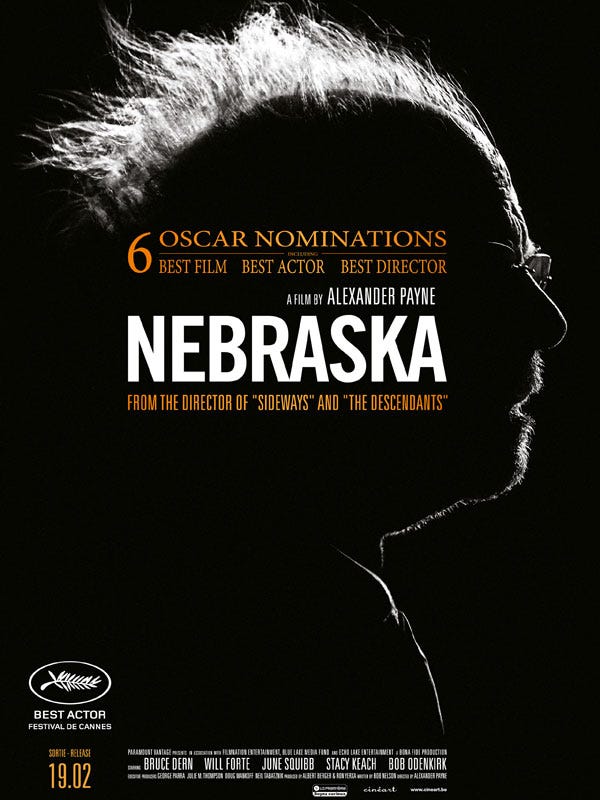
Title: Nebraska. You may read the screenplay here.
Year: 2013
Writing Credits: Bob Nelson
IMDB rating: 7.8
IMDB plot summary: An aging, booze-addled father makes the trip from Montana to Nebraska with his estranged son in order to claim a million-dollar Mega Sweepstakes Marketing prize.
Tagline: IMDB didn’t appear to have a tagline listed, but here’s mine…
There’s here. There’s now. And, there’s Nebraska.
Awards: Nominated for 6 Academy Awards including Best Original Screenplay.
Analysis: The first time I saw NEBRASKA, what most intrigued me about it was that it was a story about a man nearing death, who, in his own way, was dealing with the reality of his own mortality.
“Nebraska,” from a thematic standpoint, was more than just a state that held Woody’s fake winnings. It was Woody’s last opportunity to be all that he could be as a man. It was his last opportunity to leave something of value behind to the people closest to him.
And, when I dug into the script after the fact, I still found that theme to be visible and intriguing, but I also began to be equally intrigued by the theme of trust and believability.
Has Woody been this gullible his whole life? Several different family members and friends continually point to him being too kind and that “He believes stuff people tell him.” Or that he “Couldn’t say no to anybody. And, that ruined him.”
Or, is Woody simply a product of his generation? Older people falling prey to scam artists doesn’t seem to be anything that’s unique to this day and age, but perhaps in Woody’s day, before social media was bombarding us day and night with scams, it was a little easier to believe someone or something. Maybe it’s a combination of a man being a bit too trusting of others, finding himself in an age that’s less trusting of others. And, add in a dash of what happens to our brains chemically as we age and we have a story where a fantasy has become reality. And, that fantasy, although a fantasy, is a heartbreaking, but beautiful story about a father and son getting an opportunity to spend some time together.
Most Memorable Dialogue: The scene right after David punches out Ed Pegram in the bar and he’s basically at his wits end with Woody because after all that’s happened, Woody still wants to go to Nebraska. Up to this point, the dialogue has been kept pretty terse which makes this scene stand out a bit.
And, in this moment we see a bit more of Woody’s motives for traveling across country…
DAVID: Goddammit! You didn’t win! Can’t you get that through your head? You did not win anything! And we’re not driving all the way to Lincoln over a stupid fantasy! It’s my own damn fault for bringing you this far!
Woody slumps against a building, looks away.
DAVID: You’ve got enough money to get by. You can’t drive. What’s the point?
WOODY: I want a truck.
DAVID: Why do you need a truck so bad?
WOODY: Just to have it. I always wanted a brand new truck.
DAVID: What about the rest of the money? You don’t need a million dollars for a damn pickup truck.
Woody is still turned away.
WOODY: That money’s for you boys. I wanted to leave you something.
DAVID: We’re fine, Dad. We don’t need it.
WOODY: I just want to leave you something.
I found this to be a really beautiful reveal about Woody and his plight. At its core, it’s a father just trying to provide for his family.
Most Memorable Moments: Towards the very end when David trades in his car for a newer truck that he puts in Woody’s name, he gets a new compressor and then he lets Woody drive the truck through his old town. Although Woody never got his million dollars, for a brief moment he experiences riding through his old town, waving to the people he knows while driving this new truck. It’s Woody’s moment to shine. And, right before this, David tells Woody that the truck is in his name. Woody goes: “You work something out with those
prize people?” and David takes a long look at his father, wondering how to respond.
DAVID: Yeah. They were willing to go as far as a truck.
In his mind, Woody has succeeded. It plays out to be one of those really great movie moments and all it is, is a guy driving a truck down the street. Truly a situation where simplicity lends itself towards something large.
What Did I Learn About Screenwriting From Reading This Script: Speaking of simplicity, Bob Nelson’s script is written with very simple scene descriptions and very terse dialogue, all of which add a great deal of nuance to the story.
The subtle “small” moments keep you guessing and really make the “larger” moments all the more powerful. Not to get cliche, but sometimes less truly is more. A good lesson on writing that I was reminded of when I read this script.
Thanks, Greg! To show our gratitude for your guest post, here’s a dash of creative juju for you. Whoosh!
To see all of this year’s 30 Days of Screenplays: Vol. 2, go here.