30 Days of Screenplays, Day 14: “Tinker Tailor Soldier Spy”
Why read 30 screenplays in 30 days?
Why read 30 screenplays in 30 days?
Because whether you are a novice just starting to learn the craft of screenwriting or someone who has been writing for many years, you should be reading scripts.
There is a certain type of knowledge and understanding about screenwriting you can only get from reading scripts, giving you an innate sense of pace, feel, tone, style, how to approach writing scenes, how create flow, and so forth.
We did 30 Days of Screenplays in 2013 and you can access each of those posts and discussions here. This time, we’re trying something different: I invited thirty Go Into The Story followers to read one script each and provide a guest post about it.
Today’s guest columnist: Pedro Santos.
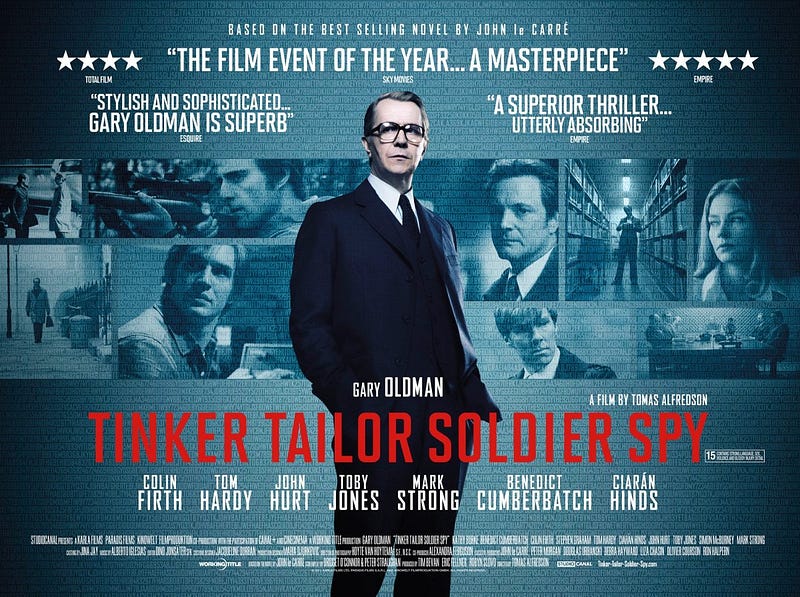
Title: Tinker Tailor Soldier Spy. You may read the screenplay here.
Year: 2011
Writing Credits: Bridget O’Connor & Peter Straughan, based on the novel by John le Carré.
IMDB rating: 7.1
IMDB plot summary: In the bleak days of the Cold War, espionage veteran George Smiley is forced from semi-retirement to uncover a Soviet agent within MI6.
Tagline: Trust no one. Suspect everyone.
Awards: Nominated for Academy Awards 2012, Best Adapted Screenplay; won the BAFTA Awards 2012 — Best Adapted Screenplay.
Analysis: The story depicts the backstage of the spy game that took place during the bleak days of Cold War. The screenplay is quite a good piece of writing that can be read as a novel. The scenes are developed in order to make the plot grow. Even if some of them seem to have too much description sometimes, the story in general is fast-paced.
Moreover, the narrative seems to be more cerebral than anything else, which is fair accordingly to the world of the story. We are in a secret war that can be compared with a chess game (which is also used as metaphor in the middle of the screenplay). That’s the reason why each scene of this puzzle — and also other elements like the structure, the plot and the character arc — follow this pattern, making us believe we are watching a chess game with really powerful players.
“Tinker Tailor Soldier Spy” seems to be more about the lifestyle of the characters during the tough times of our recent history, than about solving the plot. In a way, it can be considered a character study.
Most Memorable Dialogue:
SMILEY: (to the chair) Look, we’ve both spent our lives looking for the weaknesses in one another’s systems. Don’t you think it’s time to recognize there is as little worth on your side as there is on mine?
Silence. Smiley sits back, dropping the game.
SMILEY: (CONT’D) Never said a word. Not one word. Next morning he got back on his plane, gave the pack of cigarettes back to me, untouched — this was a chain-smoker, mind — and flew off to what he presumed would be his death. He kept my lighter. It was a gift — “To George, from Ann. All my love.”
Guillam is still staring at the chair, a little awe-struck.
PETER GUILLAM: That was Karla? And he flew back to die rather than give in?
SMILEY: Yes. (Beat) And that’s how I know he can be beaten. Because he’s a fanatic. And the fanatic is always concealing a secret doubt.
PETER GUILLAM: What did he look like?
SMILEY: That’s the thing. (Beat) I can’t remember.
Most Memorable Moments: Let’s take a look in two memorable scenes of the story:
1) The scene in Budapest:
The WAITER starts, turns, sees Prideaux leaving. Panic
flashes across his face, he draws a GUN from the back of
his belt, aims after Prideaux and FIRES - the shot echoing
in the cavernous space.
(…)
Behind him we can see the breast-feeding MOTHER. She’s dead,
a bullet hole in the centre of her forehead from the ricochet.
The baby continues to suckle on, undisturbed. Through the cafe
window we can see a MAN, partly obscured by the crowd in front
of us, the only man still seated. He lights a cigarette.
2) The scene inside a school, when the character Prideaux are
in the middle of a class teaching small children when…
Then from the CHIMNEY comes an unnerving SCRABBLING sound. A
little soot falls...
The sniggering fades out as all eyes turn nervously to the fire...
what is that noise?Then, with a terrifying SCREECH, an OWL drops down into the grate,
thrashes in the flames before flapping out into the class, its
wings now ON FIRE, shrieking hideously, headed straight for Spikely
who stands frozen in shock as the bird swoops towards his face.Then...... somehow, Prideaux is THERE and grabs the burning bird from the
air and in a second has it folded in on itself, NECK SNAPPED, and
strides out of the room with it.The boys stare after their new teacher in SHOCKED SILENCE.What Did I Learn About Screenwriting From Reading This Script: Personally, the most important thing that can be learned from this script is related with the importance of the atmosphere in storytelling. Building a good scene is not something easy to do. Maybe the first step in writing compelling scenes is in figuring out how mood and atmosphere can be composed.
The atmosphere in particular can be really something when we’re talking about translating ideas to the page. The atmosphere that surrounds “Tinker Tailor Soldier Spy” is always tense, as the subject of the story. In a few words, the writers were capable to transport the reader to the days of Cold War. And, as a matter of fact, the writers do this several times skillfully.
It’s basically a world where the III WW can explode in any moment. That’s why our characters are never completely safe. The audience does get the idea that anything can happen.
Let’s look at this example.
EXT. LONDON STREET – EVENINGSMILEY in his NEW GLASSES, towel rolled under his arm, walking
down the street. He stops for a moment, feeling himself watched.That’s a piece of writing that depicts very well the atmosphere of the whole script. That is the mood of a pretty good espionage story.
Another example of how the tension is use to set up the story and the mood:
He looks over and sees Prideaux has caught the moment of slight
clumsiness and gives the smallest of rueful smiles. A tiny moment
of contact between the two. Then both men walk on around the corner,
just two strangers headed in the same direction.
Thanks, Pedro! To show our gratitude for your guest post, here’s a dash of creative juju for you. Whoosh!
To see all of this year’s 30 Days of Screenplays: Vol. 2, go here.