30 Days of Screenplays, Day 12: “Toy Story”
Why 30 screenplays in 30 days?
Why 30 screenplays in 30 days?
Because whether you are a novice just starting to learn the craft of screenwriting or someone who has been writing for many years, you should be reading scripts.
There is a certain type of knowledge and understanding about screenwriting you can only get from reading scripts, giving you an innate sense of pace, feel, tone, style, how to approach writing scenes, how create flow, and so forth.
So each day this month, I will provide background on and access to a notable movie script.
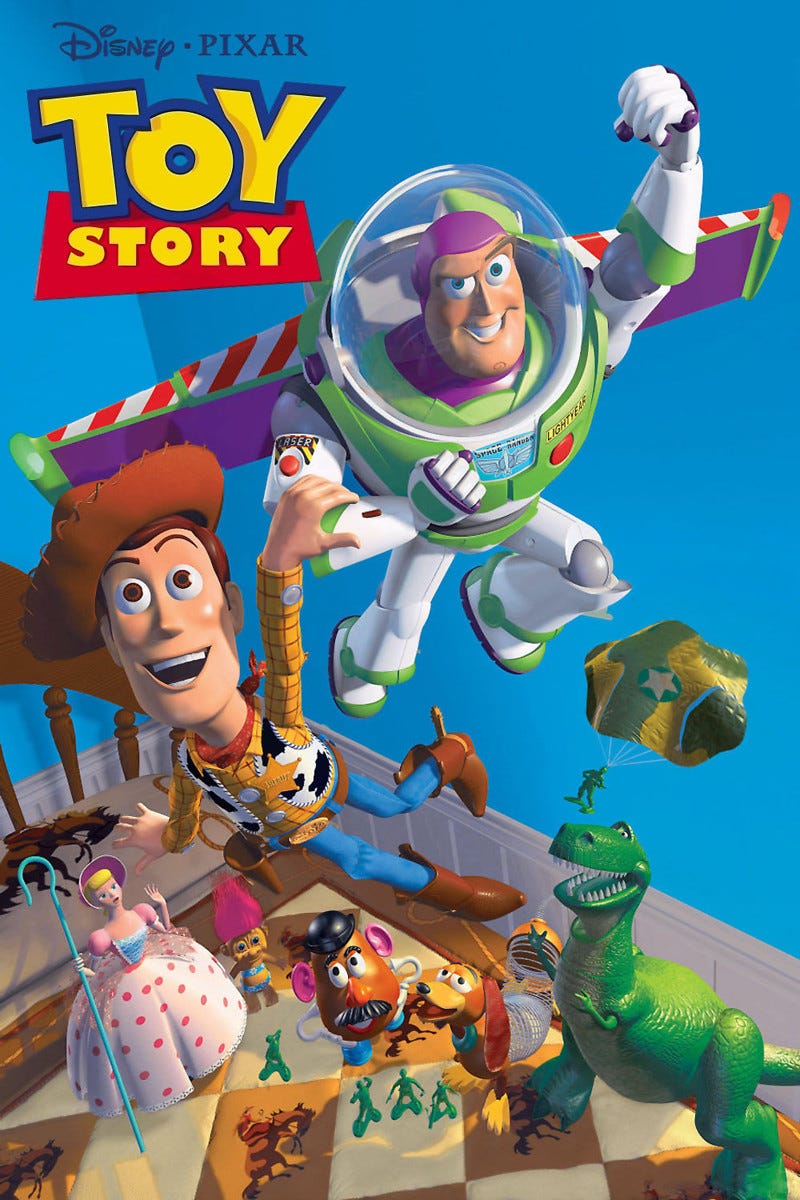
Today is Day 12 and the featured screenplay is for the movie Toy Story. You may download a PDF of the script here.
Background: Screenplay by Joss Whedon & Andrew Stanton and Joel Cohen and Alec Sokolow, story by John Lasseter & Pete Docter and Andrew Stanton and Joe Ranft.
Plot summary: A cowboy doll is profoundly threatened and jealous when a new spaceman figure supplants him as top toy in a boy’s room.
Tagline: Hang on for the comedy that goes to infinity and beyond!
Awards: Nominated for 3 Academy Awards including Best Writing, Screenplay Written Directly for the Screen.
Trivia: Woody and Buzz Lightyear are inspired by director John Lasseter’s own childhood toys. He based Woody on his own pull-string Casper doll, and once he grew out of Casper he moved on to a G.I Joe, a flashy toy at the time of his childhood.
My oldest child was 4 years-old when Toy Story debuted, so they have grown up with Pixar movies — and in a way, so have I as they have taken the craft of storytelling to a whole other level. And Toy Story started it all.
There are so many things to look for when reading this script. One dynamic is how often there is a complication, roadblock, or reversal in the Plotline, one after another after another. I suspect this is a reflection of their background in animation because if you think about some of the classic cartoon series Pixar’s creative types grew up with — “Tom & Jerry,” “Sylvester & Tweety,” “Roadrunner,” “Bugs Bunny” — the plots of each animated short are in essence a series of events that mess with the story’s participants, i.e., complications, roadblocks, reversals. What this does in the context of a full-length feature film is make the Protagonist’s journey that much more difficult and, by extension, more meaningful because the enormous set of obstacles they encounter push them to their limits, forcing them to reach down deep into who they are to accomplish their goals. So as you read Toy Story, pay attention to all the impediments in the Protagonists’ way.
For example, let’s break down the ending [pages refer to script called “Final Draft,” date November 1995:
P. 120: Woody and Buzz see the family van as it’s about to leave with the moving van. COMPLICATION: Buzz is stuck in the fence. Woody has to run back to help him free.
P. 121: Woody and Buzz make it to the street only to see the family van drive away. COMPLICATION: The moving van almost hits them, causing them to duck out of the way.
P. 122: Woody and Buzz chase after the moving van with Buzz grabbing onto a strap, then Woody. COMPLICATION: Scud, the dog, chomps down onto Woody’s leg.
P. 123: Woody is about to let loose. REVERSAL: Buzz leaps off the van and onto Scud.
P. 123: Woody tries to open the van door. COMPLICATION: The door is stuck and only opens when the van brakes.
P. 123: Buzz flung off Scud and tries to hide under a parked car. COMPLICATION: Buzz is too big to fit under the car.
P. 124: Woody finds the RC car and throws it out onto the street to save Buzz. COMPLICATION: The other toys attack Woody.
P. 125: Buzz gets on RC and tries to escape Scud. COMPLICATION: Rocky messes with Woody and the controls of the RC.
P. 126: With Buzz on RC, Woody continues to try and steer him to safety. REVERSAL: The toys toss Woody off the van.
P. 127: Woody lands on RC with Buzz. COMPLICATION: They have to careen out of the way of a car.
P. 129: When the toys see Woody and Buzz on RC, they realize that Woody was telling the truth. COMPLICATION: When they lower the van’s ramp, it almost squashes Woody and Buzz.
P. 130: Woody and Buzz grab onto Slinky dog. REVERSAL: Its batteries running low, RC slows down.
P. 131: ROADBLOCK: RC batteries run out. Woody and Buzz watch the van driving away.
P. 131: Woody has the great idea to light the rocket attached to Buzz’s back. REVERSAL: A car zooms by and blows out Woody’s match.
P. 133: Using Buzz’s mask to direct the sunlight onto the fuse to light the rocket, Woody and Buzz zoom through the air toward the van. COMPLICATION: They go airborne, sending RC into the van, and Woody and Buzz hurtling through the sky.
P. 134: Buzz flips out his wings and they begin to fly. COMPLICATION: They overshoot the van.
And finally Woody and Buzz drop down through the car roof, landing safely in the back seat next to Andy.
That’s like one complication, roadblock, or reversal per page in the sequence. This not only makes for good entertainment, it makes the Protagonist’s efforts to achieve their goal that much more difficult, and therefore that much more worthwhile when they achieve it.
What’s your take on Toy Story? Stop by comments and post your thoughts.
To see all of the posts in the 30 Days of Screenplays series, go here.
This series and use of screenplays is for educational purposes only!