30 Days of Screenplays, Day 12: “Looper”
Why read 30 screenplays in 30 days?
Why read 30 screenplays in 30 days?
Because whether you are a novice just starting to learn the craft of screenwriting or someone who has been writing for many years, you should be reading scripts.
There is a certain type of knowledge and understanding about screenwriting you can only get from reading scripts, giving you an innate sense of pace, feel, tone, style, how to approach writing scenes, how create flow, and so forth.
We did 30 Days of Screenplays in 2013 and you can access each of those posts and discussions here. This time, we’re trying something different: I invited thirty Go Into The Story followers to read one script each and provide a guest post about it.
Today’s guest columnist: Dan Mulhall.
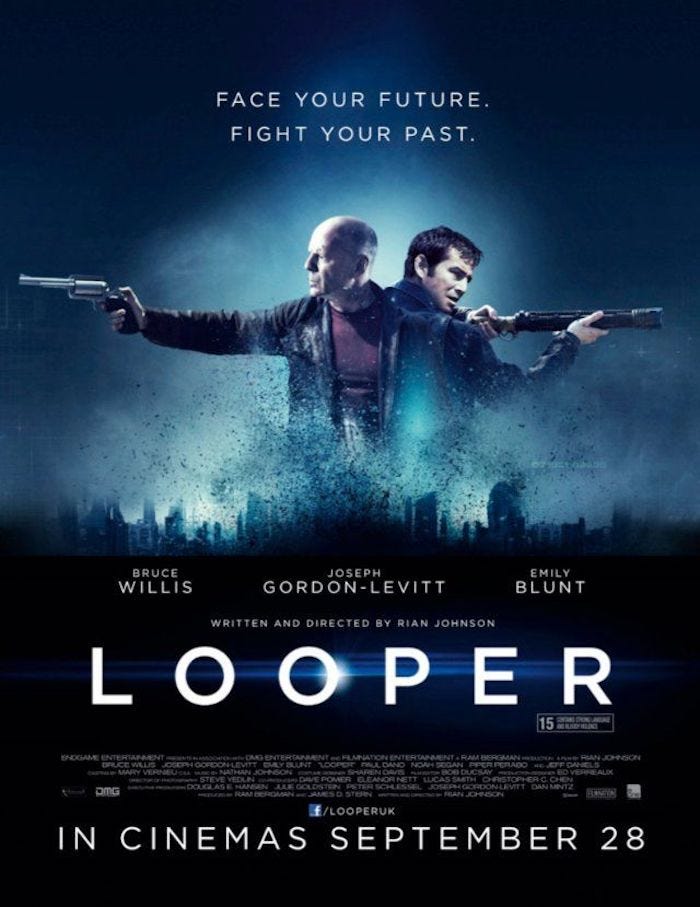
Title: Looper. You may read the screenplay here.
Year: 2012
Writing Credits: Rian Johnson
IMDB rating: 7.5
IMDB plot summary: In the year 2044, a man working for a group of killers called “Loopers” (they work for the mob and kill people who are sent blindfolded back in time from the year 2074 by their bosses) recognizes a victim as himself. He hesitates resulting in the escape of his older self.
Tagline: Hunted by your future. Haunted by your past.
Awards: Nominated for Best Original Screenplay, WGA, 2013
Analysis: Rian Johnson’s “Looper” is a bit of an inverse “Back to the Future.” Instead of a young man going back in time to see where he came from, the young man’s older self travels back in time to show him what he will become. The idea that who we were informs who we are and creates who we will become — and how love can affect each of these stages — is the central drive of “Looper.”
Something I’ve struggled with is fully exploring theme in my writing, so when a reader gets to “THE END” they understand what it all meant. Johnson’s screenplay weaves his theme into every aspect of the story in a way that never feels forced or complicated, and that is its greatest strength.
In a finished film, details get lost in the sights and sounds. There’s scenes shot a particular way, actor’s lines have a specific cadence, and a soundtrack crescendos in the background. You can miss otherwise minor things — breadcrumbs — that end up paying off by the end. These are typically the lines or moments you only pick up on a second viewing, when you go “ohhhh” with a wave of understanding and some “I see what you did there.”
When reading a script, details can’t get lost. In a great script, everything you need to know is right there on the page, and nothing else. The reader must be told about the breadcrumbs so the filmmakers can, you know, film them later on. However, “Looper” impressively lays out its breadcrumbs while obscuring their meaning.
For example, in Act One, Joe only ever exchanges two bars of gold with Abe after a job, while other loopers are consistently shown exchanging four. On film, you might not notice the difference. But reading it, it takes up a quarter of a page “showing” it happening in action lines and dialogue. That has weight. The observant reader might question why the screenwriter included it, and it’s not until later on, once we read that Joe is filling a secret floor safe with gold bars, that it clicks into place.
Plenty of scripts have breadcrumbs or mystery boxes or whatever. What’s great about “Looper” is that these things secretly inform us of the theme. This tiny “gold bar” story thread gives Joe a reason to turn his buddy Seth into Abe. He needs his money. But, it also secretly tells us a lot about who Joe IS and who he WAS.
Joe’s someone who plans ahead, something his constant French lessons also hammers home. He’s someone who does his job, but is a little different from his peers, maybe a little smarter. And he’s someone who knows what it’s like to have nothing, a saver who wants to avoid going back to nothing after his loop is closed. Joe’s a survivor, he needs his gold to survive.
When we see Joe become Old Joe, we watch him waste that carefully saved gold on drugs. He sold out Seth’s life for that gold, but he wastes it on drugs, not any meaningful life. And once he’s out of gold, he’s forced to become a hired goon to feed his addictions. Forced to survive again. That’s Joe’s core, regardless of past, present, or future.
Until the story’s end. (Implied spoiler alert).
“Looper” ends when Joe chooses not to survive. He “breaks the loop,” kills himself, and the audience realizes this whole story was about the power of love (and not in the “Back to the Future” Huey Lewis sense).
We know Old Joe was saved from an unremarkable future-life of drugs and crime by his future-wife, a woman he came back to fight for. In the present, we see Joe on his way to becoming Old Joe, but get saved by Sara, literally as she helps him through his drug withdrawal. We see him interact with her and with Cid, a subtle shift underneath that signals his decision to “break the loop” at the end of the film.
He does that so Cid may live. But not just live like “not die.” Not “survive” like Joe and Old Joe have. Really, truly LIVE, this time with the love of his mother Sara and the hope that her presence and influence will prevent Cid from becoming the sinister Rainmaker of the future. Cid represents Joe’s now lost future.
This high concept of time travel killers is really a story about how a guiding parental force, or lack thereof, can change your life. (But it still totally has awesome time travel stuff and a dude gets ripped in half!) The theme was everywhere — between Abe and Kid Blue, between Seth and Seth’s Future Self — you just didn’t notice it. Like hiding spinach inside your kid’s brownies, it’s never obvious, in your face, or on-the-nose. Only after you’ve enjoyed it do you really understand. Now that’s some good writing.
Most Memorable Dialogue: The first lines of dialogue from Joe, which explain everything we need to know about time travel, are great, but the best single lines? Probably “I’m from the future. You should go to China.” or “I don’t want to talk about time travel shit, because we’ll start talking about it and then we’ll be here all day making diagrams with straws.”
Most Memorable Moments: Even on the page, the capture of Seth’s loop by Abe’s Gat Men is the most memorable sequence. The time travel logic of it might fry your brain if you dwell too long but the simple and effective concept — a man slowly loses his limbs as they are removed from his younger self — is so visually interesting, even when reading it, that you can’t help being enthralled. Johnson’s concise and clipped style for these pages is aces. We don’t get lurid prose or extended explanations of what’s happening. And we don’t need it. Plus, it too ties into the theme of your past being what shapes you. Here, very literally.
What Did I Learn About Screenwriting From Reading This Script: My analysis shows my primary take-away: hang your theme on every scene of your script.
But here’s something else Johnson does well: If your script deals with some “out there” sci-fi notions, explain the bare minimum necessary to enjoy the story. Then, don’t worry about it any more. I love dense time travel movies (so, “Primer”) but Johnson tells us exactly what we need to know, then waves away the rest by having characters say it’s confusing, even they don’t understand it, and moving on. That could be seen as cheating, but it works here because THESE CHARACTERS wouldn’t care about the intricacies of time travel. They’re not physicists waxing philosophical about time travel. They’re hardened criminals who care about what’s right in front of them and nothing else. That’s an elegant solution to prevent over exposition that’s also rooted in character.
Thanks, Dan! To show our gratitude for your guest post, here’s a dash of creative juju for you. Whoosh!
To see all of this year’s 30 Days of Screenplays: Vol. 2, go here.