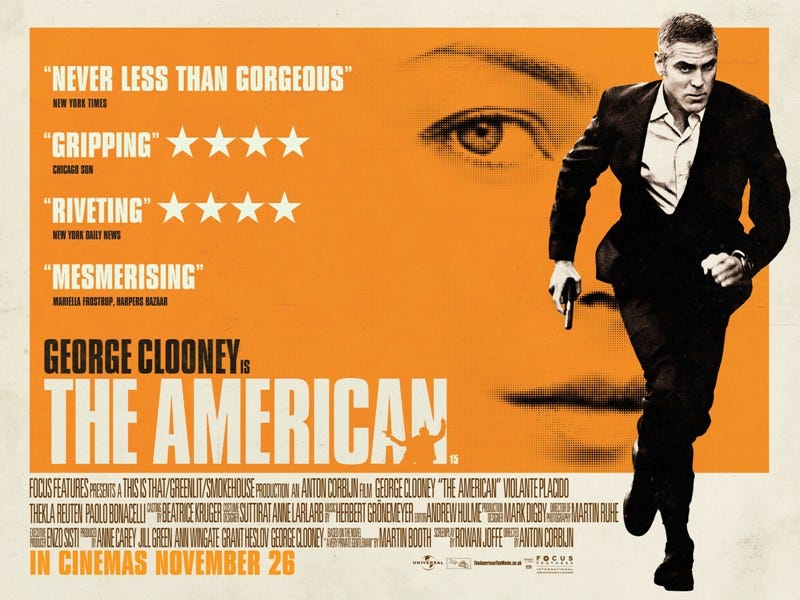
30 Days of Screenplays, Day 11: “The American”
Why read 30 screenplays in 30 days?
Why read 30 screenplays in 30 days?
Because whether you are a novice just starting to learn the craft of screenwriting or someone who has been writing for many years, you should be reading scripts.
There is a certain type of knowledge and understanding about screenwriting you can only get from reading scripts, giving you an innate sense of pace, feel, tone, style, how to approach writing scenes, how create flow, and so forth.
We did 30 Days of Screenplays in 2013 and you can access each of those posts and discussions here. This time, we’re trying something different: I invited thirty Go Into The Story followers to read one script each and provide a guest post about it.
Today’s guest columnist: Michael Egan.
Title: The American. You may read the screenplay here.
Year released: 2010
Writing Credits: Screenplay by Rowan Joffe // Based on the novel A Very Private Gentleman by Martin Booth
IMDB rating: 6.3
IMDB plot summary: “Alone among assassins, Jack is a master craftsman. When a job in Sweden ends more harshly than expected for this American abroad, he vows to his contact Pavel that his next assignment will be his last. Jack reports to the Italian countryside, where he holes up in a small town and relishes being away from death for a spell. The assignment, as specified by a Belgian woman, Mathilde, is in the offing as a weapon is constructed. Surprising himself, Jack seeks out the friendship of local priest Father Benedetto and pursues romance with local woman Clara. But by stepping out of the shadows, Jack may be tempting fate.”
Tagline: An assassin hides out in Italy for one last assignment.
Analysis: Right from the title page we get a glimpse into the kind of character we’re about to meet in this script. Rowan Joffe based his screenplay on Martin Booth’s novel, “A Very Private Gentleman”. It sets us up for the type of man we’re about to encounter when we turn the page. The type who keeps to himself. No friends. No family. No nothing.
His name is Jack, “dark, fit, mid-forties.” As his description fills out, we realize he’s a man at conflict with himself. A man whose shoulder bares a soldier’s tattoo, but whose body shows the signs of age. A distinguished gentleman with a killer’s instinct. Literally. A killer. Jack’s a hit-man.
“The impressive US Army Special Forces crest tattooed on the shoulder of his bare torso is at odds with Jack’s quiet manner and the distinguished silver that flecks his hair and stubble. JACK is no longer young.”
When we first meet Jack, he’s staring into the remains of a dying fire. Symbolic imagery, for sure. He’s contemplating something. Perhaps the choices he’s made in life. Perhaps the many sins he’s committed. Perhaps the sins he’s about to commit. Maybe his own fire is dying out. We don’t know. And the writer isn’t telling us. At least not yet anyway.
It’s interesting to think about how we’re introduced to Jack. We don’t meet him stalking through a crowded high-speed train with a gun in his hand, searching for the bad guy. We don’t find him in the midst of a high-speed chase, taking hair-pin corners on mountain roads at break-neck speeds. It’s not a gun fight or a bar fight or any kind of fight. It’s a quiet, peaceful moment. A man staring into a fire. Sipping whiskey. Thinking. Thinking. Always thinking.
That’s what struck me about this character. The time he spends alone with his thoughts. That’s part of the assassin’s life, I suppose. Solitude. And since Jack is hiding out in a small Italian town in this story, waiting for his next assignment a la In Bruges, it makes sense that he’d be on his own. Especially when he makes the decision on Page 8 to ignore his boss’s orders (probably because he doesn’t trust him, or anyone for that matter) and decides to go his own way.
That was the moment in the script when we realize that Jack is running from the past and his old way of life. It seems he just wants to be done with it. Just wants to leave it all behind. To walk away. But like the tattoo on his shoulder, his past is a permanent mark he carries with him. Can he ever really get away?
The result is he’s a man on the run. Always looking over his shoulder. Always waiting for the bullet that’s going to get him. Never at peace. In fact, the old priest he befriends along the way, FATHER BENEDETTO, points this out:
FATHER BENEDETTO: Some men watch some of the shadows. You
watch them all.
Father Benedetto also puts Jack’s deepest need into words:
JACK: All men are sinners.
FATHER BENEDETTO: Some are greater sinners than others.
And those who seek peace have much sinning in their history.
JACK: I don’t seek peace.
FATHER BENEDETTO: Until now.
JACK: Maybe.
Peace. Maybe that’s what Jack is really after all along. It’s not so much that he’s running from something as he’s running toward it. He wants peace.
And in the end, when he finally realizes what he wants — and who he wants — he has a chance to find that peace. Finally. But is it too late for him?
It’s a complex and dark character. A lonely character. It’s no wonder George Clooney read the script and saw himself in it. But that’s another story for another time.
Most Memorable Dialogue / Most Memorable Moment: The scene with Jack and Father Benedetto walking through the park, pausing by the trees like the Stations of the Cross, stood out for me.
EXT. PARCO DELLA RESISTENZA — JUST AFTER DAWN
A small park not far from Castel Del Monte’s town square.
It is just after dawn. The pine trees and the poplars are
silent. The sun is not yet up but the day is light.
Sparrows hop about, searching for crumbs.
JACK, ravaged by lack of sleep, wanders about like the demon
of a lost darkness, looking for his hole down to the underworld.
FATHER BENEDETTO: Buongiorno! You’re up early!
He’s twenty meters away, his hand raised in half-welcome,
half-benediction.
JACK: I just needed some air.
They greet one another and FATHER BENEDETTO falls into slow
step with JACK. The priest walks with his hands behind his back.
JACK with his hands in his pockets.
FATHER BENEDETTO: I walk here to meditate. Once a week. The trees
are like the Stations of the Cross: by certain trees I thank God
for certain favours he has granted me. For example, here by this
pine, I thank him for the many friendships I have and ask him to
look after those of my friends who are sinners.
They reach a Cypress tree and FATHER BENEDETTO bows his head in
prayer. He gives a small sideways glance at JACK.
JACK: All men are sinners.
FATHER BENEDETTO: Some are greater sinners than others. And those
who seek peace have much sinning in their history.
JACK: I don’t seek peace.
FATHER BENEDETTO: Until now.
JACK: Maybe.
FATHER BENEDETTO: Forgive me. This is the priest in me speaking.
But you have done much sinning, Signor Clarke. You still do.
JACK: Well you know, I see a whore. She’s young enough to be my
daughter.
FATHER BENEDETTO: I do not refer to the sins of carnality. But to
the deadly sins…
JACK: Aren’t all sins equal?
FATHER BENEDETTO: We are not discussing theology, my friend, but
you.
JACK is silent.
FATHER BENEDETTO: What job do you do, Signor? Are you on the run,
as they say?
JACK: Everyone’s on the run from something.
FATHER BENEDETTO: Some men watch some of the shadows. You watch
them all.
JACK: Everything I’ve done, I’ve had good cause to do.
FATHER BENEDETTO: Do you wish to tell me?
JACK: Confess?
FATHER BENEDETTO: Yes.
JACK: For what reason?
FATHER BENEDETTO: For your own sake. Perhaps I can pray for you?
A YOUNG COUPLE kissing on a nearby bench are part hidden by the shade
of the trees.
FATHER BENEDETTO: I wonder how many bastards have been made here?
A change of pace.
FATHER BENEDETTO: You work in metal. You are given some steel by Fabio,
the car doctor.
They stare at one another. JACK wants to confess. He does not know why.
But he doesn’t. The couple catches JACK’s eye and he does something
we’re not expecting:
JACK: Was he conceived here father? Fabio. The ‘car doctor’?
FATHER BENEDETTO is motionless.
FATHER BENEDETTO: Why do you ask me that?
JACK: You have each other’s photos, you have each other’s eyes. Where was
he conceived, Father? Under one of these trees? At night? Like all the
other bastards?
There is a very, very long pause. FATHER BENEDETTO stares up at JACK with
extraordinary intensity.
FATHER BENEDETTO: I do not remember, Signore. It was many years ago.
FATHER BENEDETTO walks. JACK follows. A gust of wind makes dust swirl from the gravel path. The two men do not speak again until they reach the next set of Cyprus trees.
FATHER BENEDETTO: In the end it is I who confesses to you.
JACK: And you want me to do the same?
FATHER BENEDETTO: Perhaps. For your own good. You cannot doubt the existence of Hell. You live in it. It is a place without love. As for me, I go about my daily duties because the town requires it of me. Some know what you know. Perhaps I have no right to wear these robes. But I do have a heart full of a father’s love. Something close to His heart! And for that I am both grateful
and happy.
On JACK.
FATHER BENEDETTO: What do you have, my friend?
Another gust of wind. The priest looks up into JACK’s face.
The assassin’s eyes are red and stinging. Perhaps its from the dust.
I had the sense all along that Jack knew what was going to happen to him. That he was, like Jesus on his way to Calvary, willingly walking into certain death. That he knew his fate.
But then again, maybe Rowan Joffee never intended for his hit-man protagonist to be compared to our Lord and Savior. Who knows?
What Did I Learn About Screenwriting From Reading This Script:
The first thing I noticed when I started reading this script was Rowan Joffe’s use of white space. Take a look at the opening scene:
EXT. NORTHERN SWEDEN – TWILIGHTA lake.A forest.A dacha.A Saab outside the winterhouse.A light within.It’s a quick set-up. A bit choppy. But it establishes the writer’s style early on. And quickly pulls the reader in. And if that’s our goal — to pull the reader in — maybe we should pay attention to the white space in this script.
Here’s another example:
EXT. WOODS- MORNINGINGRID leads JACK through the trees. Her coat has a white fur
collar. They are fresh-faced and warm from bed.They head towards a vast and frozen lake.JACK senses something in the woods.Beneath the Conifers: impenetrable darkness.JACK looks around.Thick snow blankets the world and muffles any sound. There is not the slightest breeze.EXT. LAKESIDE- MORNINGThey continue through the woods until they reach the shoreline of the lake.INGRID steps onto the ice.Holds out her hand.A beat.JACK takes INGRID’s hand.Solid as stone, the frozen lake takes his weight.They walk out, INGRID slipping and laughing.The landscape is magical.JACK begins to relax, slipping and swearing.Suddenly, he stops.There are footprints in the thin snow going out across the lake.
Beside the Snow-hare’s prints are those of a man.Instead of wading through dense blocks of narrative, Joffe breaks the action up into bite-size chunks. Again, pulling the reader in. Making his or her job easier.
I guess that was my biggest takeaway from The American. Always remember the reader. Do whatever it takes to keep the reader pressing forward, turning pages, wanting more. If you, as the screenwriter, give them a chance to put the script down and catch their breath, they’ll probably take it.
You’ll just have to hope and pray they pick it back up again
Thanks, Michael! To show our gratitude for your guest post, here’s a dash of creative juju for you. Whoosh!
Twitter: @eganmike.
To see all of this year’s 30 Days of Screenplays: Vol. 2, go here.