30 Days of Screenplays, Day 11: “Memento”
Why 30 screenplays in 30 days?
Why 30 screenplays in 30 days?
Because whether you are a novice just starting to learn the craft of screenwriting or someone who has been writing for many years, you should be reading scripts.
There is a certain type of knowledge and understanding about screenwriting you can only get from reading scripts, giving you an innate sense of pace, feel, tone, style, how to approach writing scenes, how create flow, and so forth.
So each day this month, I will provide background on and access to a notable movie script.
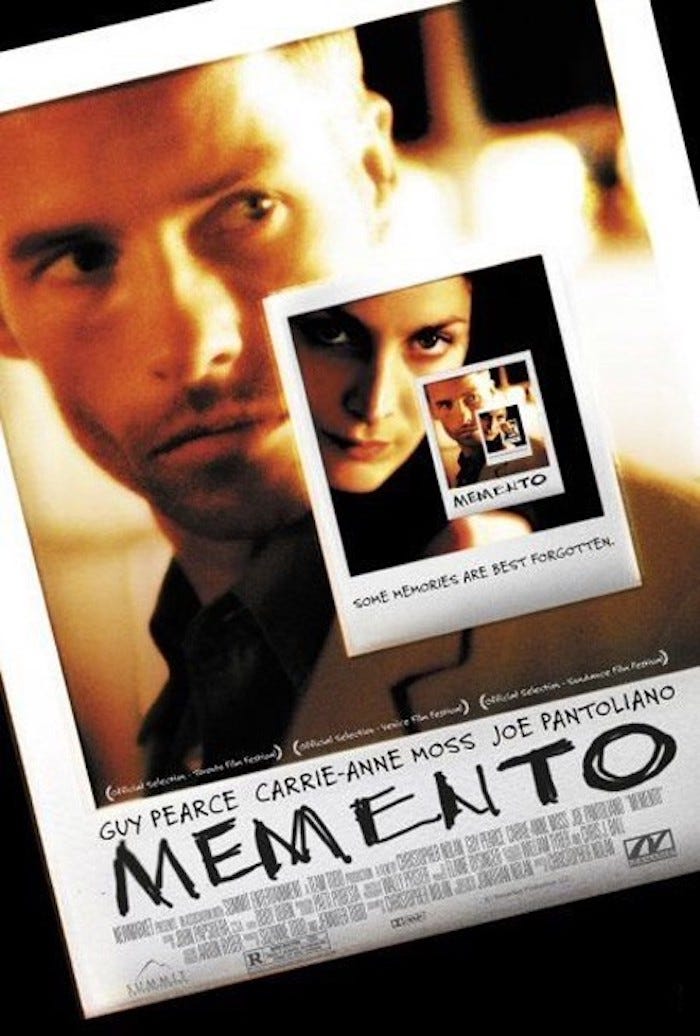
Today is Day 11 and the featured screenplay is for the movie Memento (2000). You may download a PDF version of the screenplay here.
Background: The screenplay was written by Christopher Nolan based on a short story by Jonathon Nolan.
Plot summary: A man, suffering from short-term memory loss, uses notes and tattoos to hunt for the man he thinks killed his wife.
Tagline: Some memories are best forgotten.
Awards: Nominated for an Academy Award for Best Original Screenplay.
Trivia: Christopher Nolan’s screenplay was based on his brother Jonathan Nolan’s story “Memento Mori”. But the screenplay is still considered original (rather than adapted) because Jonathan’s story wasn’t published until after the film was completed.
One reason I included Memento is obvious: it’s a great example of a script that tells a story in a non-traditional fashion with respect to time. More than that, it’s an excellent screenplay that grabs you from the first page, and does not let you go until you reach the end. This is a fantastic script to read while watching the movie at the same time.
I have one simple personal guideline about non-linear movies: The non-linear feature has to be organic to the story. It can’t just be the filmmakers’ choice because they thought it was a cool way of telling the story. To me, that’s just as obnoxious as a director doing one self-indulgent camera set-up after another. Instead of telling a story, the effect is to point at themselves. “Look at me, how clever I am! I can jumble up the timeline!”
I confess when I first saw the movie (and I’ve only seen it once), I basically just ran with the backward-and-forward plots as the overall story worked for me as a viewer. But reading the script, I pondered the question: Is Leonard’s backward plot organic to the story?
I had this conversation in a previous post and a reader noted this:
Memento is basically a simple story and may be quite boring if told straightforward-ly. But what is interesting is not only because it mixes the story order (one is in reverse, another is forward), but also because that way we get a feeling of how it feels to be Leonard, to only remember things in sequences of a couple of minutes. So in a way the jumbling of the structure helps in stating the theme.
The only way to get ‘inside’ Leonard’s experience is to tell his story in reverse. Therefore the conceit is not only organic, it’s necessary. Reader Steve Bedford made this point:
Leonard is always doing something, always active, and by going in reverse order, we are able to feel his confusion. We are able to be far more sympathetic to him because we can feel what he feels.
Another advantage of using the reverse time-scheme is to intensify our sympathy for Leonard.
The other thing I want to mention is something quite simple, but actually quite elegant. I noted it here in a Scene Description Spotlight:
For the movie, they use black-and-white footage to signify sequences that run in forward chronological order, and color footage for sequences that run in reverse chronological order, both color schemes specified in the script. But that’s for the movie. What about for the cast and crew reading the script? How to tip them off?
What the Nolans did was use regular typeface for the reverse chronological sequences and italics to signify forward chronological sequences.
An unusual choice in terms of script format, but again necessary to help the reader keep the respective plots straight.
What’s your take on Memento? Stop by comments and post your thoughts.
To see all of the posts in the 30 Days of Screenplays series, go here.
This series and use of screenplays is for educational purposes only!