30 Days of Screenplays, Day 10: “The Artist”
Why read 30 screenplays in 30 days?
Why read 30 screenplays in 30 days?
Because whether you are a novice just starting to learn the craft of screenwriting or someone who has been writing for many years, you should be reading scripts.
There is a certain type of knowledge and understanding about screenwriting you can only get from reading scripts, giving you an innate sense of pace, feel, tone, style, how to approach writing scenes, how create flow, and so forth.
We did 30 Days of Screenplays in 2013 and you can access each of those posts and discussions here. This time, we’re trying something different: I invited thirty Go Into The Story followers to read one script each and provide a guest post about it.
Today’s guest columnist: April Reagan.
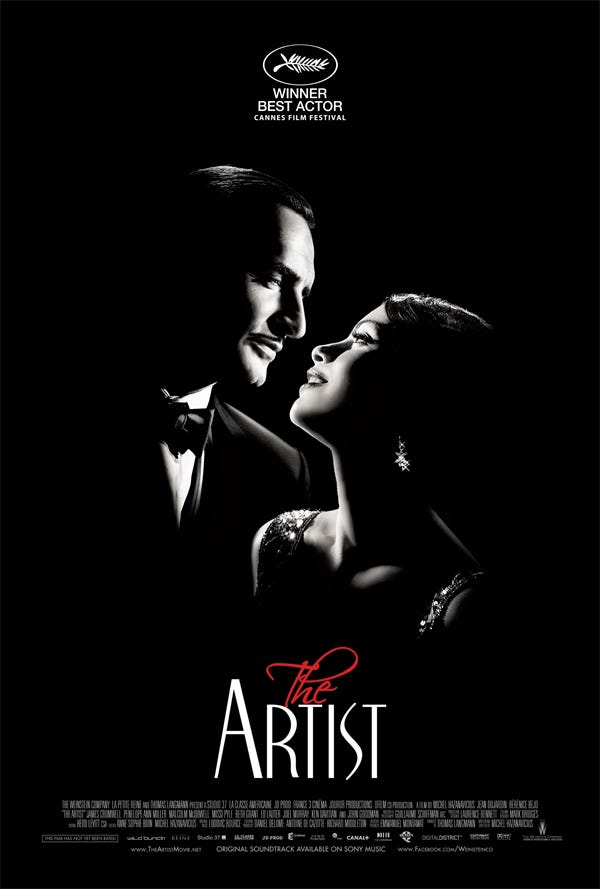
Title: The Artist. You may read the screenplay here.
Year: 2011
Writing Credit: Michel Hazanavicius
IMDB rating: 8.0
IMDB plot summary: Outside a movie premiere, enthusiastic fan Peppy Miller literally bumps into the swashbuckling hero of the silent film, George Valentin. The star reacts graciously and Peppy plants a kiss on his cheek as they are surrounded by photographers. The headlines demand: “Who’s That Girl?” and Peppy is inspired to audition for a dancing bit-part at the studio. However as Peppy slowly rises through the industry, the introduction of talking-pictures turns Valentin’s world upside-down.
Analysis: The writer does a beautiful job in striking the right balance between exposition and action for this modern silent film — providing the main storyline and also character emotion, normally read through dialogue and its subtext. The story really has just the main plot — which may play to the melodramatic style and also be necessary in the silent film. One could argue that the movie market has a sub-plot, but I believe that to be a stretch. In this way, the story does have a shallow feeling to it, but as the film really settles into the study of the main character and makes that very rich.
The writer uses several tools to tell the story in this medium. Besides using title cards, the writer relies on newspaper text, movie titles and plots, as well as photos to emphasize contrast and for dramatic effect. These techniques are effective at providing depth and texture in the story. For example, the opening scene features George in a film, where he’s being subjected to cruelty of ultrasound piping into his ears, to which he responds “I won’t talk!” Also, the movie titles in which Peppy appears through the story are also telling — at first “Beauty Spot” — a reference to the fake mole George introduces her to in the beginning, then as her career progresses, “The Rookie,” then later “On The Roof.” At one point, George’s flop of a silent film “Tears of Love” is shortened to just “Tears” as workers change out titles. Another later film Peppy stars in is titled “Guardian Angel.”
General Structure
Because there is very little dialogue in the script, it is 42 pages providing for 100 minutes of screen time. Act 1 is hard to finely peg for sure, for me, as could see it breaking either right at Zimmer (the producer) demonstrating at “talkie” to George, but also just after George’s panic attack about this big industry change (~pp1–14). Nonetheless, Act 2 carries us through the slow rise of actress Peppy and decline of George. This arc eventually climaxes where George is devastatingly humiliated when he realizes Peppy has not only been caring for him but had anonymously bailed him out, moving to take his own life (pp15–40). Act 3 shows swift reckless action by Peppy to save George from himself and even give him a hand in returning to fame (pp40–44).
Melodrama Genre, Silent Films and Black and White
It is understandable that the silent films were often melodramatic, given the need to exaggerate to convey through visual styles. Hazanavicius is reported to have wanted to even minimize the intertitles in this film.
One might wonder how this silent film weighs in against the most successful early silent films. Here we compare it to the top 5 grossing silent films, according to Variety (as cited on Wikipedia):
- The Birth of a Nation (1915) — $10,000,000 — IMDB 6.9
- The Big Parade (1925) — $6,400,000 — IMDB 8.3
- Ben-Hur (1925) — $5,500,000 — IMDB 8.1
- Way Down East (1920) — $5,000,000 — IMDB 8.1
- The Gold Rush (1925) — $4,250,000 — IMDB 8.3
Rating-wise, The Artist fits into this group, thought slightly under. Those of you that follow opening weekend figures for modern movies might be surprised to learn that The Artist drew a meager $204,878 (USA) (18 November 2011). It isn’t cleared how limited the market is for that time. Gross was $44,667,095 (USA) as of 15 June 2012, when accounted for inflation, this would be only $2M, which would slip into #15 of all time. It is hard for me to judge if these numbers are remarkable in that a quality silent film can be made and viewed on par with the original age, or, if today The Artist is such a novelty for movie-goers that it had inflated success.
Generally speaking, I was surprised to note the large number of black and white films made since 1970. Certainly this can be used intentionally for dramatic effect, period placement, and other reasons.
Notable Script Tidbits
Fast action — Most of the action of the script is written in long paragraphs, except where quick action needs to be emphasized and quicker to read. For example, on page three, each step in the action has a new line.
Intertitles — These were written in bold, mixed type at full width, starting with “Title card:”
Mixing scenes — One technique I have not seen yet, in scripts, is the way prior scenes were continued after a new scene began. It is done by using in parentheses the prior scene number then writing the new action in line. This is seen as early as page 4 (see scene 10).
Most Memorable Dialogue: Given this is a silent film, there isn’t a lot of dialogue, however, there are a few places where several the writer uses the title cards for dialogue that is notable:
- Early on, when Peppy is waiting for calls for extras, she shows a fellow actor the picture of her and George from the paper, and the other actor responds simply by pointing to the article title “Who’s That Girl?”
- When George’s wife wants to engage in conversation, she says “We have to talk, George.” There is a nice play on the plot with the retort from George “Or not.”
- A bit unconventional, two key conversations between Peppy and George actually take place with their feet — doing a back and forth in dancing.
Most Memorable Moments:
- There are several poignant moments in the film, one of the earliest being when George and Peppy cross paths as George leaves Zimmerman, having learned he would need to move on with Paramount. Analogous to their careers, George is on his way down stairs and Peppy is on her way up. Indeed when they stop to talk, she stops on stairs just above him.
- In George’s film “Tears of Love,” there is a scene which is again an analogy of his condition — he sinks in quick sand, going down, and eventually being covered where he is unable to talk.
- When George decides to leave Peppy’s care — he is walking along the street and catches his image, bum-like, and a shadow of what used to be in the manikin.
- In Peppy’s final rescue of George, she lifts him up with the same thing that really first drew them together — dancing.
Critiques:
- The writer used the phrase “takes it in the chin” so often it became tiresome.
- The scene of George learning to deal with sound in his dressing room seemed odd to me. Besides finding the writing in the script hard to follow, I do remember being a bit confused by the scene when watching the movie.
What Did I Learn About Screenwriting From Reading This Script:
I intentionally picked the silent film because I had long been curious about how the films were scripted. Historically speaking, the sound for these movies were actually done live, and according to Professor McNamara at DeAnza College in Cupertino, these may or may not have come with a score for live music or sound effects directions, so there was no reliance on the dramatic effect of music in those cases — it was 100% visual.
What I learned in doing this review is that this script utilized many of the tricks used in traditional silent films, in using melodramatic style, high expression and action, focus on the main character and what was probably on the lighter side of intertitles usage.
Technically speaking, I learned how to use Title Cards, reference prior scenes and how action, alone for the most part, can actually be quite effective in telling a rich story.
Thanks, April! To show our gratitude for your guest post, here’s a dash of creative juju for you. Whoosh!
April is the host of this site: thecleverscript.com.
To see all of this year’s 30 Days of Screenplays: Vol. 2, go here.