2024 Scene-Writing Challenge: Day 1
Write some scenes. Win a great prize.

Write some scenes. Win a great prize.
To kick off the New Year, I hereby declare January to be Scene-Writing Month here at Go Into The Story. Every Monday-Friday, I will upload a post with a scene-writing prompt. Each day, write a scene per those guidelines. Upload your scene here in the response section of the original post. That way you can critique others’ pages and receive feedback on your scene as well.
Why scene-writing? If the average scene is 1 1/2 to 2 pages long and a script is 100–120 pages, then a screenwriter writes between 50–80 scenes per screenplay. Thus in a very real way, screenwriting is scene-writing. The better we get at writing scenes, it stands to reason the better we get as a screenwriter.
To provide extra motivation for this series — to get people to WRITE PAGES — I am giving away some of my Core classes to Scene-Writing Challenge participants. That’s right: For free!
Everything you need to know about screenwriting theory in this unique curriculum based on eight principles: Plot, Concept, Character, Style, Dialogue, Scene, Theme, Time.
CORE I: PLOT — A one-week class which begins with the principle Plot = Structure and explores the inner workings of the Screenplay Universe: Plotline and Themeline. Start date: January 15.
CORE II: CONCEPT — A one-week class which begins with the principle Concept = Hook and examines multiple strategies to generate, develop and assess story ideas. Start date: January 29.
CORE III: CHARACTER — A one-week class which begins with the principle Character = Function and delves into archetypes: Protagonist, Nemesis, Attractor, Mentor, and Trickster. Start date: February 12.
CORE IV: STYLE — A one-week class which begins with the principle Style = Voice and surfaces keys to developing a distinctive writer’s personality on the page. Start date: February 26.
CORE V: DIALOGUE — A one-week class which begins with the principle Dialogue = Purpose and probes a variety of ways to write effective, entertaining dialogue. Start date: March 11.
CORE VI: SCENE — A one-week class which begins with the principle Scene = Point and provides six essential questions to ask when crafting and writing any scene. Start date: March 25.
CORE VII: THEME — A one-week class which begins with the principle Theme = Meaning and gives writers a concrete take on theme which can elevate the depth of any story. Start date: April 8.
CORE VIII: TIME — A one-week class which begins with the principle Time = Present and studies Present, Present-Past, Present-Future and time management in writing. Start date: April 22.
Each is a 1-week online class featuring six lectures written by me, lots of screenwriting insider tips, logline workshops, optional writing exercises, 24/7 message board conversations, teleconferences with course participants and myself to discuss anything related to the craft.
NOTE: I provide feedback and am actively involved in our online chats. That includes a 90 minute teleconference for each Core class.
If you’re new to screenwriting, have intermediate experience, or you’ve read it all, but want to explore character-driven screenwriting, here is your chance to learn the foundation of screenplay structure that goes beyond formula.
“Scott Myers is an uncommonly sensitive and erudite thinker and writer about the craft of modern screenwriting.” — Phil Hay, Crazy/Beautiful, The Invitation, Destroyer
This is not about secret systems or magic formulas, rather the Core content presents a story-crafting process that starts with characters, works with characters, and ends with characters. That process of engaging you with your story universe through your characters and getting you in touch with these living, breathing individuals informs every step of your creative process, leading you to story structure, themes, conflict, subplots, and all the rest. As I say, Character Driven Screenwriting
A popular option is the Core Package which gives you access to the content in all eight Craft classes which you can go through on your own time and at your own pace, plus automatic enrollment in each 1-week online course — all for nearly 50% the price of each individual class. If you sign up now, you can have immediate access to all of the Core content.
This year, I’m making available a special offer: If you enroll in the Core Package, I will send you an autographed copy of my book: The Protagonist’s Journey … for free!
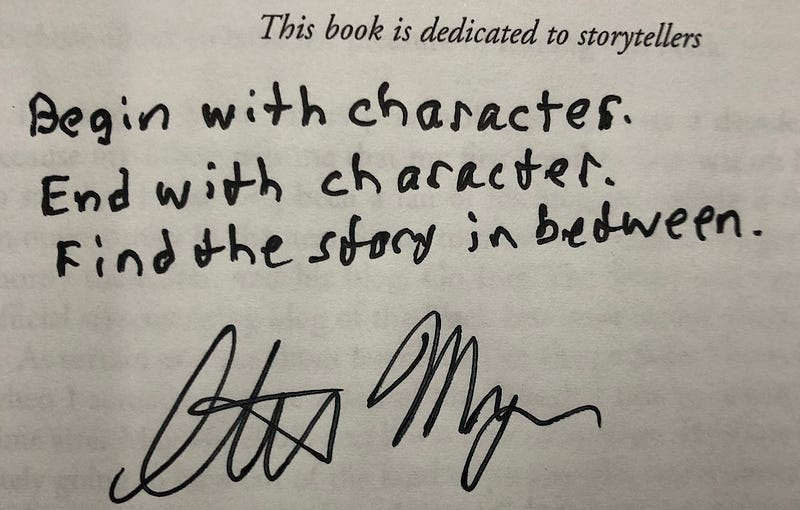
My book is an introduction to character-driven screenwriting and storytelling. The Core curriculum takes you much deeper into the subject matter and touches on all the key principles you need to know to elevate your screenwriting chops.
“I’m a huge fan of Scott’s classes, and I signed up for his Core Package, which I cannot speak highly enough about. If anyone wants to take a serious look at improving their writing, there is more than enough material to keep you busy for a few… dare I say, lifetimes? He’s the best. No bones about it.”
~ Heather Farlinger
In January, to qualify to take one of my Craft classes for free, write and submit ten [10] Scene-Writing Challenge posts, then provide feedback on ten [10] posts from other writers. The former to get you writing, the latter to work your critical-analytical skills.
A chance to take any of my eight Core classes, interface with me online along with the usual stellar group of writers who take Screenwriting Master Class courses, while using writing exercises and feedback to upgrade your skill at writing and analyzing scenes?
ISN’T THAT AN AWESOME IDEA?!!!
That’s what I’m prepared to do to encourage you to write pages.
A couple of logistical notes:
- Limit your scenes to 2 pages. First, most scenes are 2 pages or less in length. Second, out of fairness to everyone participating in the public scene-writing workshop, let’s not abuse anyone’s patience or time with really long scenes.
- Don’t be concerned about proper script format when you copy/paste your scene, rather the content and execution are the important thing. So as a default mode, do this: (1) Don’t worry about right-hand margins on scene description or dialogue, just keep typing until it manually shifts each line. (2) Don’t worry about character name position, rather do this:

Today’s prompt: Write a scene involving a golf cart.
The obvious scene: One involving golf. What about a retirement village? A beach resort? How about a chase scene. That could be fun. Whatever you do, use the golf cart to make the scene entertaining.
As always when writing a scene, think conflict. Or at the very least tension.
Write a 1–2 page scene, then copy/paste in comments.
If you are interested in qualifying for 1 free Core class with me, please note in each post you submit the number of scenes you have written. If today is your first effort, note that it is Scene 1. The next one, Scene 2. And so forth.
Also when you provide feedback on someone’s scene, please note in each reply the number of comments you have uploaded. So if today is your first response, Feedback 1. The next one, Feedback 2.
You are on an honor system, as I don’t have time to check every post, so do the right thing!
Remember: In order to qualify for one of my free Core classes, you need to submit ten [10] Scene-Writing Challenge posts, then provide feedback on ten [10] posts from other writers. One post and one feedback per scene prompt.
FEEDBACK TIP: Suggest a way to up the pressure on the characters to give the scene more of a dramatic or comedic spin.
It’s the 2024 Scene-Writing Challenge! Give a jolt to your creative and writing muscles… and win one free online class with yours truly.
NOTE: When you can verify the 10 scenes you’ve written and the 10 scenes on which you provided feedback, email me and let me know which of the eight Core classes you’d like to take. That’s all you need to do!
Onward!