2022 Zero Draft Thirty September Challenge: Story Prep — Script Diary
A series to help prepare writers for next month’s Zero Draft Thirty writing challenge.

A series to help prepare writers for next month’s Zero Draft Thirty writing challenge.
Do you have a story you want to write? A feature length movie screenplay? An original TV pilot? A web series pilot? A novel? Short story? An epic length limerick?
The 2022 Zero Draft Thirty September Challenge is for you!
September 1: You type FADE IN / “Once upon a time…”
September 30: You type FADE OUT / “…They all lived happily ever after.”
It’s free! It’s fun! It’s Fade In to Fade Out!
For everything you need to know to join, click here.

To help prepare writers for the #ZD30SCRIPT Challenge, this week I am running a series on Story Prep.
Today: Script Diary.
The last thing I do before I type FADE IN is create yet a Word file, which I call Script Diary.
I come to the diary to start every writing session. I visit it when I get stuck. I return to it when I hit on a story revelation. Day after day, I use my script diary to chronicle the writing of the story.
At the start of a writing session, I note the date and time in the script diary, then get my fingers and brain loosened up by typing up my thoughts about the scene I am about to tackle. I’ll remind myself what type of scene it is, which characters are participating in it, what each of their agendas is, who is playing what story function for that scene, how the scene relates to the overall plot, what the central point of the scene is, and so on. As I’m doing that, normally lines of dialogue pop to mind and I’ll put those down — so in essence I’m pre-drafting the scene, and can take that sketch to my script file and use it to write the actual scene.
I also use the script diary to track my emotional connection to the story. For instance, I may be worried about whether the scene I’m about to write will work or not. I may be concerned that one of the characters doesn’t feel quite right. If I’m stuck, I use the diary as a place to express my fears about the story; in fact, if I’m really stuck, I’ll ‘ask’ the characters, right there in my diary, to talk to me, show me what they want or need.
Now you may think I’m crazy — talking to my characters, asking them for help! But ever since I’ve started using a script diary, my experience of my story’s characters has become that much more… real, I suppose is the best way to describe it.

Whenever I am stuck, I start writing in my script diary, and invariably I become aware of my characters. Suddenly, one of them will turn and halfway glance at me or motion, and I’ll ‘follow’ them.
What I am saying is that my characters lead me deeper into my story. They show me the way. And the script diary is a crucial part of that experience because, I think, I am opening myself up to my characters, creating a ‘dialogue’ with them on those diary pages.
And there’s something else that’s very cool about a script diary: when you’re done with the project, you’ve got this journal of the entire writing process. You can go back to see and feel the actual moments where you found a breakthrough, where you busted through a story block, where your characters spoke to you.
Like everything else in this succession of posts, a script diary may not work for you. However, I encourage you to try it at least once. I think you’ll be pleasantly surprised.
Back to the Zero Draft Thirty Challenge. For extra motivation, here is a Zero Draft Thirty calendar you can use to track your progress next month:
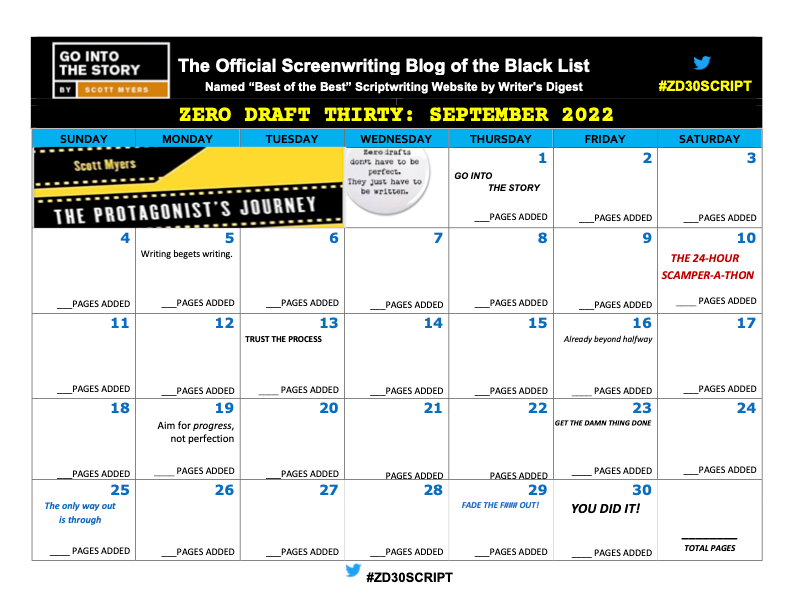
Tomorrow, I’ll have another story prep tip.
Have you got your story concept ready to rock and roll in the 2022 Zero Draft Thirty September Challenge? Come back here every day in September to share the experience with a slew of other writers as you make your way to FADE OUT.
Zero Draft Thirty Challenge: Pound Perfectionism. Push Productivity.
Twitter: #ZD30SCRIPT.
Facebook: Zero Draft Thirty.
Onward!