2020 Zero Draft Thirty September Challenge: Day 19
One month. FADE IN to FADE OUT. Creativity meets Productivity.

One month. FADE IN to FADE OUT. Creativity meets Productivity.
Zero Draft Thirty: Day 19.
Write an entire draft of a script in September — FADE IN. FADE OUT. Or any sort of creative goal you have in front of you.
Feature length movie screenplay. Original TV pilot. Rewrite a current project. Break a story in prep. Generate a month’s worth of story concepts.
Whatever you feel will ratchet your creative ambitions into overdrive…
DO THAT!
September 1: You type FADE IN / “Once upon a time…”
September 30: You type FADE OUT / “…They all lived happily ever after.”
It’s free! It’s fun! It’s Fade In to Fade Out!
For everything you need to know to join, click here.
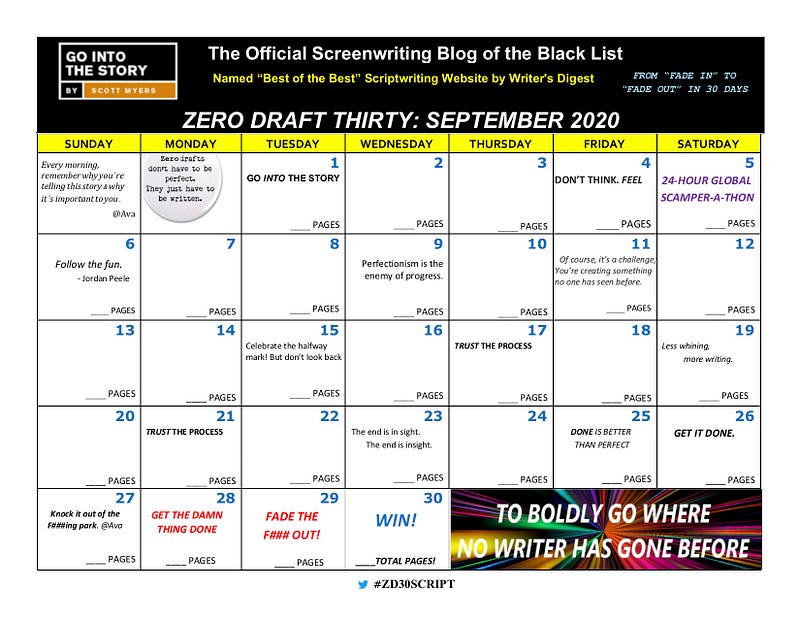
To download your copy of the official Zero Draft Thirty calendar created by Stephen Dudley, click here.
On Twitter, use this hashtag: #ZD30SCRIPT.
Zero Draft Thirty Facebook Group: Here. 3,900+ members strong.
Today’s Writing Quote
“Audiences go to movies to feel. When the movie becomes too mechanical instead of organic, audiences detach from the film.”
— Simon Kinberg
Today’s Inspirational Poem
A Spiral Notebook
By Ted Kooser
The bright wire rolls like a porpoise
in and out of the calm blue sea
of the cover, or perhaps like a sleeper
twisting in and out of his dreams,
for it could hold a record of dreams
if you wanted to buy it for that
though it seems to be meant for
more serious work, with its
college-ruled lines and its cover
that states in emphatic white letters,
5 SUBJECT NOTEBOOK. It seems
a part of growing old is no longer
to have five subjects, each
demanding an equal share of attention,
set apart by brown cardboard dividers,
but instead to stand in a drugstore
and hang on to one subject
a little too long, like this notebook
you weigh in your hands, passing
your fingers over its surfaces
as if it were some kind of wonder.
I love this poem. It’s a poem for writers. The tactile experience of writing, reflective of the magic and wonder of something emerging from nothing.
Zero Draft Thirty: Day 1
Zero Draft Thirty: Day 2
Zero Draft Thirty: Day 3
Zero Draft Thirty: Day 4
Zero Draft Thirty: Day 5
Zero Draft Thirty: Day 6
Zero Draft Thirty: Day 7
Zero Draft Thirty: Day 8
Zero Draft Thirty: Day 9
Zero Draft Thirty: Day 10
Zero Draft Thirty: Day 11
Zero Draft Thirty: Day 12
Zero Draft Thirty: Day 13
Zero Draft Thirty: Day 14
Zero Draft Thirty: Day 15
Zero Draft Thirty: Day 16
Zero Draft Thirty: Day 17
Zero Draft Thirty: Day 18
Each day this month, I’ll post a Zero Draft Thirty Challenge post here at Go Into The Story. And as I’ve done with every past Challenge, I will hand out an award for a notable Tweet, Facebook post, or comment here on the blog. This cycle, the winner will receive the Frances Marion Award!
Today’s Frances Marion Award winner: Sean Robert Daniels.
Over in the Zero Draft Thirty Facebook group, Sean posted this:
Good morning everyone!
I’m proud to share that my collaborators and I finished “Consensual” our Zero-Draft 30 on the 15th! (Actually we finished the First-First draft on September 3rd, and the draft on the 15th is actually the 3rd…)
I hope you don’t mind indulging me, but I would like to detail a little of our process, if only to share how effective we found collaboration to be, even in these strange lockdown times.
Also, I have to confess that taking part in Zero-Draft-30 was more by coincidence than design, as our producer and studio wanted a first draft by the 15th. But due to delays around contracts and feedback we started quite late.
So the team was myself, my wife Kate, and our friend Sarah.
(Sarah and I had met via Twitter, became friends, and when my wife and I sold our treatment we invited her to collaborate with us on the script. We’ve only ever met on Zoom, and not in person yet.)
Prior to starting the script, the three of us collaborated on a Step-Outline for the studio. (For those who aren’t aware, this is a very detailed description of the beats, sequences, and sometimes scenes in a script. This proved immensely helpful.)
This took us five days in total, but was over a ten-day period, as we’d meet every alternate day (to rest, and to allow everyone to also work on their own projects.)
As you’ll see, prep work makes light work.
I typically start my writing day at 04h30am, which is hours before any of my collaborators are awake. So on Day 1, I converted the Step-Outline into a Scriptment.
A Scriptment, in case you’re not aware, is a very detailed planning document. Each scene is given a Scene Heading, and a description as to what the scene is about. For example:
INT. CLASSROOM — DAY
Sean is teaching his students. He suspects one of them might be a time traveller, so tries to identify them with trick questions. He ends thinking it’s Adam, but the time traveler is really Bonita.
A lot of this kind of thing was present in the Step-Outline, but the sequences often needed to be broken into separate scenes for the Scriptment. Additionally, Step-Outlines don’t note the ‘connective tissue’ you sometimes need. (Scenes that you might need to explain geography, passages of time etc.)
By the time we all met at 10h00am the Scriptment was done and we were ready to begin. (I should add here, that apart from converting the Step-Outline to a Scriptment, I didn’t do any ‘lone writing’ on the draft until the touch-ups on the last day. So instead of writing in the morning, I would read or relax.)
Kate and I mainly use Final Draft, Sarah primarily uses Fade In. But for this project we all used the Pro Version of WriterDuet — which allowed all three of us to write on the same document at exactly the same time.
When writing we’d be on a Zoom Call, and write together.
This was beneficial for two key reasons:
(1) It was comforting to see everyone writing. As people who have almost always written in a solo setting, it was heartwarming to look at the Zoom call and see others literally writing on the same script. Plus the variety of expressions we go through is fantastic!
(2) If there were any problems/questions/notes we had, we could immediately discuss them.
For all the drafts drafts we wrote scenes separately, each picking and choosing what we wanted to write. Fortunately we naturally gravitated to different sections, so there weren’t any territorial skirmishes.
When we’d written a scene, we coloured it blue to show that it’d been done.
Between the First-First and 2nd Draft we did a live table read amongst the three of us. We then met up and spent a session simply cutting scenes and working on shaping the story correctly. This meant that a whole swathe of new scenes needed to be written for Draft 2.
But because we were happy with the shape of the story after Draft 2, we were able to focus on character, dialogue and action for Draft 3.
Before we started Draft 3 I colour-coded the scenes according to who had written them. Kate was Pink, Sarah was Violet, and I was Green.
During Draft 3 we would all tackle scenes we hadn’t written, then colour them black.
Once the entire script was coloured black, we all went through Draft Three together a scene a time. Working line by line.
For the final step, the script was exported out of WriterDuet into Final Draft, and I cleaned up the spelling & grammar, widows and orphans and unintended repetitions. (Shaving off two pages).
So our timeline looked like this:
31 August — Scriptment Done, First-First Draft Writing (8 Hours)
1 September — First-First Draft Writing (4 Hours)
2 September — Rest Day
3 September — First-First Draft Done (4 Hours — 133 Pages)
4 September — Rest Day
5 September — Table Read (3 Hours)
6 September — Rest Day
7 September — Story Edit (4 Hours)
8 September — Rest Day
9 September — Draft 2 Writing and Done (8 Hours — 142 Pages)
10 September — Rest Day
11 September — Draft 3 Writing (4 Hours)
12 September — Draft 3 Writing (4 Hours)
13 September — Rest Day
14 September — Draft 3 Done (8 Hours — 126 Pages)
15 September — Draft 3 Cleaned (4 Hours — 124 Pages)
To close, here are a few thoughts on why our collaboration worked smoothly and effectively:
(1) We were all writing the same film.
By this I mean we all were on the same page regarding the story, characters, arcs, genre, tone and theme.
(2) We accommodated everyone’s needs.
We didn’t want to alter anyone’s sleep or eating patterns, so this meant that (for the most part) we worked between 10h00–14h00. The 8 hour days were always 10h00–14h00 and then 18h00–22h00.
(3) We rested.
When working on the Step-Outline we found working two days in a row was quite draining. But having rest days kept our energy and creative levels consistently high.
(4) We weren’t precious.
Our goal was to write the best version of our story, not try have the most of our own writing in the draft. So lines and moments we each loved would get tossed frequently, and no one ever got hurt.
(5) We made sure to praise what we liked.
Whenever we came across a moment, a line, or a scene that we liked, we made sure to praise whoever wrote it. Even if it was about to get cut.
If you’ve read all the way to here, thank you for your patience. I hope it’s been of some help!
All the very best for you and your draft!

For that helpful information on process, today’s recipient of the Frances Marion Award is Sean Robert Daniels!

You, too, can be a recipient of an award. Just offer some insight, humor, or something which catches my eye, either here, the Facebook group, or on Twitter (#ZD30SCRIPT).
For more information on Frances Marion, one of the earliest and most influential screenwriters in Hollywood, go here.
For background on how the Zero Draft Challenge came into being and what it is, go here, here, and here.
Now Zeronauts, Scampers, Word Warriors, and Outlaws…
Go at it, page by page, paragraph by paragraph… word by word.