2018 Cologne Film Festival
My keynote address on October 8, 2018 on European Series Day.
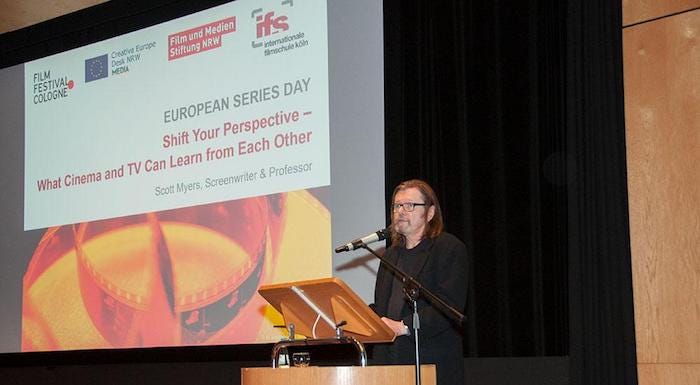
My keynote address on October 8, 2018 on European Series Day.
I recently made a whirlwind trip to Germany for a pair of exciting events. The first was a two-day writing workshop at the Internationale Filmschule Köln with a dozen local screenwriters, TV writers, producers, and filmmakers. The focus: “Breaking Story: A Character-Based Approach to Story Prep.” We talked screenwriting theory, brainstormed some of their stories, then walked through them the process I have developed and taught in nearly forty Prep: From Concept to Outline workshops I have led over the years. Judging from the feedback both at the event and from subsequent emails I’ve received, it was a rousing success.
The second event took place on Monday, October 8 at the 2018 Cologne Film Festival where I was invited to deliver the keynote address on the festival’s European Series Day. With so many changes in the world of movies and television here in North America, I was intrigued to research and explore what is happening in Europe. I have tracked the entertainment business here and internationally for over three decades, but I was surprised at some of the discoveries I made.
Here is the entire text of my keynote address. I suspect you will be surprised, too, at what’s transpiring in Europe and how that entertainment content is becoming more available to audiences around the globe.
Film Festival Cologne European Series Day
Monday, October 8, 2018
2:00PM
Film Meets Series
What Cinema and TV Can Learn from Each Other: Influences, Convergences, and Story-Crafting Takeaways
I would like to thank the Film Festival for inviting me to speak today because this subject — the convergence of cinema and television — has fascinated me for several years. What is happening here in Europe, as well as Asia, North America, and around the world in the arena of what we may call ‘visually focused entertainment’ is remarkable. It’s a compelling mix of technological advances and cultural shifts which is not only changing the way we watch stories, but also how we as creatives tell stories… and perhaps equally as important sell stories.
In order to frame my remarks today, I would like to provide some historical context and to do that I want to begin in the year 1987. Why 1987? That is the year I broke into the business as a screenwriter. I sold a feature length movie spec script I had written called K-9. A spec script, for those of you who may not know, is a screenplay a writer writes speculatively. Not an assignment, not for pay, but written in the hope they can sell the script, have it optioned, or at the very least gain representation by a manager and/or agent.
In January 1987, Universal Studios in Hollywood bought my spec script K-9 as a preemptive purchase and eventually produced and released the movie in 1989 starring James Belushi. It went on to a successful box office run, a #1 film in North America, spawning a one-hour broadcast network TV pilot, and two sequels.
I should note the movie has been particularly popular in Germany in part I presume because the co-star is a German shepherd. Named Jerry Lee. The logline: “A loner cop in pursuit of a drug kingpin gets a new partner: A police dog.” In Germany, the movie was retitled: “Mein Partner mit der kalten Schnauze.” My partner with the cold nose. I still receive royalty checks from foreign markets each year with Germany at the top of the list. So “Danke, Deutschland.”
I have been in the film and television business for more than three decades. I have written over thirty commissioned projects for every major Hollywood movie studio and broadcast TV network except ABC… which is why I don’t watch ABC. One hour dramas. Half-hour single camera. Half-hour three camera sit-com. What used to be called “movie of the week”. I have written them all. Also, I was an executive producer for Trailblazer Studios for eight years where we produced dozens of hours of non-scripted television for the Scripps and Discovery networks as well as PBS documentaries.
Moreover, as the host of the website GoIntoTheStory.com since its launch in 2008, I have developed more relationships with screenwriters, TV writer-producers, agents, managers, studio executives, and industry professionals than I did when I lived for years in the heart of Los Angeles. Go Into The Story is the official screenwriting blog of the Black List, the premiere screenwriting brand in Hollywood, and this year my blog was named Best of the Best scriptwriting website by Writers Digest. The site has enabled me to engage in a decade long dialogue with creatives all around the world offering a unique perspective on the changes in the global entertainment universe.
So let’s step back in time for a few minutes to 1987. It was a completely different entertainment universe. When my agents sat me down after K-9 had been set up at Universal Pictures, one of the first things they asked me was this: Do you want to write movies or TV? I had to decide — one or the other. As little as three decades ago, there was a wall between the two. You either worked in film or TV. There was almost no crossover.
Screenwriting was considered prestige. TV writing? It was creative with a small “c”. The budgets were low. The visual experience was limited — static action, talking heads, scenes filled with dialogue. As a successful TV writer-producer told me at the time while working on a well-known three-camera half-hour sit-com: “We make good money, but it’s hack money.” The perception from the Writers’ Guild to the general public was movies were equivalent to eating at a Michelin four star restaurant while television was a fast food diner.
Cut to today. It’s a sea change. Some call it the Second Golden Age of Television. Notable series from North America like Game of Thrones and Breaking Bad, from Spain the heist thriller Le casa de papel, from Germany the science fiction thriller Dark, from France the supernatural drama Les Revenants, from the U.K. the science fiction anthology series Black Mirror, from Norway the teen drama Skam, the list of compelling TV series from all around the world and notably here in Europe goes on and on, a staggering number and growing each year.
Clearly, TV series are hot at a global level and the hot take in the media is that the quality of storytelling and even visual experience on television is equal, if not better than movies. And that wall between writing movies and television has completely crumbled. Not just for writers, but directors and actors. Talent, which in the past, would have never considered working in TV, now leap at the opportunity — drawn by long-form storytelling, short time commitments, and interesting roles. This crossover of talent has in turn elevated the quality of the content in contemporary TV series to unprecedented levels.
How did this happen? This is an important question to ask because the roots of the current global televised renaissance lie in a handful of key technological developments and resulting shifts in business philosophy.
In my view, it all begins with the video cassette recorder. This humble, even clunky piece of equipment, what was commonly referred to as the VCR, created a major shift in consumer viewing habits. I remember when my movie K-9 came out on video in 1990 after its theatrical release, standing in my local video store in Beverly Hills, amazed that people were renting it to take home to watch. At that time, no one thought people would actually buy movies on videocassette, it was strictly a rental model.
In fact, that possibility — buying videocassettes — didn’t really dawn on studio executives until video rental stores started to offer well-worn video copies of movies for five or ten dollars. The original tape would typically cost $79.95 or $89.95 dollars. Few, if any consumers would spend that kind of money on a movie. But a used videocassette for a few bucks? Even with a degraded picture due to a worn-down tape, consumers figured it was worth the money to be able to own a movie. That way, they could watch it anytime they wanted.
So the first piece of the puzzle in answering how we got to where we are today slips into place with the VCR and videocassettes: Consumers began to experience the power of being able to watch entertainment when they wanted.
Things really took off with the development of the DVD or Digital Video Disc. Far superior video. Concurrently, the emergence of high definition television. CRT, LED, OLED, Plasma, 3D, 4K to 35 inch, 55 inch, 80 inch to the inevitable full wall screen envisioned years ago in the science fiction book Fahrenheit 451. Combined with high-end digital audio systems, consumers now can have access to cinema screening systems which are a fair replication of the theatrical movie experience — all in the comfort of their own home.
With these technological developments, another piece of the puzzle dropped into place: Consumers could now not only watch entertainment when they wanted, but also where they wanted.
Their whistles whetted by newfound control over their entertainment choices, consumers let it be known they also wanted to control how they wanted to watch entertainment. Two technological advances merged to widen the spectrum of possibilities. One was the Internet. When I first broke into the business, I remember walking into the offices of a studio executive at 20th Century Fox marveling at a new piece of equipment he showed off atop his desk: A telephone modem which could convey information at a blazing 28.8 bits per second. Today in 2018, consumers can download entire movies and TV episodes in a matter of moments.
The other technological advance: Smart phones. Remember in the good old days when we used telephones to talk with people? Now our mobile phones are the equivalent of mini-computers, but more important to content creators, a platform for viewing entertainment.
It may be hard to believe, but Hollywood resisted this idea for years: Why would consumers want to watch visually stunning movies like Lawrence of Arabia, 2001: A Space Odyssey, Das Boot on a tiny smart phone screen? But today, even as filmmakers like Christopher Nolan go public with tirades about the tyranny of consumers watching his big screen epics like Dunkirk on a small screen like their cellphones, that’s precisely what’s happening.
I have taught university students for over a decade, currently as an assistant professor at the DePaul University School of Cinematic Arts in Chicago. Each new term, I poll them in my first class: What are you watching? Over the years, the trend has been toward television series and away from movies. But here’s the thing, when I ask those who watch TV series on an actual television, virtually none of them do. They use their televisions to play videogames. They use their computers, or tablets, or yes, their cellphones to watch their favorite TV series.
Indeed, I ask my students, “How do you keep up with so many TV shows?” Their answer: They watch them while doing other things. They will have the program on their iPad, working on their studies or wandering around the internet on their laptop computers, while they’re carrying on text message, Face Time, or Snapchat conversations with their friends. To them, this type of multitasking entertainment and social experience has become a natural thing, part of their daily routine.
That behavior is symbolic of the fact that consumers can not only watch entertainment when they want and where they want, they can also enjoy TV and movies how they want.
These technological advances explain much of how we got to where we are today, but there is one final piece of the puzzle we need to consider when reflecting on the ascendancy of television, this so-called era of Peak TV.
In 1997, a former Peace Corps volunteer turned computer scientist was watching all of these technological trends and put two and two together: Unlike boxy videocassettes, DVDs were slim and could fit into a large envelope and thus be shipped. Combine that with a website to order DVDs, why not create a company which for a monthly fee, consumers can get movies delivered to their home via mail?
That individual was Reed Hastings and he co-founded a company called Netflix. Then as technology continued to expand the horizons of what was available and consumers could view entertainment via their internet service provider, Hastings said: “Why settle for making a small percentage of profit off the mail delivery of DVDs when I can own the IP — intellectual property — myself?”
As of 2017, Netflix spent $6.3 billion on original and acquired programming. Indeed, Netflix accounts for 15% of all downstream internet traffic worldwide.
As we know, Netflix is not alone as there are multiple competing streaming services. In 2017, Amazon spent $4.7 billion on original and acquired programming, Hulu $2.5B, and relative newcomers Apple and Facebook a ‘mere’ $1B.
By 2022, one set of numbers I saw projected that Amazon will actually bypass Netflix in terms of dollars spent on original content: $8.3B for Amazon as compared to $6.8B for Netflix. Witness the $250M commitment Amazon made to create a Lord of the Rings series. Interesting to note that Apple is expected to have the steepest increase in dollars spent on original content: By 2022, they are projected to spend $4.2B on non-sports related entertainment product.
And more streaming services are on the horizon. Disney is going to launch its own service in 2019 with a subscription price substantially lower than Netflix. They will make available their entire Disney library which includes Marvel, Pixar, and Star Wars.
Then earlier this week, Pluto TV, which has corporate offices in Berlin, announced it would be available in the U.K. as a free app for subscribers to Now TV with plans to move into more European countries.
How has the rise of streaming services impacted the quality of television programming? If you remember the movie All the President’s Men in which the secretive political operative known as Deep Throat told Washington Post reporter Bob Woodward the key to unraveling the Watergate scandal: “Follow the money.”
Well, that’s what creatives have done: They have been following the money over to streaming services. Successful TV showrunners like Shonda Rhimes, Ryan Murphy, and Kenya Barrish have signed $100M+ deals with Netflix.
As Netflix chief content officer Ted Sarandos said: “I would look at our overall deals as a way we’re continuing to develop IP. Instead of buying companies, you’re buying the ability to create intellectual property together with Shonda, with Ryan. A lot of people talk about Peak TV as a pejorative. I talk about it as a complete celebration. If this is Peak TV, I’ll take more ‘peak.’ It’s the best time in the history of television to be a producer and a creator.”
And their plans definitely include Europe. In a big way.
After establishing outposts in London and Amsterdam, in September, Netflix announced they were creating a fully staffed bureau in Paris. They also announced seven new French original film and TV series projects. Then barely a week later, Netflix announced they were opening a similar office in Madrid, this after they had laid out plans some months back to build a 22,000 square meter production hub there dedicated mainly to Spanish-language film and TV series projects.
With the announcements, Hasting said Netflix’s push into international content was key to thrive in the current competitive environment. “When our suppliers — including Disney — are saying that they are now going to become our competitors… it does mean we have to do more original productions, in France, Germany, Asia… And we understood that it was likely to happen and it’s one of the reasons why we have been producing so much original content.”
Indeed, after the success of two original German TV series Dark and Babylon Berlin, Netflix is doing its third original series here with the upcoming The Wave, based on the 2008 film and the 1981 young adult novel by Todd Strasser.
Erik Barmack is the Vice President of International Originals at Netflix and these were his comments upon that announcement: “Based on a highly acclaimed book and film, ‘The Wave’ has everything it needs to excite global audiences. With ‘Dark’ we have already proven that Germany is a home of great and globally successful storytelling. The combination of the powerful plot and the strong line up of German creatives that will be working on ‘The Wave,’ makes us very excited.”
Notice that word he uses twice: global. Netflix is acting like a Hollywood studio on steroids. 85% of their spending is earmarked for original movies and TV series, responding to the fact that 90% of Netflix customers regularly watch original programming.
Whereas Warner Bros. will put out 23 movies this year, the most of any of the major Hollywood studios, Disney will release only 10. By comparison, Netflix is releasing 83 original films in 2018.
As for television series, Netflix will produce or acquire an incredible 700 new or exclusively licensed television shows, including more than 100 scripted dramas and comedies, dozens of documentaries and children’s shows, stand-up comedy specials and unscripted reality and talk shows from approximately 21 countries.
With the startling emergence and growth of streaming services, as well as consumers’ continuing thirst for TV entertainment, it’s great news for content creators including those here in Europe. However, these technological and business changes are also impacting the way writers and creatives ought to think about the TV series projects they develop, pitch, and produce.
You might be familiar with the “four quadrant theory” of entertainment. Four quadrants reflective of four target demographic groups: Adult, Child, Male, Female. This has been fundamental to the business model for the film industry for decades. Companies like Pixar Animation Studios have thrived creating content which targets each of those four target demos in all of their movies from Toy Story to Coco: Adult, Child, Male, Female.
This has been the model for much of TV production around the globe as well. Networks creating multiple series targeting specific demo groups or ideally, TV series which can appeal to all age groups and gender identification.
While this model still exists, I believe there is a new four quadrant approach adopted over the last decade by major Hollywood studios as well as Netflix, which has emerged in response to all of the technological and cultural shifts we have just been considering.
The new four quadrant model: Franchise. International. Nostalgia. Spectacle.
The short-hand reference: FINS. Franchise, International, Nostalgia, Spectacle. This new model impacts every creative involved in streaming TV content around the globe including here in Europe. I would think it will trickle down to local production as well.
Let’s consider each of these four quadrants.
Franchise
To really understand the current obsession with franchises and the glut of prequels, sequels, reboots, and remakes, we have to grasp this key fact: The TV and movie business is fundamentally a fear-based environment. If studio and network executives could say ‘no’ to every prospective project and still keep their jobs, that would be their inclination. Why? Because every time they commit financial resources to a project, there is a considerable chance that project will fail. If that executive is attached to too many cancelled series or a really big financial disaster, they will find themselves in the unemployment line.
Thus, as far as creatives are concerned, the buyer has an extremely high threshold we have to clear to hit their comfort level.
This is one big reason why they are obsessed with franchises: If they find a project which strikes gold with an audience, these executives know they can return to that content season after season.
In fact, they are so desperate to find TV franchises, they will look for every opportunity to turn a project from a non-franchise into a franchise.
Earlier, I mentioned the Spanish series Le casa de papel.
Money Heist, as it’s known in English, debuted in Spain on Antena 3 in May 2017, with the first part running nine episodes. A second part of six episodes aired between October and November of 2017.
When Netflix acquired the streaming rights, they edited the Part One episodes into 40–55 minute shows, going from nine to thirteen episodes. They reedited Part Two from six episodes into nine. In effect, they created ‘more’ content with the same amount of run time.
Then they acquired rights to the series to create a third part which will be exclusive to Netflix. The interesting thing: The entire series is about a single bank heist. In effect, Netflix has created a three season franchise out of one crime.
Two takeaways for creatives here in Europe and abroad when it comes to pitching scripted TV: First, the path of least resistance is to pitch content which is ‘similar but different.’ Similar to a preceding TV series which has succeeded as a franchise. But somehow different. The original Netflix German TV series Dark is like Stranger Things, but different and in my view, a much better show with its darker tone and examination of time.
Second, when you pitch original content, be mindful of a mentality creeping into the consciousness of the buyers. In Hollywood, the buzz phrase for original content nowadays is that it is “untested.” This is how addicted studios and networks are to franchise content, that anything new and original is considered to be “untested.”
Indeed, a veteran TV writer Javi Grillo-Marxauch, who has written for such U.S. series as Charmed, Boomtown, Medium, and most notably Lost, just recently tweeted:
i told a colleague about the thing i’m pitching today. he said: it’s amazing! what was that i.p. — comic book? anime? israeli format? i told him it was an original. his next expression was a combination of “what is this ‘original’ you speak of?” and “shyeah, good luck widdat.”
So if you do have plans to develop and pitch an original TV project, not based on existing IP, best to go in with a strong high concept. Like the current Norwegian TV series Norsemen which I was introduced to by a colleague this weekend at a writers workshop hosted by the Internationale Filmschule here in Cologne. The series the Norseman takes place in 790AD, a half-hour comedy set in a small Viking village, but the characters deal with issues you and I confront in our daily lives, just without the accoutrements of contemporary living. It’s Modern Family meets The Vikings. You can see it, you get it right away, it’s a strong series concept and easy to market.
In an entertainment world filled with franchises, there is a premium for creatives to think in terms of high concepts, simple, but compelling series ideas which can grab a potential viewer’s attention based on the show’s fundamental conceit.
So that’s a few thoughts about the first quadrant in the new four quadrant theory: Franchise. Let’s turn to the second: International.
International
When I broke into the business in 1987, Variety and the Hollywood Reporter would provide weekend box office results from what at the time they referred to as the “foreign” or “overseas” market. Back then, 70% of all box office movie receipts derived from North American theaters (U.S. and Canada) with 30% coming from the “foreign” market.
Today, the numbers are completely reversed: 70% of box office revenues derive from what is now more accurately referred to as the “international” market. Indeed, any day now, China will bypass North America as having the most annual box office revenues of any country.
What we have witnessed in the U.S. is the internationalization of the approach to the movie and TV business. This extends to everything from story or series concept to cast and marketing.
Here’s an example. There was a spec script that sold in 2011 written by a professional acquaintance of mine Greg Russo. The logline of the script that sold:
“The story of a washed-up ex-Formula One driver who wakes up trapped inside a BMW. He answers a phone ringing in the glove box, only to be told that he has 90 minutes to deliver the bomb-rigged car to a target or his wife and daughter will be killed.”
Your basic action genre piece. When Greg first wrote it and sent it out, it was called I-95, set along the Eastern seaboard of the United States, racing up the famed interstate highway. A production company was interested, but thought it would generate more dollars internationally if they shifted the location to Germany to a more famous superhighway. Greg made that change and the script sold as Autobahn.
Hollywood has never been more receptive to international story content. They see markets like Europe, Asia, South America, even Africa as growing markets.
Two takeaways for creatives. First, just as Netflix, major studios, and networks are thinking “globally,” so, too, should we. What of our TV series concepts could have a global appeal? Is this a series which would resonate with audiences in different countries? To the degree we take into account these considerations, we up the commercial viability of the project. Moreover, we elevate the possibility that the format could be adapted into series in other countries just like The Office or Who Wants to Be a Millionaire successfully did.
Second, think international at home. In the U.S. entertainment community, we talk a lot about “inclusion” and “diversity.” TV series which feature ethnically diverse casts and storylines. A series recently debuted on CBS in the U.S. called The Neighborhood. Its premise: “A friendly guy from the Midwest tries to fit in in a tough L.A. neighborhood.” White guy in a black neighborhood, a topical spin on the gentrification issue.
It brings to mind the cutting edge German series from last decade Türkisch für Anfänger, where a German woman and a Turkish man fall in love and try to live a normal life with their children at the heart of contemporary German society.
As streaming services bring the entire world’s entertainment right into our homes, I believe that we, as creatives, have a golden opportunity to tap into stories which feature themes, storylines, and characters which reflect our growing global connection.
Nostalgia
Our third quadrant in the new four quadrant business model is Nostalgia. We are awash in nostalgia. Jurassic World an homage to Jurassic Park. Star Wars: Episodes VII and VIII are an homage to Star Wars: Episodes IV and V. Ghostbusters 3 is an homage to Ghostbusters, a female version of the original movie what we can call a ‘shequel’. TV series from the 80s remade as movies. 80s movies remade as TV series.
Here in Germany, an example of nostalgia is the TV series Deutschland 83 and Deutschland 86 which recall the days before the fall of the Berlin Wall and a reunified nation.
This also plays to the whole idea of pre-branded content, easier to market if the audience already knows about it.
So a takeaway for creatives: Lean into nostalgia. You’re a consumer. You’ve lived your life. What of your personal history and those of your generation deserves a retelling? Perhaps a different take on what has transpired in the past.
The fact is nostalgia is hot and it doesn’t appear to be going away anytime soon.
Finally, the fourth quadrant of the new four quadrant approach to film and TV entertainment: Spectacle.
Spectacle
With TV budgets growing bigger, computer generated imagery more economical and visually compelling than ever, and bolder storylines, we are seeing more spectacle in TV series than ever. Which is ironic because of the six aspects of story which Aristotle describes in “Poetics,” spectacle is last on the list in importance.
Not in today’s world of entertainment. Movies are primarily a visual medium. TV has become a more visual medium. The conventional wisdom in Hollywood is that while dialogue may be limited in terms of its translatability in the international market, visuals are not. An explosion on screen elicits the same reaction in Poland, Italy, and Portugal as it does in the United States, Canada, and Mexico.
In some ways, it’s like we’ve come full circle to the earliest days of cinema in the United States. Back in the first two decades of the 20th century, the audience for movies was the common people and most of them were immigrants. They did not share a common language, but they could understand silent movies because the visuals communicated the story, not dialogue. Similarly today, with the majority of movie and TV audience being an international one — over 60% of Netflix subscribers exist outside North America — visual storytelling featuring spectacular images has become even more important than ever.
Thus, a takeaway for creatives: Think visually in the TV series you develop and pitch. Even in sit-coms. If you have a chance to watch the NBC single-camera comedy The Good Place, it takes comedic visual storytelling to a whole other level of spectacle.
Ask yourself: What stories and series ideas can you develop which most embrace visual storytelling and lend themselves to big, brash imagery?
So the new four quadrant theory comprised of Franchise, International, Nostalgia, and Spectacle is something to be aware of as you create TV series concepts and, of course, movies.
There are other influences to consider. For example, the viewing habits and story sensibilities of young people. A decade ago, a study I read suggested that by the time a person reached 21 years of age, they would have read, seen, or heard 10,000 stories. Today, that number has increased exponentially. Movies, TV series, but also video games, comic books, graphic novels, or even text conversations, YouTube videos, web series, and on and on and on. Because of this deep immersion into stories, young audiences are incredibly sophisticated viewers of entertainment, even if they don’t know it.
So some changes we have to consider:
- Young people need less exposition.
- They enjoy being dropped into a story in media res, in the middle, it enables them to participate more in the story experience as they like to figure out things like video games
- They are keenly aware of tropes, but want us to subvert or invert expectations.
- Scenes are getting shorter, probably a reflection of young people’s enjoyment of short form content.
And speaking of which, have you heard of a new project in Hollywood called NewTV? The brain child of former Paramount, Disney, and DreamWorks Animation exec Jeffrey Katzenberg, he has raised $1B to do this: create a mobile-specific subscription entertainment service, stocked with big-budget shows from top-flight talent that are no longer than 10 minutes in length. Imagine Quentin Tarantino writing and directing a 10 minute TV story.
Katzenberg is basing his hypothesis on the surge in video viewed on smartphones. There’s no question this is happening: On average, the number of minutes viewed per day on mobile devices by consumers globally has risen from about 14 minutes in 2015 to a projected 35 minutes in 2018.
This NewTV initiative is intriguing for several reasons, not the least of which is because it brings us full circle to the original point of this talk: the convergence of cinema and TV. Because the very first years of cinema were single reel films which lasted — are you ready — 10 minutes. So what Katzenberg is testing out with his NewTV initiative is the same idea as was initiated by movies 100 years ago. Again, the convergence of movies and TV.
[NOTE: A few days after my address, Katzenberg announced the name of his NewTV initiative: Quibi.]
Let me wind down my talk by suggesting that no matter how old or new a TV series concept or movie idea is, no matter new technologies or ‘similar but different’ entertainment projects, it still all comes down to one thing: Story.
Right now, more than ever, the world needs your stories. Your personal stories. Your specific voice. Your unique take on life.
Due to the internationalization of the entertainment marketplace, there has never been a greater opportunity for you as a creative.
And just like I did with my spec script K-9, pounding it out on an Apple IIc computer with 5 and ¼ inch floppy discs, printing it out on a dot matrix printer which took 45 minutes to spit out a feature length screenplay, it doesn’t matter what technology you have available to use.
You have your own creativity which is distinctive to you.
Go make your own IP. Write a spec script. Create a web series. Produce a short film. If someone sees monetary potential, any of those efforts can be a path to creative success.
Lean into that. Embrace it. Have the courage the tell stories you want to tell. Yes, there is Franchise, International, Nostalgia, and Spectacle. And if your stories traffic in any or all of those four quadrants, more power to you.
But ultimately it is your vision, your talent, and your passion which will serve you in good stead.
The world needs your stories. The world needs Europe’s voice.
Go. Make. Do.
The world is waiting for you.
The changes in the world of visual entertainment are happening fast and having an impact globally. In writing my keynote address for the 2018 Cologne Film Festival European Series Day reminded me of how important it is for creatives today to widen their horizons to include the entire world in their story-crafting process.
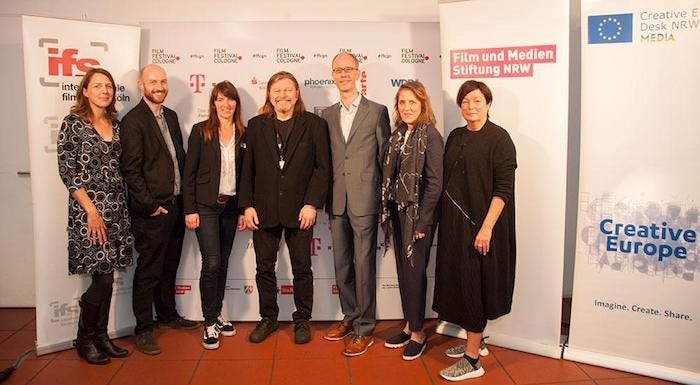
Special thanks to two people who were instrumental in bringing me over to Cologne for a very special trip: Carolin Große Hellmann, head of the screenwriting department at the Internationale Filmschule Köln, and Andreas Gäßler also from the Internationale Filmschule.
Twitter: @FilmFestivalCGN.